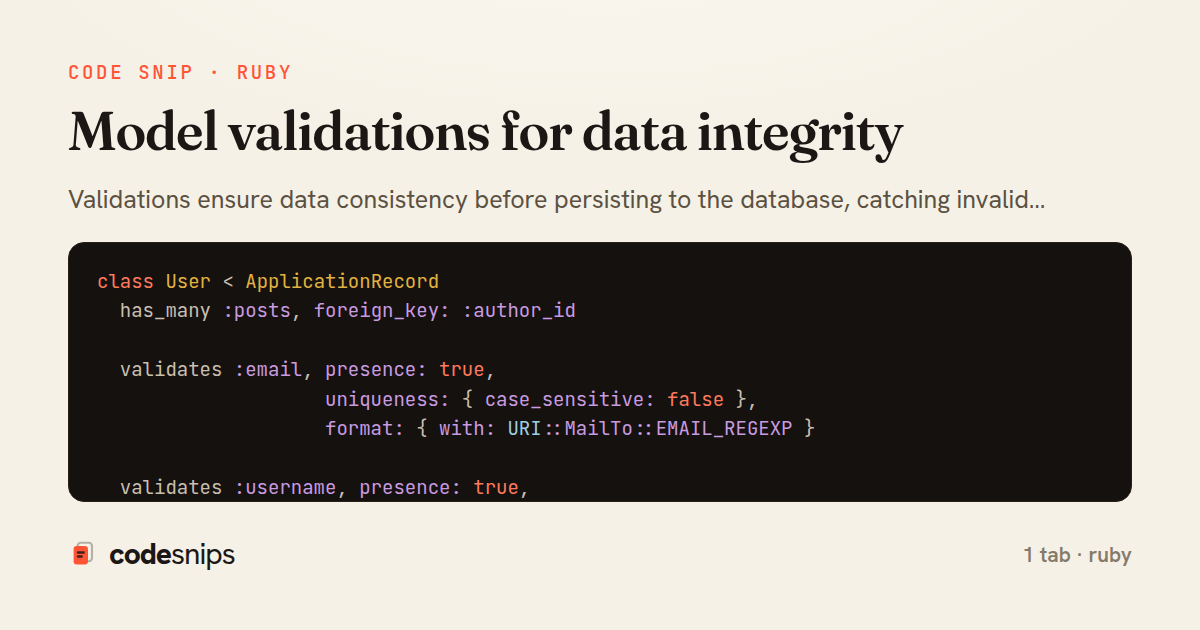
class User < ApplicationRecord
  has_many :posts, foreign_key: :author_id

  validates :email, presence: true,
                    uniqueness: { case_sensitive: false },
                    format: { with: URI::MailTo::EMAIL_REGEXP }

  validates :username, presence: true,
                       uniqueness: { case_sensitive: false },
                       length: { in: 3..30 },
                       format: { with: /\A[a-zA-Z0-9_]+\z/, message: 'only allows letters, numbers, and underscores' }

  validates :password, length: { minimum: 8 }, if: :password_required?
  validate :password_complexity, if: :password_required?

  private

  def password_required?
    new_record? || password.present?
  end

  def password_complexity
    return if password.blank?

    unless password.match?(/[A-Z]/) && password.match?(/[a-z]/) && password.match?(/[0-9]/)
      errors.add(:password, 'must include uppercase, lowercase, and numbers')
    end
  end
end
Validations ensure data consistency before persisting to the database, catching invalid states early in the request lifecycle. I combine presence validations for required fields, uniqueness constraints that map to database indexes, and format validations for structured data like emails or URLs. Custom validators encapsulate complex business rules that involve multiple attributes. The key distinction is that validations run in Ruby, so they can't prevent race conditions—I use database constraints as a backstop. I also validate associations using validates_associated to bubble up nested errors. For complex validation logic, I extract it into custom validator classes that implement validate_each, keeping models readable.
Related snips
class CommentsController < ApplicationController
  before_action :set_post

  def create
    @comment = @post.comments.build(comment_params)
System test: asserting Turbo Stream responses
class Post < ApplicationRecord
  belongs_to :author, class_name: 'User'
  has_many :comments, dependent: :destroy

  scope :published, -> { where.not(published_at: nil).where('published_at <= ?', Time.current) }
  scope :draft, -> { where(published_at: nil) }
ActiveRecord scopes for reusable query logic
module Api
  module V1
    class UsersController < BaseController
      def show
        user = User.includes(:profile).find(params[:id])
ETags for conditional requests and caching
class PostsController < ApplicationController
  def index
    @posts = Post.includes(:author)
                 .order(created_at: :desc)
                 .page(params[:page])
                 .per(10)
Turbo Frames: infinite scroll with lazy-loading frame
require "csv"

class PeopleCsvStream
  include Enumerable

  HEADERS = %w[id full_name email signed_up_at plan].freeze
Resilient CSV Export as a Streamed Response
<form data-controller="query-sync" data-action="change->query-sync#apply">
  <select name="status" class="rounded border p-2">
    <option value="">Any</option>
    <option value="open">Open</option>
    <option value="closed">Closed</option>
  </select>
Filter UI that syncs query params via Stimulus (no front-end router)
Share this code
Here's the card — post it anywhere.