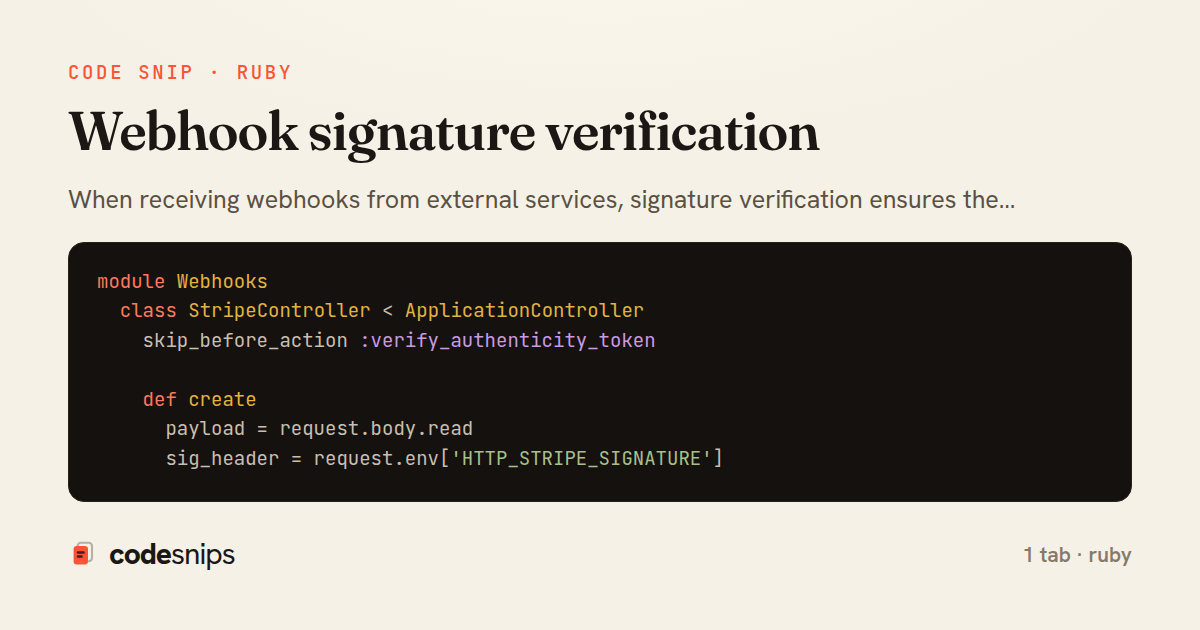
module Webhooks
  class StripeController < ApplicationController
    skip_before_action :verify_authenticity_token

    def create
      payload = request.body.read
      sig_header = request.env['HTTP_STRIPE_SIGNATURE']

      begin
        event = Stripe::Webhook.construct_event(
          payload, sig_header, Rails.application.credentials.stripe[:webhook_secret]
        )
      rescue Stripe::SignatureVerificationError => e
        Rails.logger.warn("Webhook signature verification failed: #{e.message}")
        return render json: { error: 'INVALID_SIGNATURE' }, status: :unauthorized
      end

      # Process the verified event
      case event.type
      when 'payment_intent.succeeded'
        ProcessPaymentSuccessWorker.perform_async(event.data.object.id)
      when 'customer.subscription.deleted'
        ProcessSubscriptionCancelledWorker.perform_async(event.data.object.id)
      end

      render json: { received: true }, status: :ok
    end
  end
end
When receiving webhooks from external services, signature verification ensures the payload comes from the claimed sender and hasn't been tampered with. Services like Stripe and GitHub include an HMAC signature in headers computed from the request body and a shared secret. I recompute the HMAC on the received body using the same secret and compare it to the provided signature using constant-time comparison to prevent timing attacks. The raw request body must be used for signature verification, not the parsed version, which is why I sometimes need to read request.body.read before Rails parses it. Failed verification should return 401 immediately without processing the payload to avoid acting on forged requests.
Related snips
class CommentsController < ApplicationController
  before_action :set_post

  def create
    @comment = @post.comments.build(comment_params)
System test: asserting Turbo Stream responses
class Post < ApplicationRecord
  belongs_to :author, class_name: 'User'
  has_many :comments, dependent: :destroy

  scope :published, -> { where.not(published_at: nil).where('published_at <= ?', Time.current) }
  scope :draft, -> { where(published_at: nil) }
ActiveRecord scopes for reusable query logic
payload = {
  sub: user.id,
  iss: 'https://auth.example.com',
  aud: 'codesnips-api',
  exp: 15.minutes.from_now.to_i,
  iat: Time.now.to_i,
JWT issuance and verification without common footguns
timestamp = request.headers.fetch('X-Signature-Timestamp')
signature = request.headers.fetch('X-Signature')
payload = request.raw_post

data = "#{timestamp}.#{payload}"
expected = OpenSSL::HMAC.hexdigest('SHA256', ENV.fetch('WEBHOOK_SECRET'), data)
HMAC signed API requests for webhook and partner integrity
module Api
  module V1
    class UsersController < BaseController
      def show
        user = User.includes(:profile).find(params[:id])
ETags for conditional requests and caching
class PostsController < ApplicationController
  def index
    @posts = Post.includes(:author)
                 .order(created_at: :desc)
                 .page(params[:page])
                 .per(10)
Turbo Frames: infinite scroll with lazy-loading frame
Share this code
Here's the card — post it anywhere.