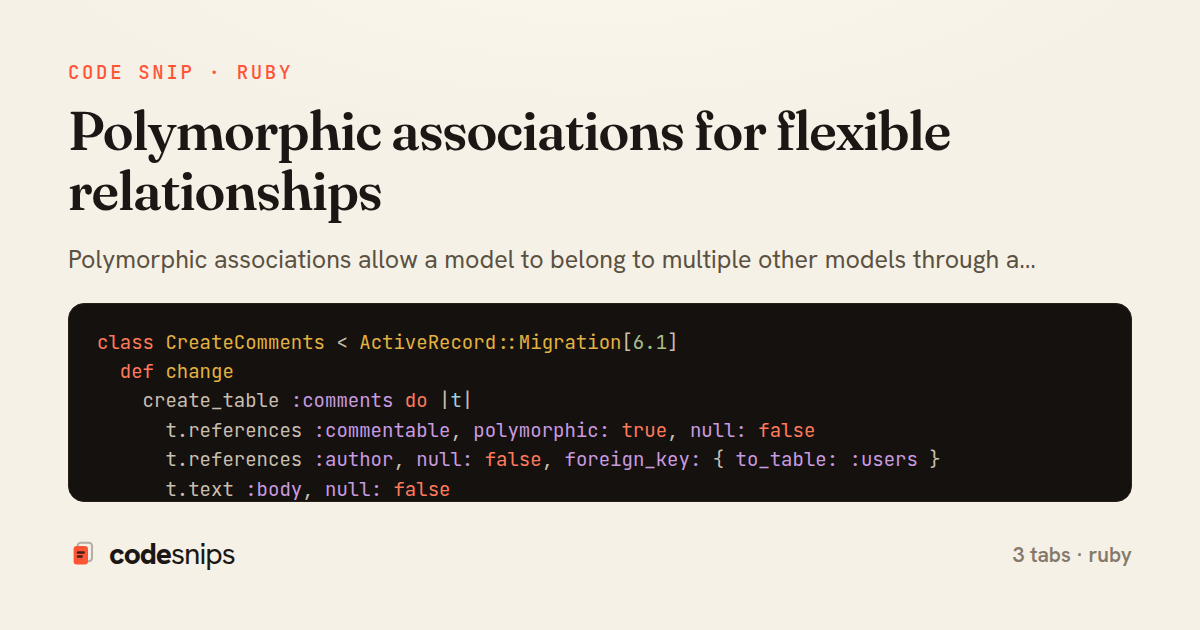
class CreateComments < ActiveRecord::Migration[6.1]
  def change
    create_table :comments do |t|
      t.references :commentable, polymorphic: true, null: false
      t.references :author, null: false, foreign_key: { to_table: :users }
      t.text :body, null: false
      t.timestamps
    end

    add_index :comments, [:commentable_type, :commentable_id, :created_at]
  end
end
class Comment < ApplicationRecord
  belongs_to :commentable, polymorphic: true
  belongs_to :author, class_name: 'User'

  validates :body, presence: true
end
class Post < ApplicationRecord
  has_many :comments, as: :commentable, dependent: :destroy
end
Polymorphic associations allow a model to belong to multiple other models through a single association, which is useful for shared behaviors like comments, likes, or attachments. Instead of separate post_id and article_id columns, a polymorphic association uses commentable_id and commentable_type to store the parent's ID and class name. This pattern keeps the schema DRY when multiple models share the same relationship structure. The downside is that foreign key constraints aren't possible, and queries can be more complex. I use polymorphic associations sparingly and only when the behavior is truly identical across parent types. For partial overlap, separate tables with inheritance or multiple associations work better.
Related snips
class CommentsController < ApplicationController
  before_action :set_post

  def create
    @comment = @post.comments.build(comment_params)
System test: asserting Turbo Stream responses
class Post < ApplicationRecord
  belongs_to :author, class_name: 'User'
  has_many :comments, dependent: :destroy

  scope :published, -> { where.not(published_at: nil).where('published_at <= ?', Time.current) }
  scope :draft, -> { where(published_at: nil) }
ActiveRecord scopes for reusable query logic
module Api
  module V1
    class UsersController < BaseController
      def show
        user = User.includes(:profile).find(params[:id])
ETags for conditional requests and caching
class PostsController < ApplicationController
  def index
    @posts = Post.includes(:author)
                 .order(created_at: :desc)
                 .page(params[:page])
                 .per(10)
Turbo Frames: infinite scroll with lazy-loading frame
require "csv"

class PeopleCsvStream
  include Enumerable

  HEADERS = %w[id full_name email signed_up_at plan].freeze
Resilient CSV Export as a Streamed Response
<form data-controller="query-sync" data-action="change->query-sync#apply">
  <select name="status" class="rounded border p-2">
    <option value="">Any</option>
    <option value="open">Open</option>
    <option value="closed">Closed</option>
  </select>
Filter UI that syncs query params via Stimulus (no front-end router)
Share this code
Here's the card — post it anywhere.