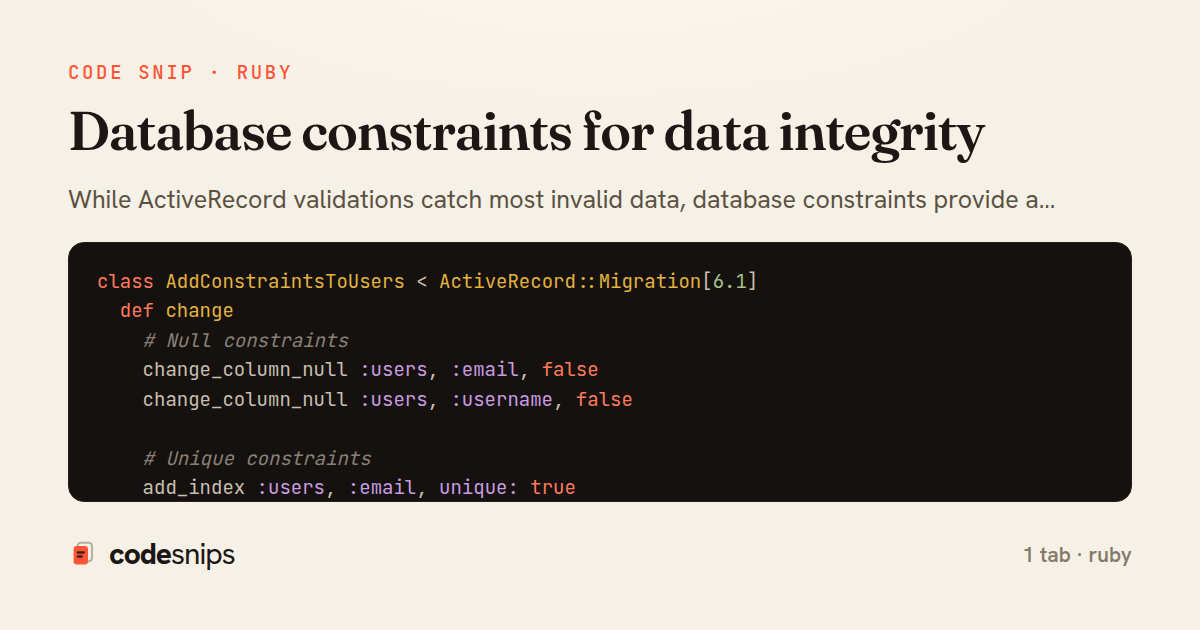
class AddConstraintsToUsers < ActiveRecord::Migration[6.1]
  def change
    # Null constraints
    change_column_null :users, :email, false
    change_column_null :users, :username, false

    # Unique constraints
    add_index :users, :email, unique: true
    add_index :users, 'LOWER(username)', unique: true, name: 'index_users_on_lower_username'

    # Check constraints
    execute <<-SQL
      ALTER TABLE users
      ADD CONSTRAINT check_email_format
      CHECK (email ~* '^[A-Za-z0-9._%+-]+@[A-Za-z0-9.-]+\.[A-Za-z]{2,}$');
    SQL

    execute <<-SQL
      ALTER TABLE users
      ADD CONSTRAINT check_username_length
      CHECK (char_length(username) >= 3 AND char_length(username) <= 30);
    SQL
  end
end
While ActiveRecord validations catch most invalid data, database constraints provide a safety net that prevents invariant violations even when validations are bypassed. I add null: false constraints for required columns, unique indexes for uniqueness constraints, and check constraints for domain validations like age > 0. Foreign key constraints with foreign_key: true prevent orphaned records when associations are deleted. The combination of validations (fast, user-friendly errors) and constraints (absolute guarantees) provides defense in depth. When a constraint is violated, Rails raises ActiveRecord::NotNullViolation or similar exceptions that I handle in error handlers. Constraints are especially important in applications with background jobs or data imports that might skip validation.
Related snips
class CommentsController < ApplicationController
  before_action :set_post

  def create
    @comment = @post.comments.build(comment_params)
System test: asserting Turbo Stream responses
-- Simple function
CREATE OR REPLACE FUNCTION get_full_name(
  first_name VARCHAR,
  last_name VARCHAR
)
RETURNS VARCHAR AS $$
Stored procedures and functions in PostgreSQL
class Post < ApplicationRecord
  belongs_to :author, class_name: 'User'
  has_many :comments, dependent: :destroy

  scope :published, -> { where.not(published_at: nil).where('published_at <= ?', Time.current) }
  scope :draft, -> { where(published_at: nil) }
ActiveRecord scopes for reusable query logic
module Api
  module V1
    class UsersController < BaseController
      def show
        user = User.includes(:profile).find(params[:id])
ETags for conditional requests and caching
class PostsController < ApplicationController
  def index
    @posts = Post.includes(:author)
                 .order(created_at: :desc)
                 .page(params[:page])
                 .per(10)
Turbo Frames: infinite scroll with lazy-loading frame
require "csv"

class PeopleCsvStream
  include Enumerable

  HEADERS = %w[id full_name email signed_up_at plan].freeze
Resilient CSV Export as a Streamed Response
Share this code
Here's the card — post it anywhere.