require 'swagger_helper'

RSpec.describe 'Api::V1::Posts', type: :request do
  path '/api/v1/posts' do
    get 'Retrieves all posts' do
      tags 'Posts'
      produces 'application/json'
      parameter name: :page, in: :query, type: :integer, required: false
      parameter name: :per_page, in: :query, type: :integer, required: false

      response '200', 'posts found' do
        schema type: :array,
               items: {
                 type: :object,
                 properties: {
                   id: { type: :integer },
                   title: { type: :string },
                   excerpt: { type: :string },
                   author: {
                     type: :object,
                     properties: {
                       id: { type: :integer },
                       name: { type: :string }
                     }
                   }
                 }
               }

        run_test!
      end
    end

    post 'Creates a post' do
      tags 'Posts'
      consumes 'application/json'
      produces 'application/json'
      security [bearer_auth: []]

      parameter name: :post, in: :body, schema: {
        type: :object,
        properties: {
          title: { type: :string },
          body: { type: :string },
          tags: { type: :array, items: { type: :string } }
        },
        required: ['title', 'body']
      }

      response '201', 'post created' do
        run_test!
      end

      response '422', 'invalid request' do
        run_test!
      end
    end
  end
end
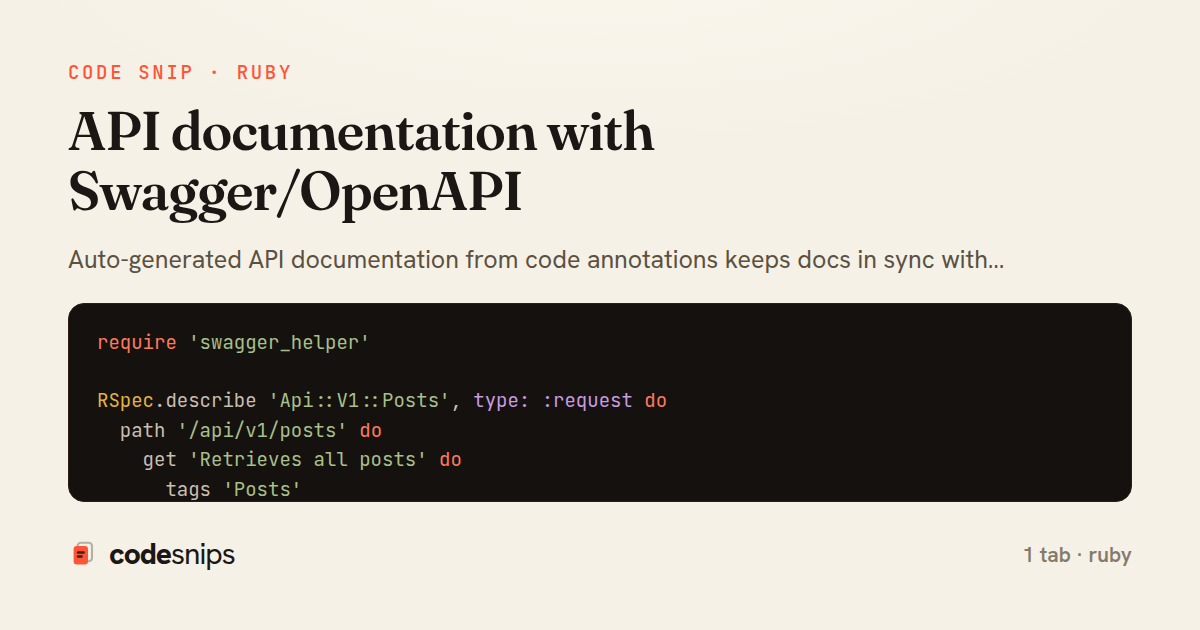
Auto-generated API documentation from code annotations keeps docs in sync with implementation and reduces maintenance burden. The rswag gem generates OpenAPI 3.0 specs from RSpec request specs, providing interactive documentation via Swagger UI. I write request specs that describe expected inputs, outputs, and status codes, and rswag generates the corresponding OpenAPI schema. This approach serves triple duty: automated tests, documentation, and client SDK generation. The generated docs include example requests/responses, authentication requirements, and validation rules. I host Swagger UI at /api-docs in staging environments so frontend developers can explore endpoints interactively. The key is maintaining discipline around keeping specs comprehensive and up-to-date.
Related snips
class CommentsController < ApplicationController
  before_action :set_post

  def create
    @comment = @post.comments.build(comment_params)
System test: asserting Turbo Stream responses
class Post < ApplicationRecord
  belongs_to :author, class_name: 'User'
  has_many :comments, dependent: :destroy

  scope :published, -> { where.not(published_at: nil).where('published_at <= ?', Time.current) }
  scope :draft, -> { where(published_at: nil) }
ActiveRecord scopes for reusable query logic
payload = {
  sub: user.id,
  iss: 'https://auth.example.com',
  aud: 'codesnips-api',
  exp: 15.minutes.from_now.to_i,
  iat: Time.now.to_i,
JWT issuance and verification without common footguns
module Api
  module V1
    class UsersController < BaseController
      def show
        user = User.includes(:profile).find(params[:id])
ETags for conditional requests and caching
class PostsController < ApplicationController
  def index
    @posts = Post.includes(:author)
                 .order(created_at: :desc)
                 .page(params[:page])
                 .per(10)
Turbo Frames: infinite scroll with lazy-loading frame
require "csv"

class PeopleCsvStream
  include Enumerable

  HEADERS = %w[id full_name email signed_up_at plan].freeze
Resilient CSV Export as a Streamed Response
Share this code
Here's the card — post it anywhere.