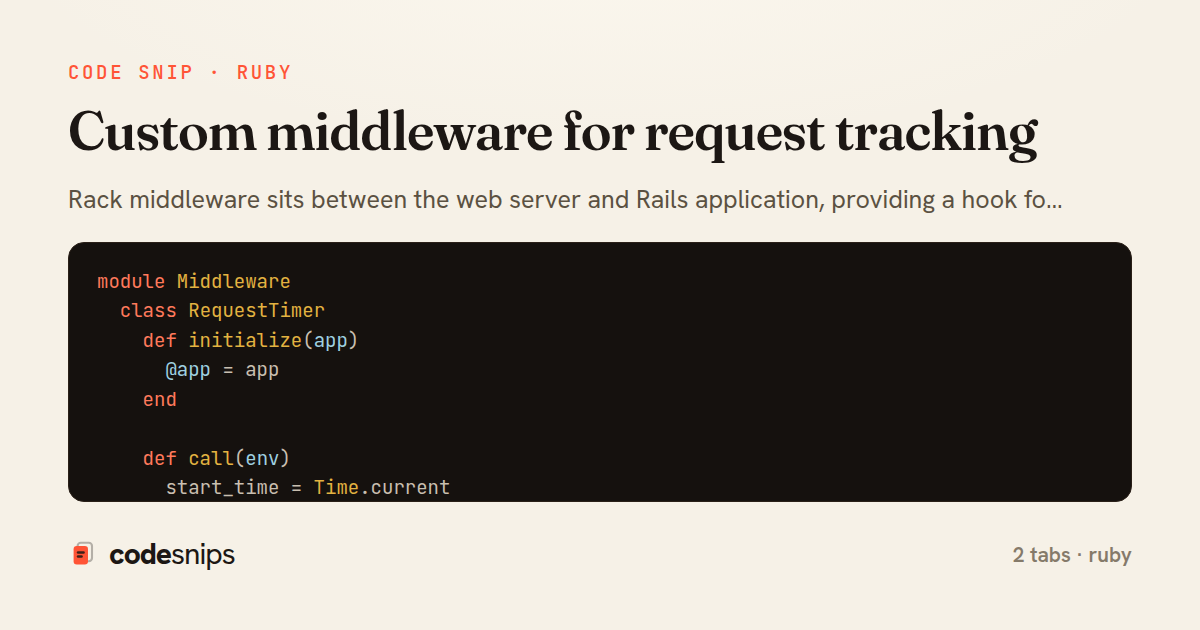
module Middleware
  class RequestTimer
    def initialize(app)
      @app = app
    end

    def call(env)
      start_time = Time.current

      status, headers, response = @app.call(env)

      duration = ((Time.current - start_time) * 1000).round(2)

      # Add timing header
      headers['X-Response-Time'] = "#{duration}ms"

      # Log slow requests
      if duration > 1000
        Rails.logger.warn("Slow request: #{env['REQUEST_METHOD']} #{env['PATH_INFO']} took #{duration}ms")
      end

      [status, headers, response]
    end
  end
end
module MyApp
  class Application < Rails::Application
    config.load_defaults 6.1

    # Add custom middleware
    config.middleware.use Middleware::RequestTimer
    config.middleware.insert_before Rack::Runtime, Middleware::RequestId
  end
end
Rack middleware sits between the web server and Rails application, providing a hook for cross-cutting concerns like request logging, metrics collection, or custom authentication. I use middleware to inject request IDs, track response times, or enforce security headers before the request reaches controllers. Each middleware is a simple class with a call method that receives the Rack env hash. Middleware can short-circuit the request by returning a response early, or pass control to the next middleware in the stack by calling @app.call(env). Proper middleware ordering matters—authentication should run before authorization, and request logging should wrap the entire stack. I keep middleware focused and single-purpose to maintain clarity.
Related snips
class CommentsController < ApplicationController
  before_action :set_post

  def create
    @comment = @post.comments.build(comment_params)
System test: asserting Turbo Stream responses
class Post < ApplicationRecord
  belongs_to :author, class_name: 'User'
  has_many :comments, dependent: :destroy

  scope :published, -> { where.not(published_at: nil).where('published_at <= ?', Time.current) }
  scope :draft, -> { where(published_at: nil) }
ActiveRecord scopes for reusable query logic
module Api
  module V1
    class UsersController < BaseController
      def show
        user = User.includes(:profile).find(params[:id])
ETags for conditional requests and caching
class PostsController < ApplicationController
  def index
    @posts = Post.includes(:author)
                 .order(created_at: :desc)
                 .page(params[:page])
                 .per(10)
Turbo Frames: infinite scroll with lazy-loading frame
require "csv"

class PeopleCsvStream
  include Enumerable

  HEADERS = %w[id full_name email signed_up_at plan].freeze
Resilient CSV Export as a Streamed Response
<form data-controller="query-sync" data-action="change->query-sync#apply">
  <select name="status" class="rounded border p-2">
    <option value="">Any</option>
    <option value="open">Open</option>
    <option value="closed">Closed</option>
  </select>
Filter UI that syncs query params via Stimulus (no front-end router)
Share this code
Here's the card — post it anywhere.