ruby
77 lines · 2 tabs
Alex Kumar
Jan 2026
2 tabs
class RateLimiter
  def initialize(key:, limit:, window:)
    @key = "rate_limit:#{key}"
    @limit = limit
    @window = window
  end

  def allowed?
    now = Time.current.to_i
    window_start = now - @window

    Redis.current.multi do |pipeline|
      # Remove old entries
      pipeline.zremrangebyscore(@key, '-inf', window_start)

      # Add current request
      pipeline.zadd(@key, now, "#{now}-#{SecureRandom.hex(8)}")

      # Count requests in window
      pipeline.zcard(@key)

      # Set expiry
      pipeline.expire(@key, @window + 1)
    end.last <= @limit
  end

  def remaining
    now = Time.current.to_i
    window_start = now - @window

    Redis.current.zremrangebyscore(@key, '-inf', window_start)
    count = Redis.current.zcard(@key)

    [@limit - count, 0].max
  end

  def reset_at
    now = Time.current.to_i
    window_start = now - @window

    oldest = Redis.current.zrange(@key, 0, 0, with_scores: true).first
    return now + @window unless oldest

    oldest[1].to_i + @window
  end
end
module ApiRateLimiting
  extend ActiveSupport::Concern

  included do
    before_action :check_rate_limit
  end

  private

  def check_rate_limit
    identifier = current_user&.id || request.ip
    limiter = RateLimiter.new(
      key: "api:#{identifier}",
      limit: 100,
      window: 60
    )

    unless limiter.allowed?
      response.set_header('X-RateLimit-Limit', '100')
      response.set_header('X-RateLimit-Remaining', '0')
      response.set_header('X-RateLimit-Reset', limiter.reset_at.to_s)

      render json: { error: 'RATE_LIMIT_EXCEEDED' }, status: :too_many_requests
      return
    end

    response.set_header('X-RateLimit-Limit', '100')
    response.set_header('X-RateLimit-Remaining', limiter.remaining.to_s)
    response.set_header('X-RateLimit-Reset', limiter.reset_at.to_s)
  end
end
2 files · ruby
Explain with highlit
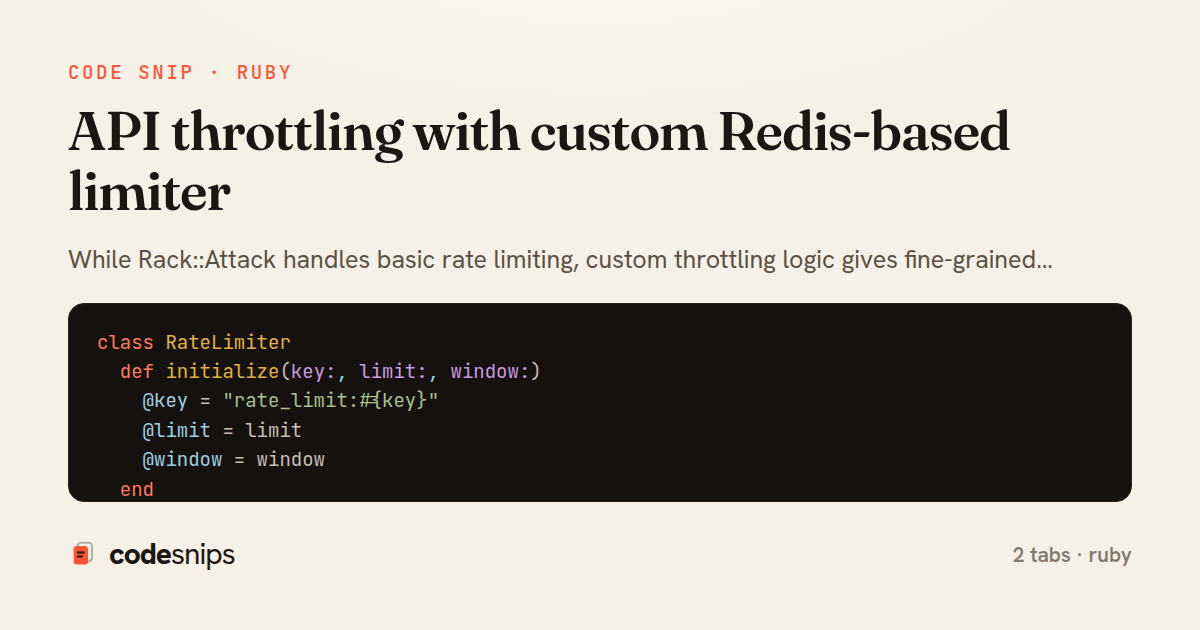
While Rack::Attack handles basic rate limiting, custom throttling logic gives fine-grained control over quotas, burst allowances, and per-feature limits. I implement a token bucket algorithm in Redis using sorted sets to track request timestamps per user/IP. Each request checks if the bucket has capacity and adds a timestamp; old timestamps beyond the window are pruned. This approach supports burst tolerance—users can make several requests rapidly as long as their average rate stays within limits. I expose remaining quota and reset time in response headers (X-RateLimit-Remaining, X-RateLimit-Reset) so clients can self-regulate. Different endpoints or subscription tiers get different bucket sizes.
Related snips
ruby
class CommentsController < ApplicationController
  before_action :set_post

  def create
    @comment = @post.comments.build(comment_params)
System test: asserting Turbo Stream responses
rails
hotwire
turbo
by codesnips
4 tabs
ruby
class Post < ApplicationRecord
  belongs_to :author, class_name: 'User'
  has_many :comments, dependent: :destroy

  scope :published, -> { where.not(published_at: nil).where('published_at <= ?', Time.current) }
  scope :draft, -> { where(published_at: nil) }
ActiveRecord scopes for reusable query logic
rails
activerecord
patterns
by Alex Kumar
1 tab
ruby
payload = {
  sub: user.id,
  iss: 'https://auth.example.com',
  aud: 'codesnips-api',
  exp: 15.minutes.from_now.to_i,
  iat: Time.now.to_i,
JWT issuance and verification without common footguns
jwt
authentication
api
by Kai Nakamura
2 tabs
ruby
module Api
  module V1
    class UsersController < BaseController
      def show
        user = User.includes(:profile).find(params[:id])
ETags for conditional requests and caching
rails
caching
http-caching
by Alex Kumar
1 tab
ruby
class PostsController < ApplicationController
  def index
    @posts = Post.includes(:author)
                 .order(created_at: :desc)
                 .page(params[:page])
                 .per(10)
Turbo Frames: infinite scroll with lazy-loading frame
rails
turbo
hotwire
by codesnips
4 tabs
ruby
require "csv"

class PeopleCsvStream
  include Enumerable

  HEADERS = %w[id full_name email signed_up_at plan].freeze
Resilient CSV Export as a Streamed Response
rails
performance
streaming
by codesnips
3 tabs
Share this code
Here's the card — post it anywhere.