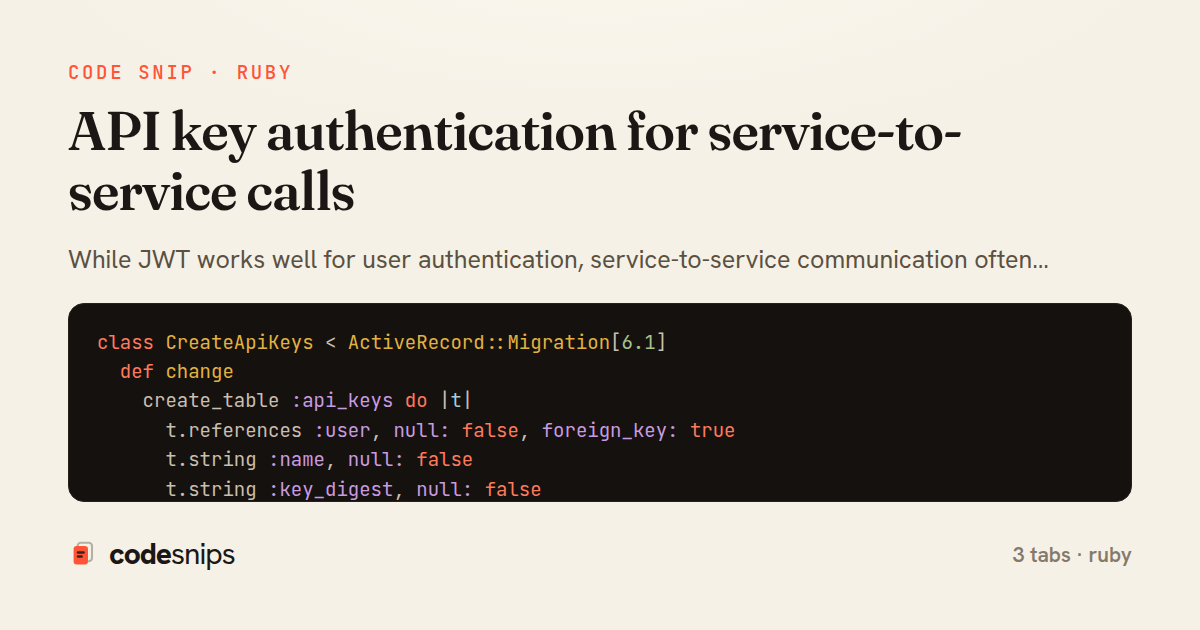
class CreateApiKeys < ActiveRecord::Migration[6.1]
  def change
    create_table :api_keys do |t|
      t.references :user, null: false, foreign_key: true
      t.string :name, null: false
      t.string :key_digest, null: false
      t.string :key_prefix, null: false
      t.text :scopes, array: true, default: []
      t.datetime :last_used_at
      t.datetime :expires_at
      t.timestamps
    end

    add_index :api_keys, :key_digest, unique: true
    add_index :api_keys, :key_prefix
  end
end
class ApiKey < ApplicationRecord
  belongs_to :user

  before_create :generate_key

  validates :name, presence: true

  def self.authenticate(key)
    return nil if key.blank?

    digest = Digest::SHA256.hexdigest(key)
    api_key = find_by(key_digest: digest)

    return nil unless api_key
    return nil if api_key.expired?

    api_key.touch(:last_used_at)
    api_key
  end

  def expired?
    expires_at.present? && expires_at < Time.current
  end

  def has_scope?(scope)
    scopes.include?(scope.to_s)
  end

  private

  def generate_key
    raw_key = SecureRandom.hex(32)
    self.key_prefix = raw_key[0..7]
    self.key_digest = Digest::SHA256.hexdigest(raw_key)

    # Return raw key to show user (only time it's visible)
    @raw_key = raw_key
  end

  attr_reader :raw_key
end
module ApiKeyAuthentication
  extend ActiveSupport::Concern

  included do
    before_action :authenticate_with_api_key
  end

  private

  def authenticate_with_api_key
    key = extract_api_key

    unless key
      render json: { error: 'MISSING_API_KEY' }, status: :unauthorized
      return
    end

    @current_api_key = ApiKey.authenticate(key)

    unless @current_api_key
      render json: { error: 'INVALID_API_KEY' }, status: :unauthorized
      return
    end

    @current_user = @current_api_key.user
  end

  def extract_api_key
    # Try Authorization header first
    header = request.headers['Authorization']
    return header.split(' ').last if header&.start_with?('Bearer ')

    # Fall back to X-API-Key header
    request.headers['X-API-Key']
  end

  def require_scope(scope)
    unless @current_api_key&.has_scope?(scope)
      render json: { error: 'INSUFFICIENT_SCOPE' }, status: :forbidden
    end
  end

  attr_reader :current_api_key, :current_user
end
While JWT works well for user authentication, service-to-service communication often uses simpler API key authentication. I generate cryptographically random API keys using SecureRandom.hex(32) and store them hashed in the database, similar to passwords. Clients send keys via Authorization: Bearer <key> or custom X-API-Key headers. Each key has associated scopes defining permissions, rate limits, and belongs to a specific account or service. I support key rotation by allowing multiple active keys per account. API keys are logged (partially, like key_abc...xyz) for audit purposes. For security, I require HTTPS for all API requests and implement rate limiting per key. Keys can be revoked immediately by deletion from the database.
Related snips
class CommentsController < ApplicationController
  before_action :set_post

  def create
    @comment = @post.comments.build(comment_params)
System test: asserting Turbo Stream responses
class Post < ApplicationRecord
  belongs_to :author, class_name: 'User'
  has_many :comments, dependent: :destroy

  scope :published, -> { where.not(published_at: nil).where('published_at <= ?', Time.current) }
  scope :draft, -> { where(published_at: nil) }
ActiveRecord scopes for reusable query logic
payload = {
  sub: user.id,
  iss: 'https://auth.example.com',
  aud: 'codesnips-api',
  exp: 15.minutes.from_now.to_i,
  iat: Time.now.to_i,
JWT issuance and verification without common footguns
module Api
  module V1
    class UsersController < BaseController
      def show
        user = User.includes(:profile).find(params[:id])
ETags for conditional requests and caching
class PostsController < ApplicationController
  def index
    @posts = Post.includes(:author)
                 .order(created_at: :desc)
                 .page(params[:page])
                 .per(10)
Turbo Frames: infinite scroll with lazy-loading frame
require "csv"

class PeopleCsvStream
  include Enumerable

  HEADERS = %w[id full_name email signed_up_at plan].freeze
Resilient CSV Export as a Streamed Response
Share this code
Here's the card — post it anywhere.