Jordan Lee
Jan 2026
2 tabs
import { Controller } from "@hotwired/stimulus"

export default class extends Controller {
  static targets = ["field"]

  validateField(event) {
    const field = event.target
    const errorElement = field.parentElement.querySelector('.field-error')

    if (!field.checkValidity()) {
      field.classList.add('field-invalid')
      field.classList.remove('field-valid')

      if (errorElement) {
        errorElement.textContent = field.validationMessage
        errorElement.classList.remove('hidden')
      }
    } else {
      field.classList.remove('field-invalid')
      field.classList.add('field-valid')

      if (errorElement) {
        errorElement.classList.add('hidden')
      }
    }
  }

  validateForm(event) {
    let isValid = true

    this.fieldTargets.forEach(field => {
      if (!field.checkValidity()) {
        isValid = false
        field.dispatchEvent(new Event('blur'))
      }
    })

    if (!isValid) {
      event.preventDefault()

      // Focus first invalid field
      const firstInvalid = this.element.querySelector('.field-invalid')
      if (firstInvalid) firstInvalid.focus()
    }
  }
}
<%= form_with model: @post,
    data: {
      controller: "form-validation",
      action: "submit->form-validation#validateForm"
    } do |f| %>

  <div class="form-group">
    <%= f.label :title %>
    <%= f.text_field :title,
        required: true,
        minlength: 5,
        maxlength: 100,
        class: "form-input",
        data: {
          form_validation_target: "field",
          action: "blur->form-validation#validateField"
        } %>
    <% if @post.errors[:title].any? %>
      <div class="field-error"><%= @post.errors[:title].first %></div>
    <% else %>
      <div class="field-error hidden"></div>
    <% end %>
  </div>

  <div class="form-group">
    <%= f.label :body %>
    <%= f.text_area :body,
        required: true,
        minlength: 50,
        rows: 8,
        class: "form-input",
        data: {
          form_validation_target: "field",
          action: "blur->form-validation#validateField"
        } %>
    <% if @post.errors[:body].any? %>
      <div class="field-error"><%= @post.errors[:body].first %></div>
    <% else %>
      <div class="field-error hidden"></div>
    <% end %>
  </div>

  <%= f.submit "Save", class: "btn btn-primary" %>
<% end %>
2 files · javascript, erb
Explain with highlit
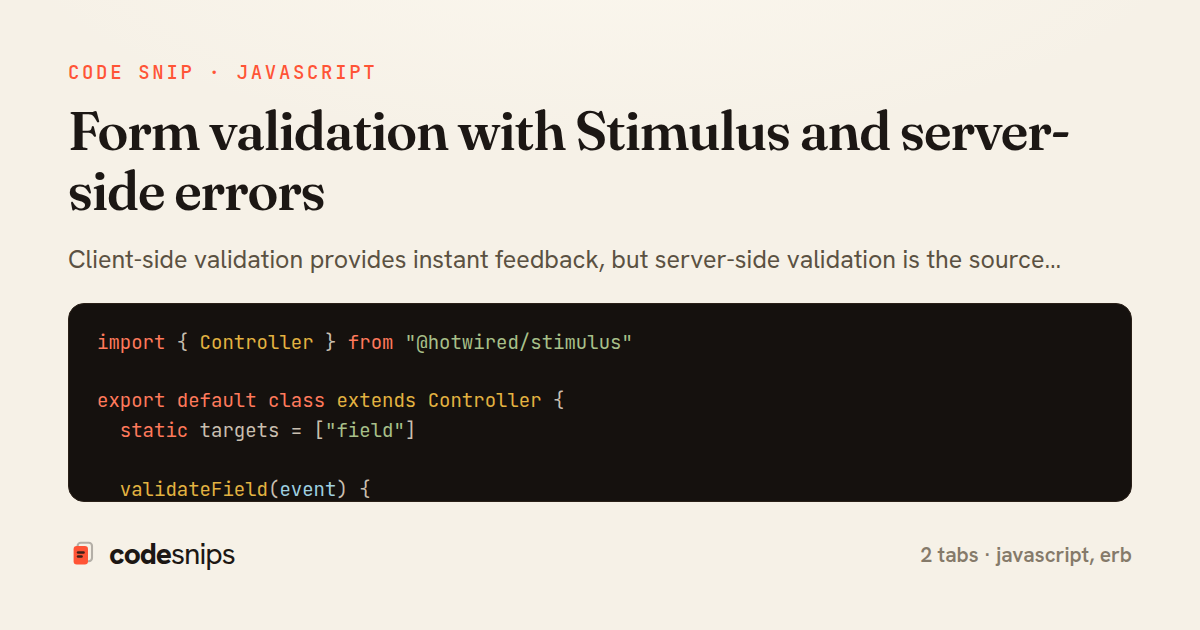
Client-side validation provides instant feedback, but server-side validation is the source of truth. I use Stimulus to add real-time validations (format, length, required fields) while still rendering server errors when validations fail on submit. The controller checks validity on blur or input events and shows inline error messages. When the form submits and the server returns errors, I render the form again with Turbo and error messages appear automatically. The progressive enhancement approach means forms work without JavaScript, but JavaScript makes them feel responsive. I also use the Constraint Validation API to tap into native browser validation and customize error messages.
Related snips
ruby
class CommentsController < ApplicationController
  before_action :set_post

  def create
    @comment = @post.comments.build(comment_params)
System test: asserting Turbo Stream responses
rails
hotwire
turbo
by codesnips
4 tabs
ruby
class Post < ApplicationRecord
  belongs_to :author, class_name: 'User'
  has_many :comments, dependent: :destroy

  scope :published, -> { where.not(published_at: nil).where('published_at <= ?', Time.current) }
  scope :draft, -> { where(published_at: nil) }
ActiveRecord scopes for reusable query logic
rails
activerecord
patterns
by Alex Kumar
1 tab
ruby
module Api
  module V1
    class UsersController < BaseController
      def show
        user = User.includes(:profile).find(params[:id])
ETags for conditional requests and caching
rails
caching
http-caching
by Alex Kumar
1 tab
ruby
class PostsController < ApplicationController
  def index
    @posts = Post.includes(:author)
                 .order(created_at: :desc)
                 .page(params[:page])
                 .per(10)
Turbo Frames: infinite scroll with lazy-loading frame
rails
turbo
hotwire
by codesnips
4 tabs
ruby
require "csv"

class PeopleCsvStream
  include Enumerable

  HEADERS = %w[id full_name email signed_up_at plan].freeze
Resilient CSV Export as a Streamed Response
rails
performance
streaming
by codesnips
3 tabs
erb
<form data-controller="query-sync" data-action="change->query-sync#apply">
  <select name="status" class="rounded border p-2">
    <option value="">Any</option>
    <option value="open">Open</option>
    <option value="closed">Closed</option>
  </select>
Filter UI that syncs query params via Stimulus (no front-end router)
rails
hotwire
stimulus
by Henry Kim
2 tabs
Share this code
Here's the card — post it anywhere.