typescript
70 lines · 2 tabs
Maya Patel
Jan 2026
2 tabs
import { useInfiniteQuery } from '@tanstack/react-query'
import api from '@/services/api'
import { Post, PaginatedResponse } from '@/types'

export function useInfinitePosts() {
  return useInfiniteQuery({
    queryKey: ['posts', 'infinite'],
    queryFn: async ({ pageParam = 1 }) => {
      const { data } = await api.get<PaginatedResponse<Post>>('/posts', {
        params: { page: pageParam },
      })
      return data
    },
    getNextPageParam: (lastPage) => {
      const { current_page, total_pages } = lastPage.meta
      return current_page < total_pages ? current_page + 1 : undefined
    },
    initialPageParam: 1,
  })
}
import { useEffect, useRef } from 'react'
import { useInfinitePosts } from '@/hooks/useInfinitePosts'
import { PostCard } from './PostCard'

export function PostsList() {
  const { data, fetchNextPage, hasNextPage, isFetchingNextPage } = useInfinitePosts()
  const sentinelRef = useRef<HTMLDivElement>(null)

  useEffect(() => {
    const observer = new IntersectionObserver(
      (entries) => {
        if (entries[0].isIntersecting && hasNextPage && !isFetchingNextPage) {
          fetchNextPage()
        }
      },
      { rootMargin: '100px' }
    )

    if (sentinelRef.current) {
      observer.observe(sentinelRef.current)
    }

    return () => observer.disconnect()
  }, [hasNextPage, isFetchingNextPage, fetchNextPage])

  const posts = data?.pages.flatMap((page) => page.data) ?? []

  return (
    <div className="space-y-6">
      {posts.map((post) => (
        <PostCard key={post.id} post={post} />
      ))}

      {hasNextPage && (
        <div ref={sentinelRef} className="py-8 text-center">
          {isFetchingNextPage ? (
            <div className="spinner"></div>
          ) : (
            <button
              onClick={() => fetchNextPage()}
              className="px-4 py-2 bg-gray-200 rounded hover:bg-gray-300"
            >
              Load More
            </button>
          )}
        </div>
      )}
    </div>
  )
}
2 files · typescript
Explain with highlit
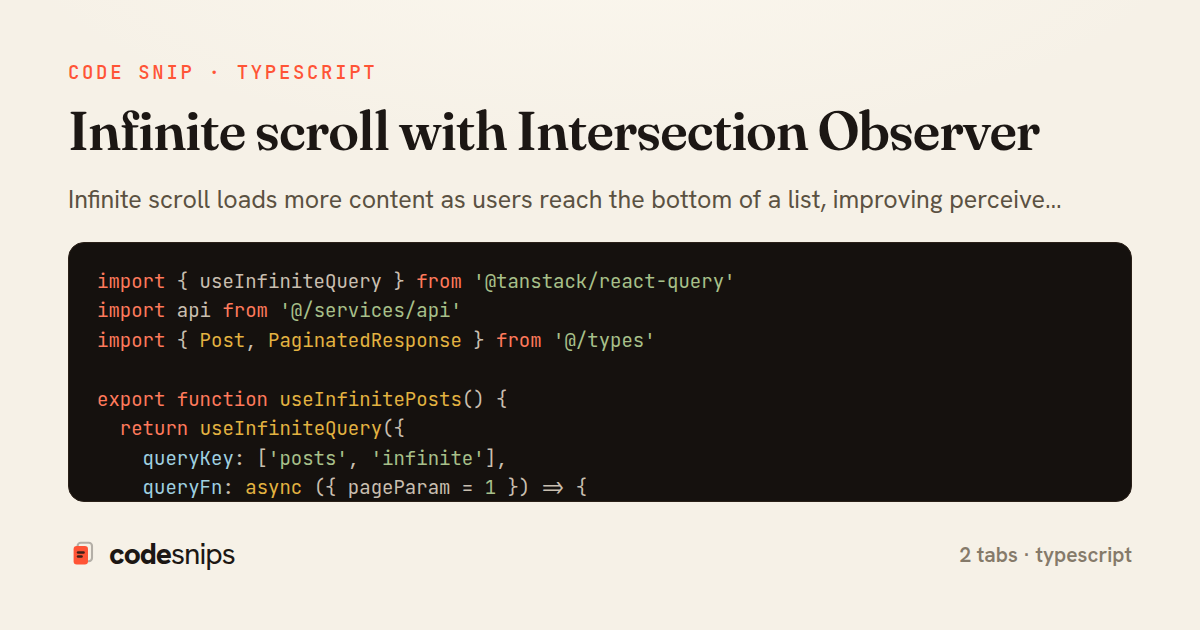
Infinite scroll loads more content as users reach the bottom of a list, improving perceived performance over pagination. I use the Intersection Observer API to detect when a sentinel element becomes visible, then trigger the next page fetch. React Query's useInfiniteQuery manages pagination state and combines pages into a flattened list. The getNextPageParam function extracts pagination metadata from the API response to determine if more pages exist. Each new page appends to the existing data array. I also provide a 'Load More' button as a fallback for users who prefer manual control or when JavaScript fails. This pattern works great for feeds, search results, or any long lists.
Related snips
typescript
export interface RetryOptions {
  retries: number;
  baseMs: number;
  maxMs: number;
  signal?: AbortSignal;
  onRetry?: (attempt: number, delay: number, err: unknown) => void;
Exponential backoff with jitter for retries
typescript
reliability
retry
by codesnips
2 tabs
ruby
class PostsController < ApplicationController
  def index
    @posts = Post.includes(:author)
                 .order(created_at: :desc)
                 .page(params[:page])
                 .per(10)
Turbo Frames: infinite scroll with lazy-loading frame
rails
turbo
hotwire
by codesnips
4 tabs
typescript
import axios, { AxiosError } from 'axios'
import { v4 as uuidv4 } from 'uuid'

const api = axios.create({
  baseURL: import.meta.env.VITE_API_URL || 'http://localhost:3000/api/v1',
  timeout: 15000,
Axios API client with interceptors
react
axios
api
by Maya Patel
1 tab
typescript
import { create } from 'zustand'
import { persist } from 'zustand/middleware'

interface FilterState {
  search: string
  category: string | null
Zustand for lightweight state management
react
zustand
state-management
by Maya Patel
2 tabs
typescript
import React from "react";

type FallbackProps = {
  error: Error;
  reset: () => void;
};
React Error Boundary + error reporting hook
react
frontend
error-boundary
by codesnips
3 tabs
javascript
const withBundleAnalyzer = require('@next/bundle-analyzer')({
  enabled: process.env.ANALYZE === 'true',
  openAnalyzer: true,
});

/** @type {import('next').NextConfig} */
Next.js bundle analyzer for targeted performance work
nextjs
performance
tooling
by codesnips
4 tabs
Share this code
Here's the card — post it anywhere.