typescript
46 lines · 1 tab
Maya Patel
Jan 2026
1 tab
import { lazy, Suspense } from 'react'
import { BrowserRouter, Routes, Route } from 'react-router-dom'
import Layout from '@/components/Layout'

// Eager load critical routes
import Home from '@/pages/Home'

// Lazy load other routes
const Posts = lazy(() => import('@/pages/Posts'))
const PostDetail = lazy(() => import('@/pages/PostDetail'))
const NewPost = lazy(() => import('@/pages/NewPost'))
const Profile = lazy(() => import('@/pages/Profile'))

// Admin routes in separate chunk
const AdminDashboard = lazy(() => import('@/pages/admin/Dashboard'))
const AdminUsers = lazy(() => import('@/pages/admin/Users'))

function App() {
  return (
    <BrowserRouter>
      <Suspense
        fallback={
          <div className="flex items-center justify-center min-h-screen">
            <div className="animate-spin rounded-full h-12 w-12 border-b-2 border-blue-600" />
          </div>
        }
      >
        <Routes>
          <Route element={<Layout />}>
            <Route path="/" element={<Home />} />
            <Route path="/posts" element={<Posts />} />
            <Route path="/posts/:id" element={<PostDetail />} />
            <Route path="/posts/new" element={<NewPost />} />
            <Route path="/profile" element={<Profile />} />

            {/* Admin routes */}
            <Route path="/admin/dashboard" element={<AdminDashboard />} />
            <Route path="/admin/users" element={<AdminUsers />} />
          </Route>
        </Routes>
      </Suspense>
    </BrowserRouter>
  )
}

export default App
1 file · typescript
Explain with highlit
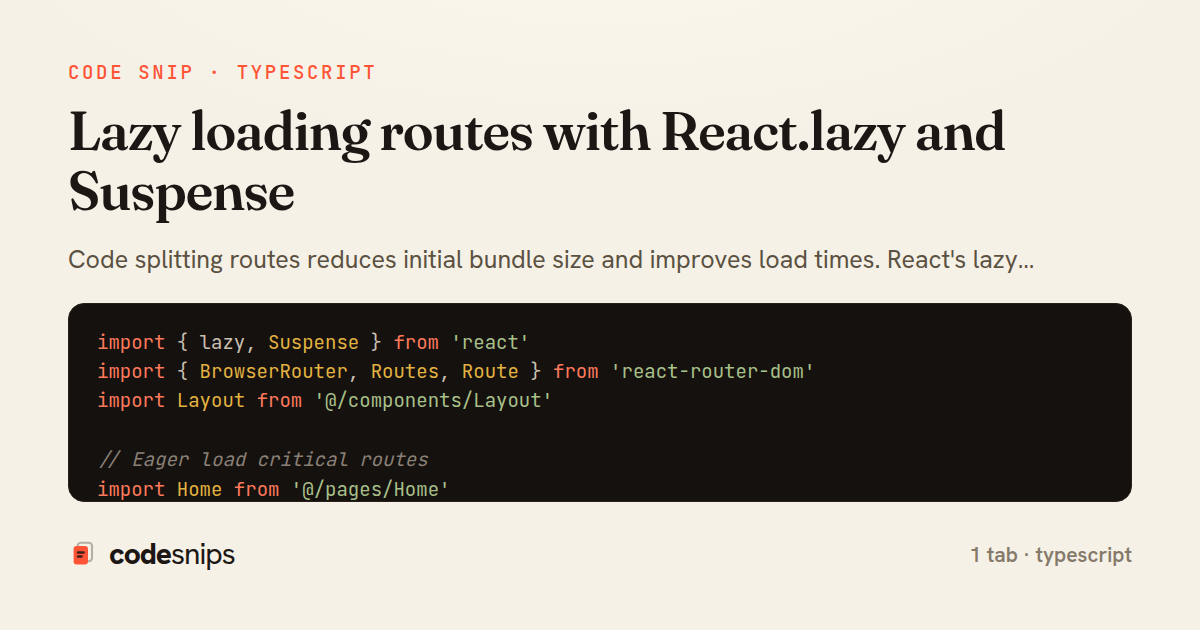
Code splitting routes reduces initial bundle size and improves load times. React's lazy function dynamically imports components when routes are accessed. Wrapped in Suspense, lazy components show fallback UI while loading. I group related routes into chunks by organizing imports—admin routes load separately from public routes. The <Suspense> boundary can be at the route level or app level depending on desired granularity. Vite automatically creates separate bundles for dynamic imports. This pattern is essential for large apps where loading everything upfront would hurt performance. Users only download the code they need, when they need it.
Related snips
ruby
class PostsController < ApplicationController
  def index
    @posts = Post.includes(:author)
                 .order(created_at: :desc)
                 .page(params[:page])
                 .per(10)
Turbo Frames: infinite scroll with lazy-loading frame
rails
turbo
hotwire
by codesnips
4 tabs
ruby
require "csv"

class PeopleCsvStream
  include Enumerable

  HEADERS = %w[id full_name email signed_up_at plan].freeze
Resilient CSV Export as a Streamed Response
rails
performance
streaming
by codesnips
3 tabs
ruby
Rails.application.configure do
  config.after_initialize do
    Bullet.enable = true
    Bullet.alert = false
    Bullet.bullet_logger = true
    Bullet.console = true
N+1 query detection with Bullet gem
rails
performance
activerecord
by Alex Kumar
2 tabs
ruby
json.array! @posts do |post|
  json.cache! ['v1', post], expires_in: 1.hour do
    json.id post.id
    json.title post.title
    json.excerpt post.excerpt
    json.published_at post.published_at
Fragment caching for expensive JSON serialization
rails
caching
performance
by Alex Kumar
1 tab
typescript
import axios, { AxiosError } from 'axios'
import { v4 as uuidv4 } from 'uuid'

const api = axios.create({
  baseURL: import.meta.env.VITE_API_URL || 'http://localhost:3000/api/v1',
  timeout: 15000,
Axios API client with interceptors
react
axios
api
by Maya Patel
1 tab
typescript
import { create } from 'zustand'
import { persist } from 'zustand/middleware'

interface FilterState {
  search: string
  category: string | null
Zustand for lightweight state management
react
zustand
state-management
by Maya Patel
2 tabs
Share this code
Here's the card — post it anywhere.