ruby
39 lines · 1 tab
Maya Patel
Jan 2026
1 tab
module Api
  module V1
    class PostsController < ApplicationController
      def create
        post = current_user.posts.build(post_params)

        if post.save
          render json: post, serializer: PostSerializer, status: :created
        else
          render json: { errors: post.errors }, status: :unprocessable_entity
        end
      end

      def update
        post = current_user.posts.find(params[:id])

        if post.update(post_params)
          render json: post, serializer: PostSerializer
        else
          render json: { errors: post.errors }, status: :unprocessable_entity
        end
      end

      private

      def post_params
        params.require(:post).permit(
          :title,
          :body,
          :status,
          :cover_image_blob_id,
          tags: [],
          images_attributes: [:id, :blob_id, :caption, :_destroy],
          meta_attributes: [:description, :keywords, :og_image]
        )
      end
    end
  end
end
1 file · ruby
Explain with highlit
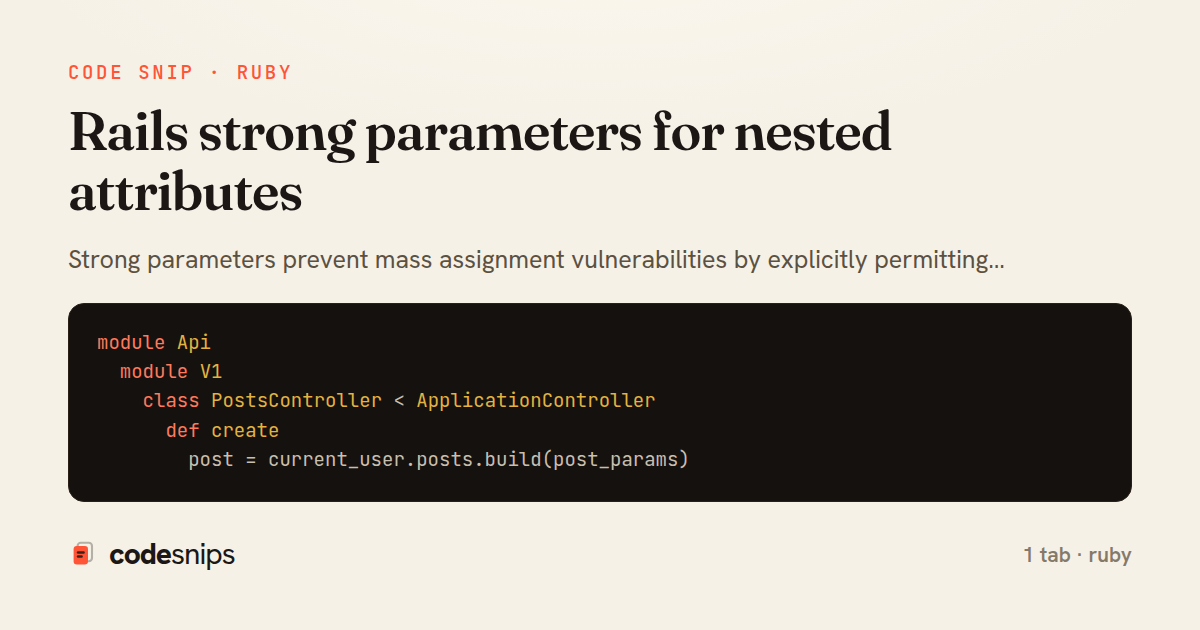
Strong parameters prevent mass assignment vulnerabilities by explicitly permitting allowed attributes. For nested associations like a post with embedded images or comments, I use nested permit calls. Arrays of primitives use [] syntax, while hashes of attributes use nested hashes. The _destroy parameter enables deletion of associated records through forms. I create private permit methods for complex nested structures to keep controllers clean. Strong parameters work seamlessly with React forms that post JSON—Rails parses the JSON into params automatically. Validation errors for nested attributes surface correctly in API responses. This security layer is essential for any Rails API accepting user input.
Related snips
ruby
class CommentsController < ApplicationController
  before_action :set_post

  def create
    @comment = @post.comments.build(comment_params)
System test: asserting Turbo Stream responses
rails
hotwire
turbo
by codesnips
4 tabs
ruby
class Post < ApplicationRecord
  belongs_to :author, class_name: 'User'
  has_many :comments, dependent: :destroy

  scope :published, -> { where.not(published_at: nil).where('published_at <= ?', Time.current) }
  scope :draft, -> { where(published_at: nil) }
ActiveRecord scopes for reusable query logic
rails
activerecord
patterns
by Alex Kumar
1 tab
ruby
payload = {
  sub: user.id,
  iss: 'https://auth.example.com',
  aud: 'codesnips-api',
  exp: 15.minutes.from_now.to_i,
  iat: Time.now.to_i,
JWT issuance and verification without common footguns
jwt
authentication
api
by Kai Nakamura
2 tabs
ruby
module Api
  module V1
    class UsersController < BaseController
      def show
        user = User.includes(:profile).find(params[:id])
ETags for conditional requests and caching
rails
caching
http-caching
by Alex Kumar
1 tab
ruby
class PostsController < ApplicationController
  def index
    @posts = Post.includes(:author)
                 .order(created_at: :desc)
                 .page(params[:page])
                 .per(10)
Turbo Frames: infinite scroll with lazy-loading frame
rails
turbo
hotwire
by codesnips
4 tabs
ruby
require "csv"

class PeopleCsvStream
  include Enumerable

  HEADERS = %w[id full_name email signed_up_at plan].freeze
Resilient CSV Export as a Streamed Response
rails
performance
streaming
by codesnips
3 tabs
Share this code
Here's the card — post it anywhere.