typescript
67 lines · 2 tabs
Maya Patel
Jan 2026
2 tabs
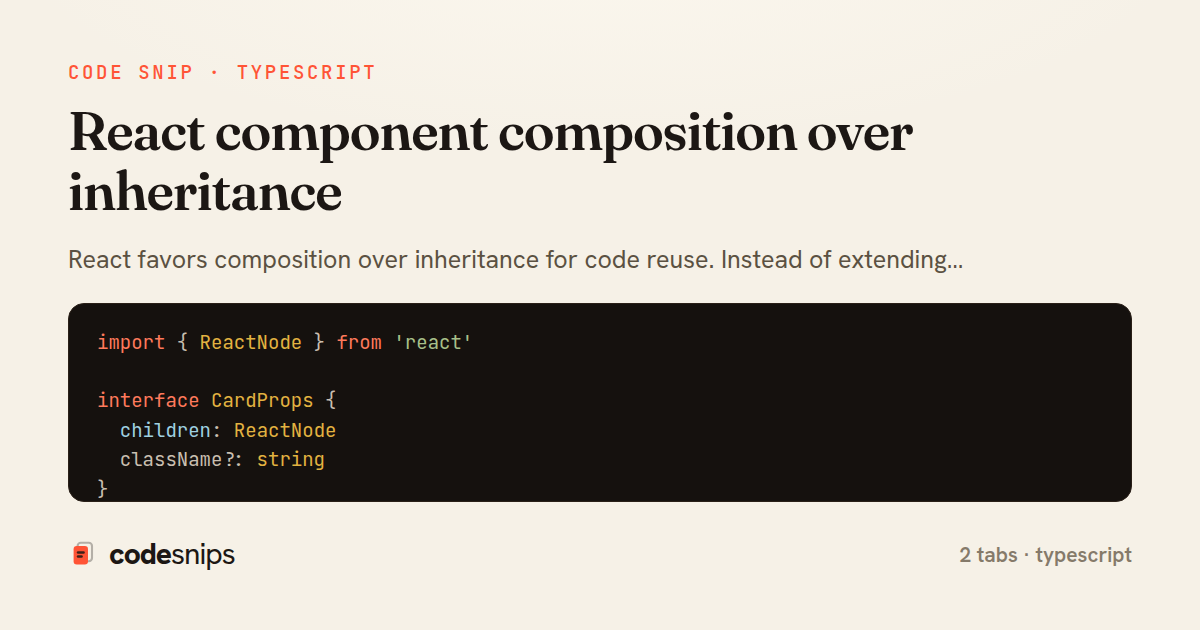
import { ReactNode } from 'react'

interface CardProps {
  children: ReactNode
  className?: string
}

export function Card({ children, className = '' }: CardProps) {
  return (
    <div className={`bg-white rounded-lg shadow ${className}`}>
      {children}
    </div>
  )
}

interface CardHeaderProps {
  children: ReactNode
  actions?: ReactNode
}

export function CardHeader({ children, actions }: CardHeaderProps) {
  return (
    <div className="flex items-center justify-between px-6 py-4 border-b">
      <div>{children}</div>
      {actions && <div className="flex gap-2">{actions}</div>}
    </div>
  )
}

export function CardBody({ children }: { children: ReactNode }) {
  return <div className="px-6 py-4">{children}</div>
}

export function CardFooter({ children }: { children: ReactNode }) {
  return <div className="px-6 py-4 border-t bg-gray-50">{children}</div>
}

Card.Header = CardHeader
Card.Body = CardBody
Card.Footer = CardFooter
function PostCard({ post }: { post: Post }) {
  return (
    <Card>
      <Card.Header
        actions={
          <>
            <button>Edit</button>
            <button>Delete</button>
          </>
        }
      >
        <h2>{post.title}</h2>
      </Card.Header>

      <Card.Body>
        <p>{post.excerpt}</p>
      </Card.Body>

      <Card.Footer>
        <div className="flex gap-4">
          <span>{post.likes_count} likes</span>
          <span>{post.comments_count} comments</span>
        </div>
      </Card.Footer>
    </Card>
  )
}
2 files · typescript
Explain with highlit
React favors composition over inheritance for code reuse. Instead of extending component classes, I compose smaller components into larger ones. Higher-order components (HOCs) wrap components to add behavior, while render props pass rendering logic as functions. The children prop enables slot-based composition where parent components control layout but children provide content. Custom hooks extract stateful logic without component wrappers. I use compound components for flexible APIs that share state via context. This compositional approach creates more flexible, testable code than inheritance hierarchies. It's the React way of achieving polymorphism and code reuse.
Related snips
ruby
class Post < ApplicationRecord
  belongs_to :author, class_name: 'User'
  has_many :comments, dependent: :destroy

  scope :published, -> { where.not(published_at: nil).where('published_at <= ?', Time.current) }
  scope :draft, -> { where(published_at: nil) }
ActiveRecord scopes for reusable query logic
rails
activerecord
patterns
by Alex Kumar
1 tab
typescript
import axios, { AxiosError } from 'axios'
import { v4 as uuidv4 } from 'uuid'

const api = axios.create({
  baseURL: import.meta.env.VITE_API_URL || 'http://localhost:3000/api/v1',
  timeout: 15000,
Axios API client with interceptors
react
axios
api
by Maya Patel
1 tab
typescript
import { create } from 'zustand'
import { persist } from 'zustand/middleware'

interface FilterState {
  search: string
  category: string | null
Zustand for lightweight state management
react
zustand
state-management
by Maya Patel
2 tabs
typescript
import React from "react";

type FallbackProps = {
  error: Error;
  reset: () => void;
};
React Error Boundary + error reporting hook
react
frontend
error-boundary
by codesnips
3 tabs
javascript
const withBundleAnalyzer = require('@next/bundle-analyzer')({
  enabled: process.env.ANALYZE === 'true',
  openAnalyzer: true,
});

/** @type {import('next').NextConfig} */
Next.js bundle analyzer for targeted performance work
nextjs
performance
tooling
by codesnips
4 tabs
typescript
import { Navigate, useLocation } from 'react-router-dom'
import { useAuth } from '@/contexts/AuthContext'

interface ProtectedRouteProps {
  children: React.ReactNode
}
React Router with protected routes
react
react-router
routing
by Maya Patel
2 tabs
Share this code
Here's the card — post it anywhere.