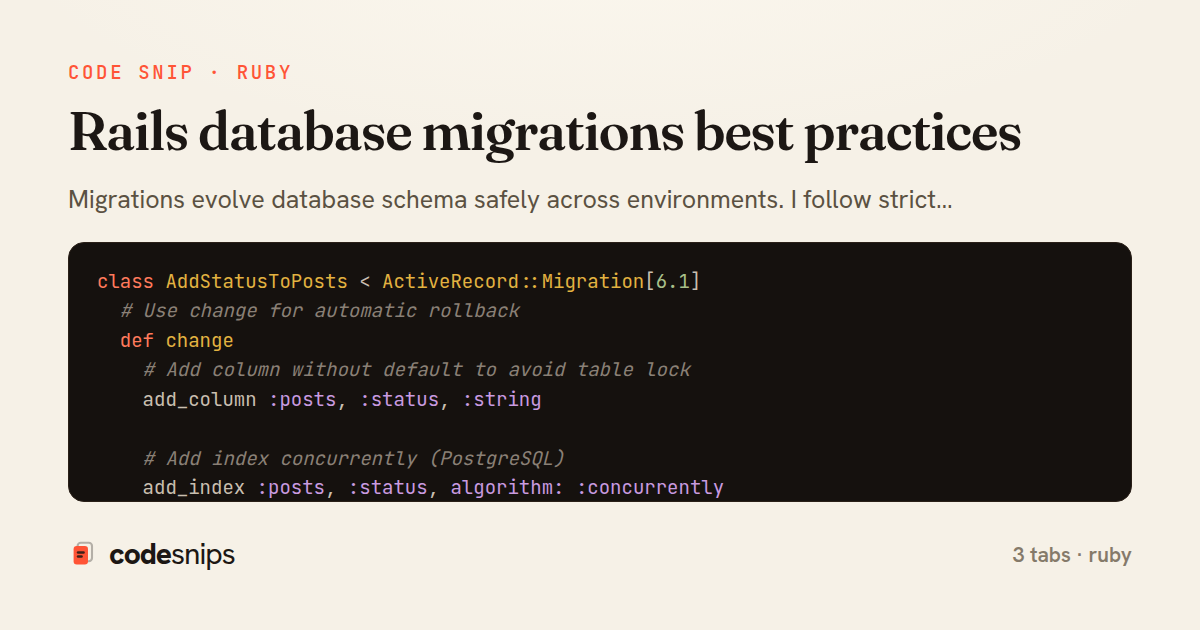
class AddStatusToPosts < ActiveRecord::Migration[6.1]
  # Use change for automatic rollback
  def change
    # Add column without default to avoid table lock
    add_column :posts, :status, :string

    # Add index concurrently (PostgreSQL)
    add_index :posts, :status, algorithm: :concurrently
  end
end
class BackfillPostStatus < ActiveRecord::Migration[6.1]
  disable_ddl_transaction! # Required for concurrent index

  def up
    # Backfill in batches to avoid locking
    Post.where(status: nil).in_batches(of: 1000) do |batch|
      batch.update_all(status: 'draft')
      sleep 0.1 # Throttle to reduce database load
    end

    # Add NOT NULL constraint after backfill
    change_column_null :posts, :status, false
  end

  def down
    change_column_null :posts, :status, true
  end
end
class SplitUserName < ActiveRecord::Migration[6.1]
  def change
    add_column :users, :first_name, :string
    add_column :users, :last_name, :string

    reversible do |dir|
      dir.up do
        User.reset_column_information
        User.find_each do |user|
          parts = user.name.to_s.split(' ', 2)
          user.update_columns(
            first_name: parts[0],
            last_name: parts[1]
          )
        end
      end

      dir.down do
        User.reset_column_information
        User.find_each do |user|
          user.update_column(:name, "#{user.first_name} #{user.last_name}".strip)
        end
      end
    end
  end
end
Migrations evolve database schema safely across environments. I follow strict conventions: one logical change per migration, descriptive names, reversible operations. Using change instead of up/down enables automatic rollback for most operations. For data migrations, I use reversible blocks or raise ActiveRecord::IrreversibleMigration. Adding indexes happens in separate migrations with algorithm: :concurrently for PostgreSQL to avoid table locks. I never edit committed migrations—create new ones to fix issues. Schema changes deploy before code to support zero-downtime deployments. For large tables, I add columns without defaults, then backfill in batches. Strong migration gem catches dangerous operations before production.
Related snips
-- Simple function
CREATE OR REPLACE FUNCTION get_full_name(
  first_name VARCHAR,
  last_name VARCHAR
)
RETURNS VARCHAR AS $$
Stored procedures and functions in PostgreSQL
class CommentsController < ApplicationController
  before_action :set_post

  def create
    @comment = @post.comments.build(comment_params)
System test: asserting Turbo Stream responses
class Post < ApplicationRecord
  belongs_to :author, class_name: 'User'
  has_many :comments, dependent: :destroy

  scope :published, -> { where.not(published_at: nil).where('published_at <= ?', Time.current) }
  scope :draft, -> { where(published_at: nil) }
ActiveRecord scopes for reusable query logic
module Api
  module V1
    class UsersController < BaseController
      def show
        user = User.includes(:profile).find(params[:id])
ETags for conditional requests and caching
class PostsController < ApplicationController
  def index
    @posts = Post.includes(:author)
                 .order(created_at: :desc)
                 .page(params[:page])
                 .per(10)
Turbo Frames: infinite scroll with lazy-loading frame
require "csv"

class PeopleCsvStream
  include Enumerable

  HEADERS = %w[id full_name email signed_up_at plan].freeze
Resilient CSV Export as a Streamed Response
Share this code
Here's the card — post it anywhere.