rust
14 lines · 1 tab
Marcus Chen
Jan 2026
1 tab
fn calculate_length(s: &String) -> usize {
    s.len()
}

fn append_suffix(s: &mut String) {
    s.push_str(" world");
}

fn main() {
    let mut text = String::from("hello");
    let len = calculate_length(&text);
    append_suffix(&mut text);
    println!("{} (length was {})", text, len);
}
1 file · rust
Explain with highlit
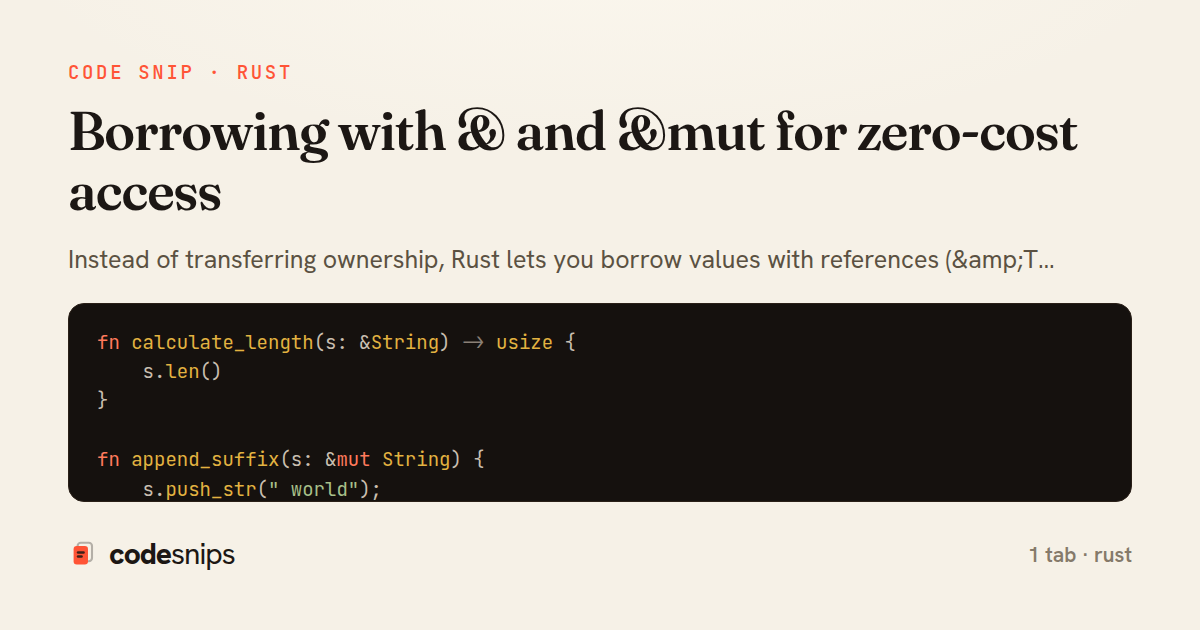
Instead of transferring ownership, Rust lets you borrow values with references (&T for immutable, &mut T for mutable). Borrows allow functions to read or modify data without taking ownership, so the caller retains access afterward. The borrow checker enforces that you can have either many immutable borrows or one mutable borrow at a time, preventing data races. This is enforced at compile time with zero runtime cost. I use immutable borrows for read-only operations and mutable borrows when I need to modify in place. The lifetime annotations ensure references never outlive the data they point to. This pattern is pervasive in Rust APIs and enables safe concurrency without locks in many cases.
Related snips
rust
struct Config<'a> {
    name: &'a str,
    value: &'a str,
}

fn parse_config(line: &str) -> Config {
Lifetime annotations for flexible borrowing in structs
rust
lifetimes
borrowing
by Marcus Chen
1 tab
rust
use crossbeam::channel::unbounded;
use std::thread;

fn main() {
    let (tx, rx) = unbounded();
Crossbeam for advanced concurrent data structures
rust
concurrency
lock-free
by Marcus Chen
1 tab
rust
use tracing::{info, instrument};

#[instrument]
fn process_request(user_id: u64) {
    info!(user_id, "Processing request");
    // Work happens here
tracing for structured logging and distributed tracing
rust
observability
tracing
by Marcus Chen
1 tab
rust
use std::sync::mpsc;
use std::thread;

fn main() {
    let (tx, rx) = mpsc::channel();
Channels (mpsc) for message passing between threads
rust
concurrency
channels
by Marcus Chen
1 tab
rust
use clap::Parser;

#[derive(Parser, Debug)]
#[command(author, version, about)]
struct Args {
    #[arg(short, long)]
clap for CLI argument parsing with derive macros
rust
cli
clap
by Marcus Chen
1 tab
rust
macro_rules! create_function {
    ($func_name:ident) => {
        fn $func_name() {
            println!("Called {}", stringify!($func_name));
        }
    };
Declarative macros (macro_rules!) for code generation
rust
macros
metaprogramming
by Marcus Chen
1 tab
Share this code
Here's the card — post it anywhere.