rust
12 lines · 1 tab
Marcus Chen
Jan 2026
1 tab
use tokio::time::{sleep, Duration};

#[tokio::main]
async fn main() {
    let handle = tokio::spawn(async {
        sleep(Duration::from_millis(100)).await;
        "task result"
    });

    let result = handle.await.unwrap();
    println!("Task returned: {}", result);
}
1 file · rust
Explain with highlit
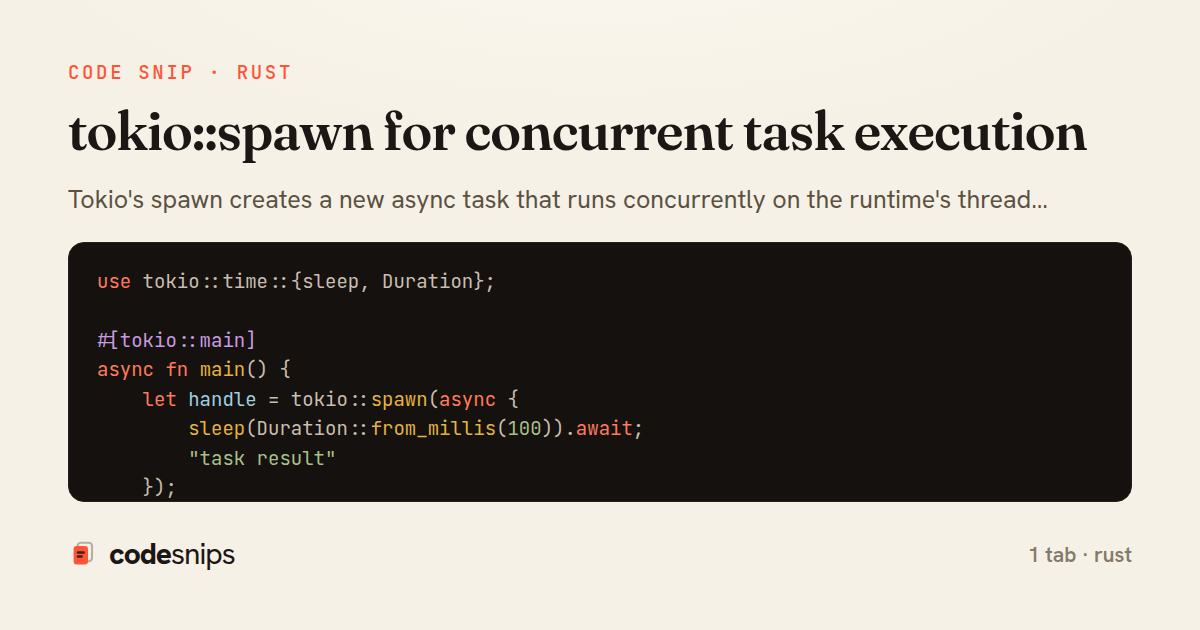
Tokio's spawn creates a new async task that runs concurrently on the runtime's thread pool. Unlike OS threads, tasks are lightweight (kilobytes of memory) and scheduled cooperatively. Each task must be 'static and Send, meaning it can't borrow local variables (use Arc to share state). I use spawn for fire-and-forget work, background processing, or to parallelize independent I/O operations. The returned JoinHandle lets you await the result or cancel the task. This pattern is how you build high-concurrency services in Rust: spawn thousands of tasks without the overhead of thousands of threads. Combined with async I/O, it's incredibly efficient.
Related snips
typescript
export interface RetryOptions {
  retries: number;
  baseMs: number;
  maxMs: number;
  signal?: AbortSignal;
  onRetry?: (attempt: number, delay: number, err: unknown) => void;
Exponential backoff with jitter for retries
typescript
reliability
retry
by codesnips
2 tabs
rust
struct Config<'a> {
    name: &'a str,
    value: &'a str,
}

fn parse_config(line: &str) -> Config {
Lifetime annotations for flexible borrowing in structs
rust
lifetimes
borrowing
by Marcus Chen
1 tab
javascript
// Creating a Promise
const myPromise = new Promise((resolve, reject) => {
  const success = true;

  setTimeout(() => {
    if (success) {
Promises and async/await patterns for asynchronous JavaScript
javascript
promises
async-await
by Alex Chang
1 tab
rust
use crossbeam::channel::unbounded;
use std::thread;

fn main() {
    let (tx, rx) = unbounded();
Crossbeam for advanced concurrent data structures
rust
concurrency
lock-free
by Marcus Chen
1 tab
rust
use tracing::{info, instrument};

#[instrument]
fn process_request(user_id: u64) {
    info!(user_id, "Processing request");
    // Work happens here
tracing for structured logging and distributed tracing
rust
observability
tracing
by Marcus Chen
1 tab
rust
use std::sync::mpsc;
use std::thread;

fn main() {
    let (tx, rx) = mpsc::channel();
Channels (mpsc) for message passing between threads
rust
concurrency
channels
by Marcus Chen
1 tab
Share this code
Here's the card — post it anywhere.