rust
11 lines · 1 tab
Marcus Chen
Jan 2026
1 tab
use std::fmt::Display;

fn print_it<T: Display>(value: T) {
    println!("Value: {}", value);
}

fn main() {
    print_it(42);
    print_it("hello");
    print_it(3.14);
}
1 file · rust
Explain with highlit
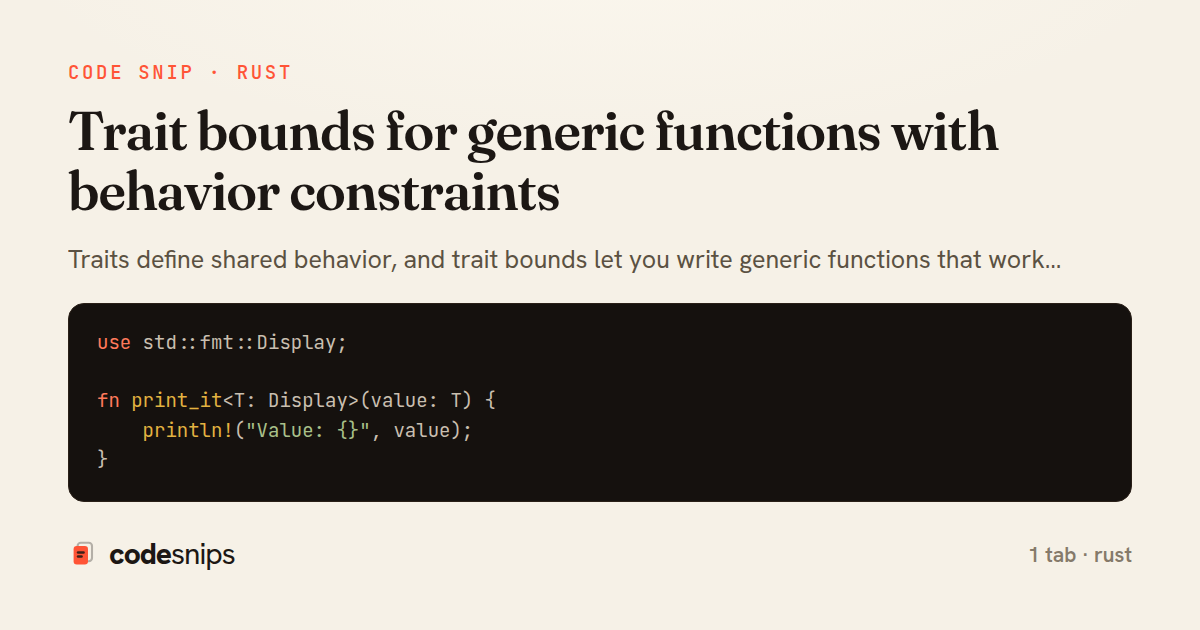
Traits define shared behavior, and trait bounds let you write generic functions that work with any type implementing a trait. The syntax T: Display means "T must implement Display." This is similar to interfaces in other languages but more powerful: you can implement traits for types you don't own, and trait bounds are zero-cost (monomorphization at compile time). I use trait bounds everywhere: for serialization (T: Serialize), for comparison (T: Ord), for cloning (T: Clone). The compiler generates specialized code for each concrete type, so there's no dynamic dispatch unless you opt in with dyn Trait. This pattern is the foundation of Rust's generic programming model.
Related snips
rust
struct Config<'a> {
    name: &'a str,
    value: &'a str,
}

fn parse_config(line: &str) -> Config {
Lifetime annotations for flexible borrowing in structs
rust
lifetimes
borrowing
by Marcus Chen
1 tab
rust
use crossbeam::channel::unbounded;
use std::thread;

fn main() {
    let (tx, rx) = unbounded();
Crossbeam for advanced concurrent data structures
rust
concurrency
lock-free
by Marcus Chen
1 tab
rust
use tracing::{info, instrument};

#[instrument]
fn process_request(user_id: u64) {
    info!(user_id, "Processing request");
    // Work happens here
tracing for structured logging and distributed tracing
rust
observability
tracing
by Marcus Chen
1 tab
rust
use std::sync::mpsc;
use std::thread;

fn main() {
    let (tx, rx) = mpsc::channel();
Channels (mpsc) for message passing between threads
rust
concurrency
channels
by Marcus Chen
1 tab
rust
use clap::Parser;

#[derive(Parser, Debug)]
#[command(author, version, about)]
struct Args {
    #[arg(short, long)]
clap for CLI argument parsing with derive macros
rust
cli
clap
by Marcus Chen
1 tab
rust
macro_rules! create_function {
    ($func_name:ident) => {
        fn $func_name() {
            println!("Called {}", stringify!($func_name));
        }
    };
Declarative macros (macro_rules!) for code generation
rust
macros
metaprogramming
by Marcus Chen
1 tab
Share this code
Here's the card — post it anywhere.