rust
13 lines · 1 tab
Marcus Chen
Jan 2026
1 tab
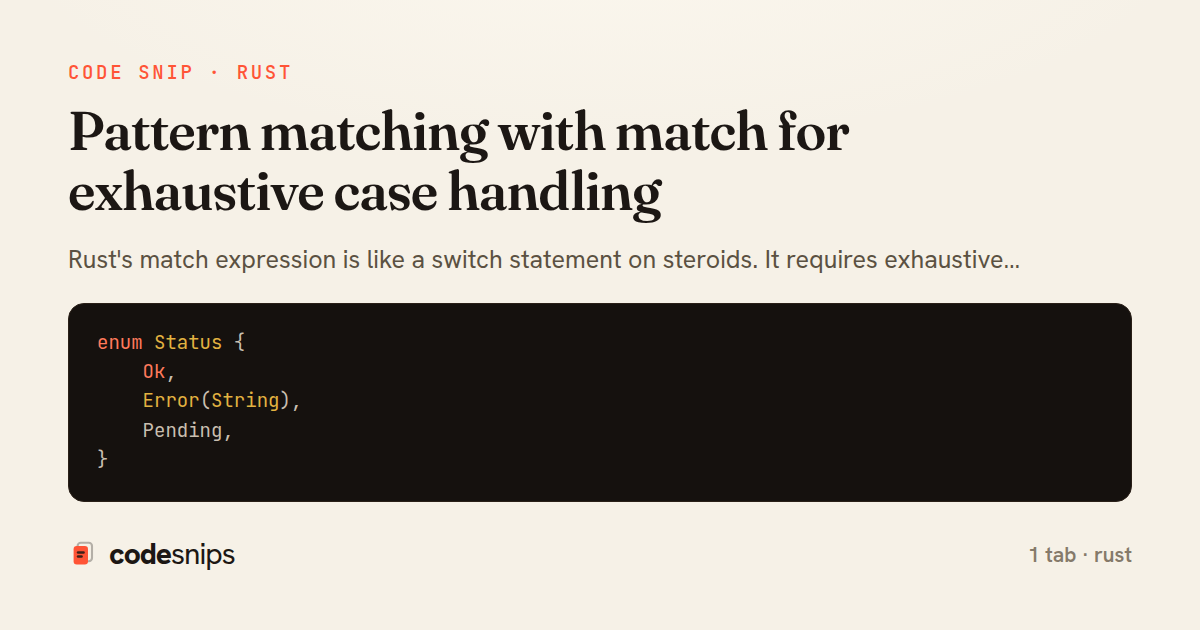
enum Status {
    Ok,
    Error(String),
    Pending,
}

fn handle_status(status: Status) -> String {
    match status {
        Status::Ok => "Success".to_string(),
        Status::Error(msg) => format!("Failed: {}", msg),
        Status::Pending => "Waiting...".to_string(),
    }
}
1 file · rust
Explain with highlit
Rust's match expression is like a switch statement on steroids. It requires exhaustive handling of all cases, and the compiler enforces this. You can match on enums, tuples, references, ranges, and destructure nested data. Guards (if condition) add extra filtering. The _ wildcard catches everything else. Because match is an expression, it returns a value, making code more concise. I use match for state machines, parsing, and any branching logic with multiple cases. The exhaustiveness check catches bugs at compile time when you add new enum variants. Combined with pattern destructuring, it's one of Rust's most powerful features for writing correct code.
Related snips
rust
struct Config<'a> {
    name: &'a str,
    value: &'a str,
}

fn parse_config(line: &str) -> Config {
Lifetime annotations for flexible borrowing in structs
rust
lifetimes
borrowing
by Marcus Chen
1 tab
rust
use crossbeam::channel::unbounded;
use std::thread;

fn main() {
    let (tx, rx) = unbounded();
Crossbeam for advanced concurrent data structures
rust
concurrency
lock-free
by Marcus Chen
1 tab
rust
use tracing::{info, instrument};

#[instrument]
fn process_request(user_id: u64) {
    info!(user_id, "Processing request");
    // Work happens here
tracing for structured logging and distributed tracing
rust
observability
tracing
by Marcus Chen
1 tab
rust
use std::sync::mpsc;
use std::thread;

fn main() {
    let (tx, rx) = mpsc::channel();
Channels (mpsc) for message passing between threads
rust
concurrency
channels
by Marcus Chen
1 tab
rust
use clap::Parser;

#[derive(Parser, Debug)]
#[command(author, version, about)]
struct Args {
    #[arg(short, long)]
clap for CLI argument parsing with derive macros
rust
cli
clap
by Marcus Chen
1 tab
rust
macro_rules! create_function {
    ($func_name:ident) => {
        fn $func_name() {
            println!("Called {}", stringify!($func_name));
        }
    };
Declarative macros (macro_rules!) for code generation
rust
macros
metaprogramming
by Marcus Chen
1 tab
Share this code
Here's the card — post it anywhere.