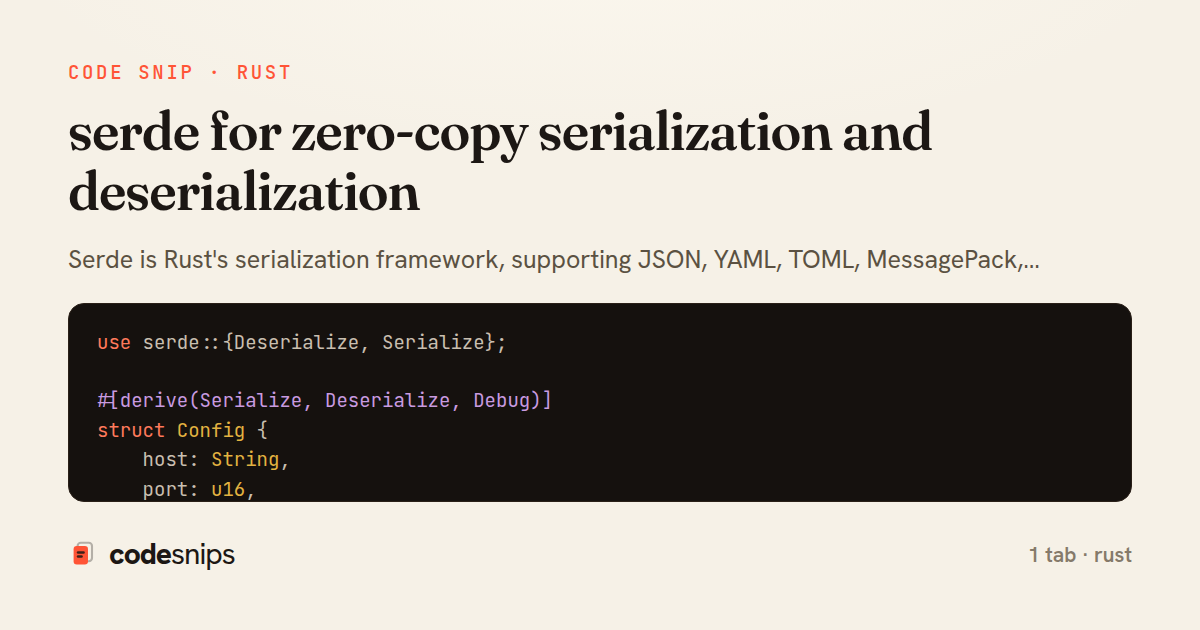
use serde::{Deserialize, Serialize};

#[derive(Serialize, Deserialize, Debug)]
struct Config {
    host: String,
    port: u16,
    #[serde(default)]
    debug: bool,
}

fn main() -> Result<(), serde_json::Error> {
    let json = r#"{"host": "localhost", "port": 8080}"#;
    let config: Config = serde_json::from_str(json)?;
    println!("{:?}", config);
    Ok(())
}
Serde is Rust's serialization framework, supporting JSON, YAML, TOML, MessagePack, and more through format-specific crates. With #[derive(Serialize, Deserialize)], your structs automatically convert to and from these formats. Serde is extremely fast because it generates specialized code at compile time and can borrow from the input (&str fields) without copying. I use serde_json for APIs, serde_yaml for config files, and bincode for binary protocols. The #[serde(rename = "...")] attribute maps Rust field names to external formats. For custom serialization, you can implement the traits manually. The ecosystem is mature, well-documented, and integrates with async I/O seamlessly. It's essential for any networked Rust application.
Related snips
struct Config<'a> {
    name: &'a str,
    value: &'a str,
}

fn parse_config(line: &str) -> Config {
Lifetime annotations for flexible borrowing in structs
use crossbeam::channel::unbounded;
use std::thread;

fn main() {
    let (tx, rx) = unbounded();
Crossbeam for advanced concurrent data structures
use tracing::{info, instrument};

#[instrument]
fn process_request(user_id: u64) {
    info!(user_id, "Processing request");
    // Work happens here
tracing for structured logging and distributed tracing
use std::sync::mpsc;
use std::thread;

fn main() {
    let (tx, rx) = mpsc::channel();
Channels (mpsc) for message passing between threads
use clap::Parser;

#[derive(Parser, Debug)]
#[command(author, version, about)]
struct Args {
    #[arg(short, long)]
clap for CLI argument parsing with derive macros
macro_rules! create_function {
    ($func_name:ident) => {
        fn $func_name() {
            println!("Called {}", stringify!($func_name));
        }
    };
Declarative macros (macro_rules!) for code generation
Share this code
Here's the card — post it anywhere.