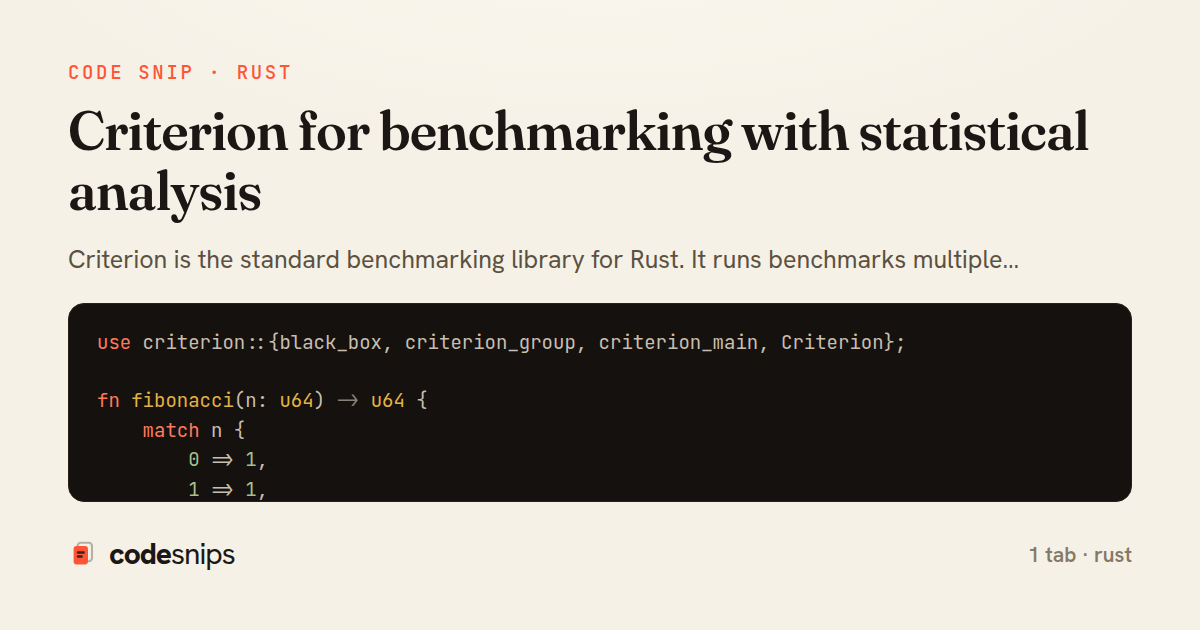
use criterion::{black_box, criterion_group, criterion_main, Criterion};

fn fibonacci(n: u64) -> u64 {
    match n {
        0 => 1,
        1 => 1,
        n => fibonacci(n - 1) + fibonacci(n - 2),
    }
}

fn bench_fib(c: &mut Criterion) {
    c.bench_function("fib 20", |b| b.iter(|| fibonacci(black_box(20))));
}

criterion_group!(benches, bench_fib);
criterion_main!(benches);
Criterion is the standard benchmarking library for Rust. It runs benchmarks multiple times, detects outliers, and reports statistical confidence intervals. The API is simple: wrap your code in a closure, and criterion measures execution time. It generates HTML reports with graphs showing performance over time. I use criterion to compare implementations, detect regressions, and validate optimizations. The library handles warmup, calibration, and noise reduction automatically. For micro-benchmarks, it's more reliable than cargo bench (which uses the unstable test::Bencher). Criterion also supports parameterized benchmarks and throughput measurements. The reports make it easy to communicate performance characteristics to stakeholders.
Related snips
struct Config<'a> {
    name: &'a str,
    value: &'a str,
}

fn parse_config(line: &str) -> Config {
Lifetime annotations for flexible borrowing in structs
require "csv"

class PeopleCsvStream
  include Enumerable

  HEADERS = %w[id full_name email signed_up_at plan].freeze
Resilient CSV Export as a Streamed Response
use crossbeam::channel::unbounded;
use std::thread;

fn main() {
    let (tx, rx) = unbounded();
Crossbeam for advanced concurrent data structures
Rails.application.configure do
  config.after_initialize do
    Bullet.enable = true
    Bullet.alert = false
    Bullet.bullet_logger = true
    Bullet.console = true
N+1 query detection with Bullet gem
use tracing::{info, instrument};

#[instrument]
fn process_request(user_id: u64) {
    info!(user_id, "Processing request");
    // Work happens here
tracing for structured logging and distributed tracing
use std::sync::mpsc;
use std::thread;

fn main() {
    let (tx, rx) = mpsc::channel();
Channels (mpsc) for message passing between threads
Share this code
Here's the card — post it anywhere.