rust
20 lines · 1 tab
Marcus Chen
Jan 2026
1 tab
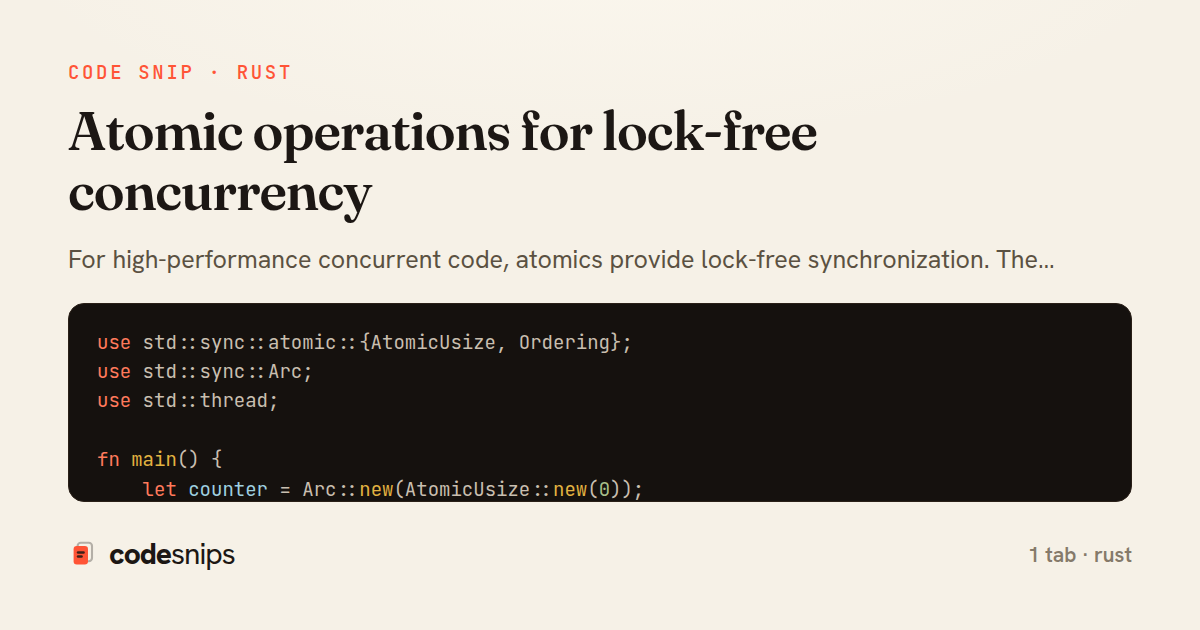
use std::sync::atomic::{AtomicUsize, Ordering};
use std::sync::Arc;
use std::thread;

fn main() {
    let counter = Arc::new(AtomicUsize::new(0));
    let mut handles = vec![];

    for _ in 0..10 {
        let counter_clone = Arc::clone(&counter);
        handles.push(thread::spawn(move || {
            counter_clone.fetch_add(1, Ordering::SeqCst);
        }));
    }

    for h in handles {
        h.join().unwrap();
    }
    println!("Count: {}", counter.load(Ordering::SeqCst));
}
1 file · rust
Explain with highlit
For high-performance concurrent code, atomics provide lock-free synchronization. The std::sync::atomic module has AtomicBool, AtomicUsize, etc., with operations like load, store, fetch_add, and compare_exchange. These compile to CPU-level atomic instructions. I use atomics for counters, flags, and simple shared state where mutexes would be overkill. The Ordering parameter (Relaxed, Acquire, Release, SeqCst) controls memory ordering, which is subtle but critical for correctness. For most cases, SeqCst is safe but slower; Relaxed is faster but requires careful reasoning. Atomics are the foundation of lock-free data structures, but I only reach for them when profiling shows locks are a bottleneck.
Related snips
rust
struct Config<'a> {
    name: &'a str,
    value: &'a str,
}

fn parse_config(line: &str) -> Config {
Lifetime annotations for flexible borrowing in structs
rust
lifetimes
borrowing
by Marcus Chen
1 tab
javascript
// Creating a Promise
const myPromise = new Promise((resolve, reject) => {
  const success = true;

  setTimeout(() => {
    if (success) {
Promises and async/await patterns for asynchronous JavaScript
javascript
promises
async-await
by Alex Chang
1 tab
rust
use crossbeam::channel::unbounded;
use std::thread;

fn main() {
    let (tx, rx) = unbounded();
Crossbeam for advanced concurrent data structures
rust
concurrency
lock-free
by Marcus Chen
1 tab
rust
use tracing::{info, instrument};

#[instrument]
fn process_request(user_id: u64) {
    info!(user_id, "Processing request");
    // Work happens here
tracing for structured logging and distributed tracing
rust
observability
tracing
by Marcus Chen
1 tab
rust
use std::sync::mpsc;
use std::thread;

fn main() {
    let (tx, rx) = mpsc::channel();
Channels (mpsc) for message passing between threads
rust
concurrency
channels
by Marcus Chen
1 tab
rust
use clap::Parser;

#[derive(Parser, Debug)]
#[command(author, version, about)]
struct Args {
    #[arg(short, long)]
clap for CLI argument parsing with derive macros
rust
cli
clap
by Marcus Chen
1 tab
Share this code
Here's the card — post it anywhere.