rust
13 lines · 1 tab
Marcus Chen
Jan 2026
1 tab
#![feature(asm)]

fn add_asm(a: u64, b: u64) -> u64 {
    let result: u64;
    unsafe {
        asm!(
            "add {0}, {1}",
            inlateout(reg) a => result,
            in(reg) b,
        );
    }
    result
}
1 file · rust
Explain with highlit
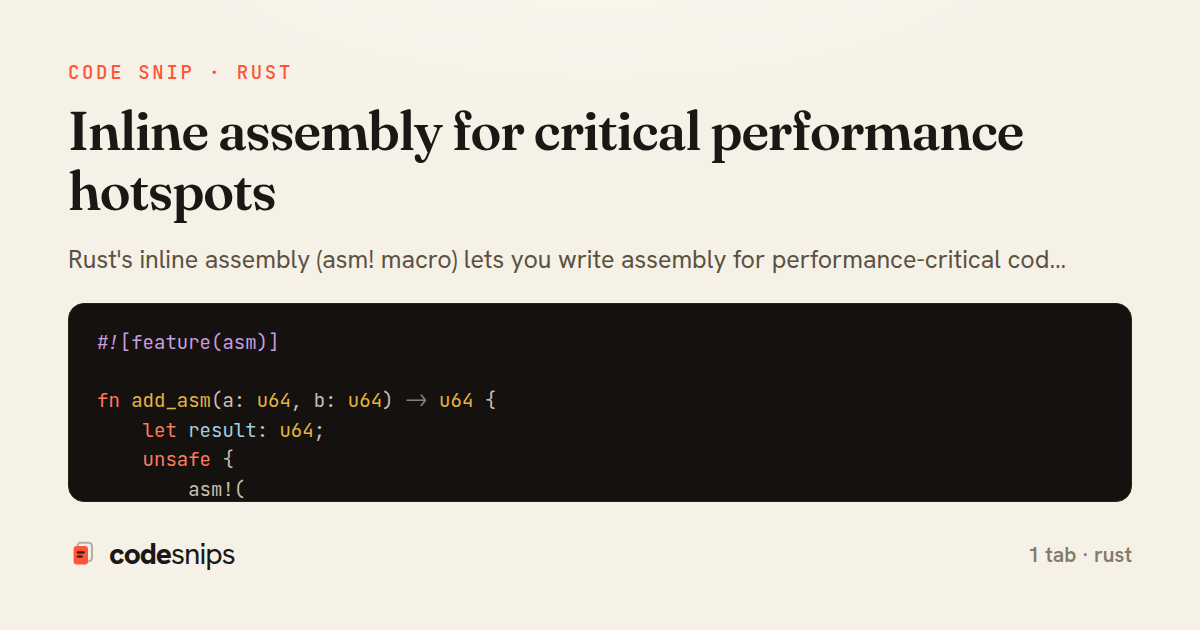
Rust's inline assembly (asm! macro) lets you write assembly for performance-critical code or to access hardware features. It's an unstable feature (nightly only) and requires unsafe. I use it sparingly for SIMD intrinsics not exposed by std::arch, cryptography, or tight loops where the compiler can't optimize well. The syntax is similar to GCC's inline assembly. You specify inputs, outputs, and clobbers. For most cases, Rust's abstractions are fast enough, but inline assembly is the escape hatch when you need it. Always benchmark before resorting to assembly, and document why it's necessary. It sacrifices portability and readability for performance.
Related snips
rust
struct Config<'a> {
    name: &'a str,
    value: &'a str,
}

fn parse_config(line: &str) -> Config {
Lifetime annotations for flexible borrowing in structs
rust
lifetimes
borrowing
by Marcus Chen
1 tab
ruby
require "csv"

class PeopleCsvStream
  include Enumerable

  HEADERS = %w[id full_name email signed_up_at plan].freeze
Resilient CSV Export as a Streamed Response
rails
performance
streaming
by codesnips
3 tabs
rust
use crossbeam::channel::unbounded;
use std::thread;

fn main() {
    let (tx, rx) = unbounded();
Crossbeam for advanced concurrent data structures
rust
concurrency
lock-free
by Marcus Chen
1 tab
ruby
Rails.application.configure do
  config.after_initialize do
    Bullet.enable = true
    Bullet.alert = false
    Bullet.bullet_logger = true
    Bullet.console = true
N+1 query detection with Bullet gem
rails
performance
activerecord
by Alex Kumar
2 tabs
rust
use tracing::{info, instrument};

#[instrument]
fn process_request(user_id: u64) {
    info!(user_id, "Processing request");
    // Work happens here
tracing for structured logging and distributed tracing
rust
observability
tracing
by Marcus Chen
1 tab
rust
use std::sync::mpsc;
use std::thread;

fn main() {
    let (tx, rx) = mpsc::channel();
Channels (mpsc) for message passing between threads
rust
concurrency
channels
by Marcus Chen
1 tab
Share this code
Here's the card — post it anywhere.