rust
10 lines · 1 tab
Marcus Chen
Jan 2026
1 tab
fn print_size<T: ?Sized>(value: &T) {
    // Can accept both &str and &String
    println!("Value: {:p}", value as *const T as *const ());
}

fn main() {
    let s = String::from("hello");
    print_size(&s);
    print_size("literal");
}
1 file · rust
Explain with highlit
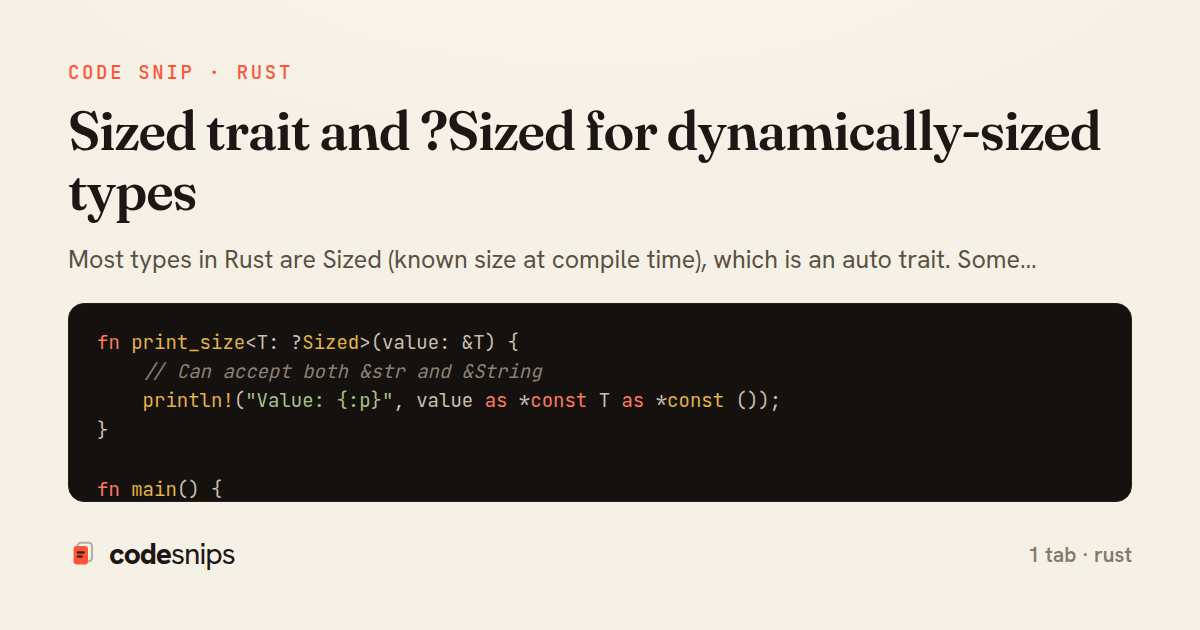
Most types in Rust are Sized (known size at compile time), which is an auto trait. Some types like str or [T] are !Sized (dynamically-sized types, DSTs). To work with DSTs, use &T or Box<T>. In generic code, T: Sized is the default bound. To accept DSTs, use T: ?Sized ("maybe sized"). I use ?Sized when writing generic functions for trait objects or slices. For example, a function taking &T where T: ?Sized can accept both &str and &String. Understanding Sized helps when you get confusing compiler errors about trait object sizes or return types. It's a subtle but important part of Rust's type system.
Related snips
rust
struct Config<'a> {
    name: &'a str,
    value: &'a str,
}

fn parse_config(line: &str) -> Config {
Lifetime annotations for flexible borrowing in structs
rust
lifetimes
borrowing
by Marcus Chen
1 tab
rust
use crossbeam::channel::unbounded;
use std::thread;

fn main() {
    let (tx, rx) = unbounded();
Crossbeam for advanced concurrent data structures
rust
concurrency
lock-free
by Marcus Chen
1 tab
rust
use tracing::{info, instrument};

#[instrument]
fn process_request(user_id: u64) {
    info!(user_id, "Processing request");
    // Work happens here
tracing for structured logging and distributed tracing
rust
observability
tracing
by Marcus Chen
1 tab
rust
use std::sync::mpsc;
use std::thread;

fn main() {
    let (tx, rx) = mpsc::channel();
Channels (mpsc) for message passing between threads
rust
concurrency
channels
by Marcus Chen
1 tab
rust
use clap::Parser;

#[derive(Parser, Debug)]
#[command(author, version, about)]
struct Args {
    #[arg(short, long)]
clap for CLI argument parsing with derive macros
rust
cli
clap
by Marcus Chen
1 tab
rust
macro_rules! create_function {
    ($func_name:ident) => {
        fn $func_name() {
            println!("Called {}", stringify!($func_name));
        }
    };
Declarative macros (macro_rules!) for code generation
rust
macros
metaprogramming
by Marcus Chen
1 tab
Share this code
Here's the card — post it anywhere.