rust
15 lines · 1 tab
Marcus Chen
Jan 2026
1 tab
use std::fmt::Display;

fn make_adder(x: i32) -> impl Fn(i32) -> i32 {
    move |y| x + y
}

fn format_value(val: i32) -> impl Display {
    format!("Value: {}", val)
}

fn main() {
    let add_five = make_adder(5);
    println!("{}", add_five(10));
    println!("{}", format_value(42));
}
1 file · rust
Explain with highlit
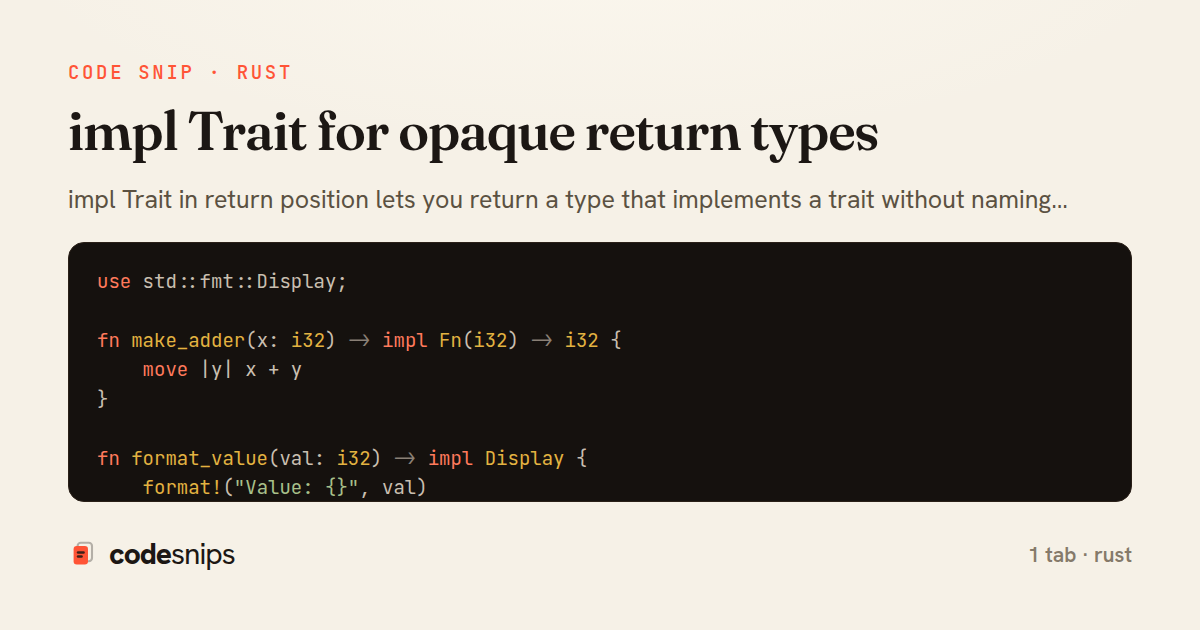
impl Trait in return position lets you return a type that implements a trait without naming it. This is useful for closures, iterators, or futures where the concrete type is complex or unnameable. The caller only knows it implements the trait. I use impl Trait for iterator chains (impl Iterator<Item=T>), async functions (which return impl Future), and anywhere the concrete type is an implementation detail. It's more ergonomic than Box<dyn Trait> because there's no heap allocation or dynamic dispatch. The limitation is that you can only return one concrete type (no branching between types). For multiple types, use trait objects or enums.
Related snips
rust
struct Config<'a> {
    name: &'a str,
    value: &'a str,
}

fn parse_config(line: &str) -> Config {
Lifetime annotations for flexible borrowing in structs
rust
lifetimes
borrowing
by Marcus Chen
1 tab
rust
use crossbeam::channel::unbounded;
use std::thread;

fn main() {
    let (tx, rx) = unbounded();
Crossbeam for advanced concurrent data structures
rust
concurrency
lock-free
by Marcus Chen
1 tab
rust
use tracing::{info, instrument};

#[instrument]
fn process_request(user_id: u64) {
    info!(user_id, "Processing request");
    // Work happens here
tracing for structured logging and distributed tracing
rust
observability
tracing
by Marcus Chen
1 tab
rust
use std::sync::mpsc;
use std::thread;

fn main() {
    let (tx, rx) = mpsc::channel();
Channels (mpsc) for message passing between threads
rust
concurrency
channels
by Marcus Chen
1 tab
rust
use clap::Parser;

#[derive(Parser, Debug)]
#[command(author, version, about)]
struct Args {
    #[arg(short, long)]
clap for CLI argument parsing with derive macros
rust
cli
clap
by Marcus Chen
1 tab
rust
macro_rules! create_function {
    ($func_name:ident) => {
        fn $func_name() {
            println!("Called {}", stringify!($func_name));
        }
    };
Declarative macros (macro_rules!) for code generation
rust
macros
metaprogramming
by Marcus Chen
1 tab
Share this code
Here's the card — post it anywhere.