rust
10 lines · 1 tab
Marcus Chen
Jan 2026
1 tab
use std::mem::MaybeUninit;

fn main() {
    let mut uninit: MaybeUninit<i32> = MaybeUninit::uninit();
    unsafe {
        uninit.as_mut_ptr().write(42);
        let value = uninit.assume_init();
        println!("Value: {}", value);
    }
}
1 file · rust
Explain with highlit
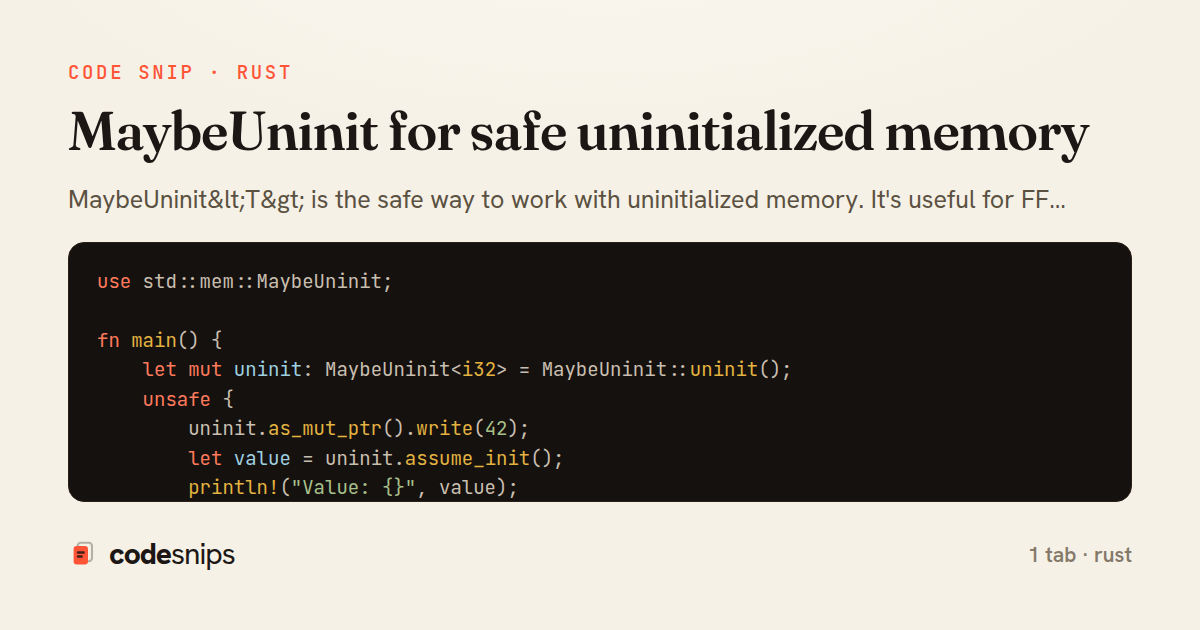
MaybeUninit<T> is the safe way to work with uninitialized memory. It's useful for FFI, performance-critical code, or when you need to initialize large arrays element-by-element. Unlike uninitialized variables (which are UB), MaybeUninit is explicitly designed for this. You write to it via .as_mut_ptr() or .write(), then call .assume_init() once it's fully initialized. The assumption is your responsibility, so it's still unsafe, but it's safer than raw pointers. I use it for zero-copy deserialization or when initializing large fixed-size buffers. It's a low-level tool but essential for certain patterns where you can't afford the overhead of default initialization.
Related snips
rust
struct Config<'a> {
    name: &'a str,
    value: &'a str,
}

fn parse_config(line: &str) -> Config {
Lifetime annotations for flexible borrowing in structs
rust
lifetimes
borrowing
by Marcus Chen
1 tab
ruby
require "csv"

class PeopleCsvStream
  include Enumerable

  HEADERS = %w[id full_name email signed_up_at plan].freeze
Resilient CSV Export as a Streamed Response
rails
performance
streaming
by codesnips
3 tabs
rust
use crossbeam::channel::unbounded;
use std::thread;

fn main() {
    let (tx, rx) = unbounded();
Crossbeam for advanced concurrent data structures
rust
concurrency
lock-free
by Marcus Chen
1 tab
ruby
Rails.application.configure do
  config.after_initialize do
    Bullet.enable = true
    Bullet.alert = false
    Bullet.bullet_logger = true
    Bullet.console = true
N+1 query detection with Bullet gem
rails
performance
activerecord
by Alex Kumar
2 tabs
rust
use tracing::{info, instrument};

#[instrument]
fn process_request(user_id: u64) {
    info!(user_id, "Processing request");
    // Work happens here
tracing for structured logging and distributed tracing
rust
observability
tracing
by Marcus Chen
1 tab
rust
use std::sync::mpsc;
use std::thread;

fn main() {
    let (tx, rx) = mpsc::channel();
Channels (mpsc) for message passing between threads
rust
concurrency
channels
by Marcus Chen
1 tab
Share this code
Here's the card — post it anywhere.