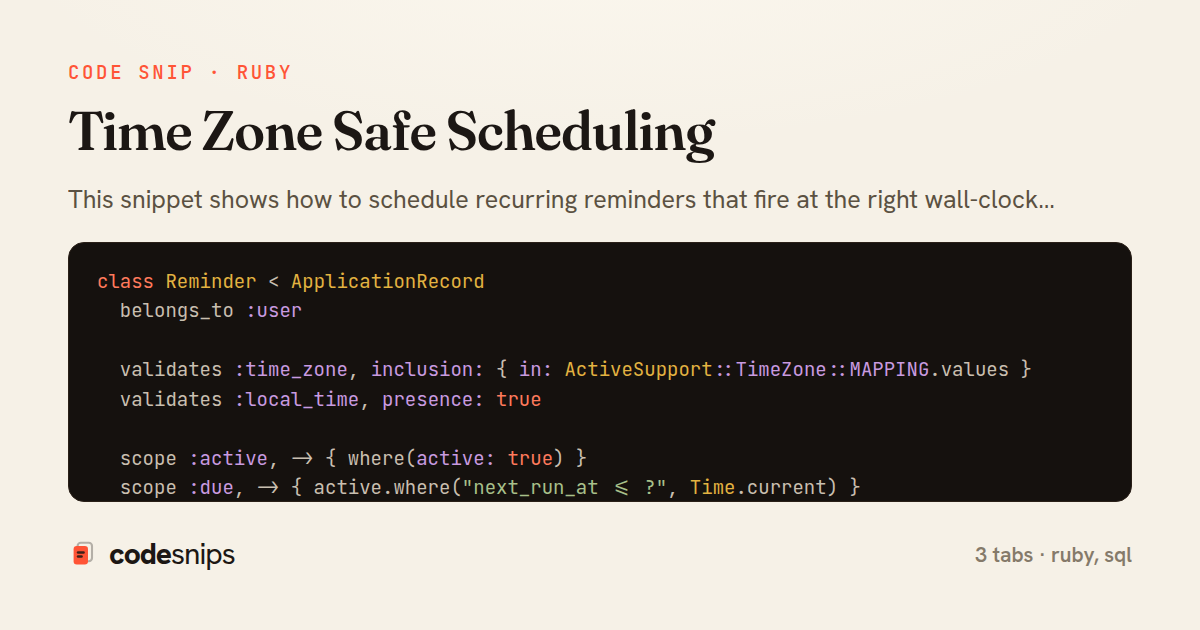
class Reminder < ApplicationRecord
  belongs_to :user

  validates :time_zone, inclusion: { in: ActiveSupport::TimeZone::MAPPING.values }
  validates :local_time, presence: true

  scope :active, -> { where(active: true) }
  scope :due, -> { active.where("next_run_at <= ?", Time.current) }

  before_validation :ensure_next_run_at, on: :create

  def zone
    ActiveSupport::TimeZone[time_zone]
  end

  def reschedule!
    update!(next_run_at: compute_next_run_at(after: zone.now))
  end

  def compute_next_run_at(after: nil)
    reference = after || zone.now
    candidate = reference.change(hour: local_time.hour, min: local_time.min, sec: 0)
    candidate += 1.day if candidate <= reference
    candidate.utc
  end

  private

  def ensure_next_run_at
    self.next_run_at ||= compute_next_run_at
  end
end
class ReminderScheduler
  include Sidekiq::Job

  sidekiq_options queue: :scheduling, retry: 3

  def perform
    Reminder.due.find_each(batch_size: 200) do |reminder|
      deliver(reminder)
    end
  end

  private

  def deliver(reminder)
    reminder.with_advisory_lock("reminder-#{reminder.id}", timeout_seconds: 0) do
      reminder.reload
      return unless reminder.active? && reminder.next_run_at <= Time.current

      ReminderMailer.notify(reminder).deliver_later
      reminder.reschedule!
    end
  end
end
CREATE TABLE reminders (
  id           bigserial PRIMARY KEY,
  user_id      bigint      NOT NULL REFERENCES users(id),
  local_time   time        NOT NULL,
  time_zone    varchar     NOT NULL,
  next_run_at  timestamptz NOT NULL,
  active       boolean     NOT NULL DEFAULT true,
  created_at   timestamptz NOT NULL,
  updated_at   timestamptz NOT NULL
);

-- Only active reminders are polled, so keep the index small and hot.
CREATE INDEX index_reminders_on_due
  ON reminders (next_run_at)
  WHERE active = true;

CREATE INDEX index_reminders_on_user_id ON reminders (user_id);
This snippet shows how to schedule recurring reminders that fire at the right wall-clock time for each user, regardless of the server's zone or daylight-saving shifts. The core mistake in naive scheduling is storing a user's "9:00 AM" as an absolute UTC instant computed once; when DST changes, that instant drifts to 8:00 or 10:00 local. The fix is to persist the intent (a local time-of-day plus an IANA zone) and recompute the next absolute instant in that zone every time.
In Reminder model, the record stores local_time (a time column read as hour/minute), time_zone (an IANA identifier like America/Sao_Paulo), and next_run_at (a UTC timestamp). The zone helper wraps ActiveSupport::TimeZone, and compute_next_run_at does the real work: it takes "now" in the user's zone, builds a candidate at the requested hour and minute using change, and rolls forward a day if that moment already passed. Crucially it calls .utc only at the very end, so all arithmetic happens in local time where DST is handled correctly by ActiveSupport. The due scope selects rows whose next_run_at has arrived.
Because next_run_at is always derived, a spring-forward day that skips 2:00–3:00 AM won't produce a duplicated or missing fire — the zone object resolves the nearest valid local time. Storing the zone per row rather than globally means each user keeps their own schedule even as they travel or the app serves multiple regions.
In ReminderScheduler job, a periodic worker loads Reminder.due, and for each one uses with_advisory_lock plus a stale re-check to guarantee only one process delivers a given reminder — important when multiple Sidekiq workers poll the same table. After enqueueing delivery it calls reschedule!, which recomputes next_run_at from the same intent so the next occurrence lands on tomorrow's local local_time.
The schema.sql tab shows the backing table: a partial index on next_run_at limited to active rows keeps the due polling query fast even with millions of reminders. The trade-off of this recompute-on-demand approach is a small polling query cost, but it buys correctness across DST, leap scheduling, and per-user zones — far safer than precomputing a long horizon of UTC instants that silently rot.
Related snips
class CommentsController < ApplicationController
  before_action :set_post

  def create
    @comment = @post.comments.build(comment_params)
System test: asserting Turbo Stream responses
class Post < ApplicationRecord
  belongs_to :author, class_name: 'User'
  has_many :comments, dependent: :destroy

  scope :published, -> { where.not(published_at: nil).where('published_at <= ?', Time.current) }
  scope :draft, -> { where(published_at: nil) }
ActiveRecord scopes for reusable query logic
module Api
  module V1
    class UsersController < BaseController
      def show
        user = User.includes(:profile).find(params[:id])
ETags for conditional requests and caching
class PostsController < ApplicationController
  def index
    @posts = Post.includes(:author)
                 .order(created_at: :desc)
                 .page(params[:page])
                 .per(10)
Turbo Frames: infinite scroll with lazy-loading frame
package dbutil

import (
  "context"

  "github.com/jackc/pgconn"
Retry Postgres serialization failures with bounded attempts
require "csv"

class PeopleCsvStream
  include Enumerable

  HEADERS = %w[id full_name email signed_up_at plan].freeze
Resilient CSV Export as a Streamed Response
Share this code
Here's the card — post it anywhere.