php
115 lines · 3 tabs
Carlos Mendez
Jan 2026
3 tabs
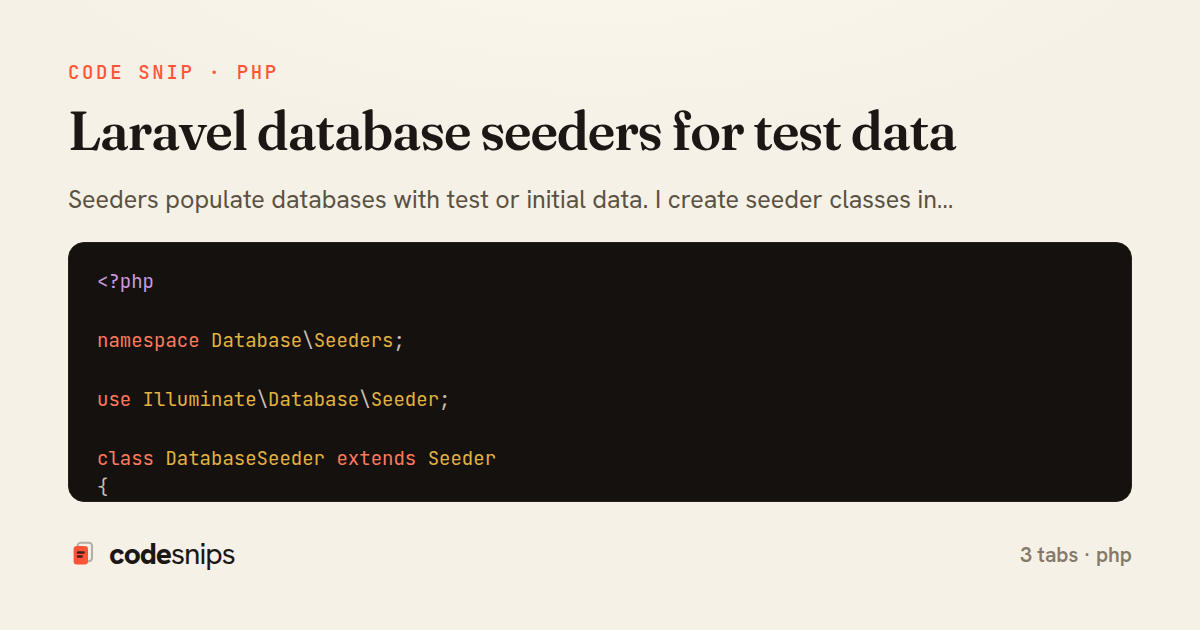
<?php

namespace Database\Seeders;

use Illuminate\Database\Seeder;

class DatabaseSeeder extends Seeder
{
    public function run(): void
    {
        if (app()->environment('production')) {
            $this->command->warn('Skipping seeders in production');
            return;
        }

        $this->call([
            UserSeeder::class,
            CategorySeeder::class,
            PostSeeder::class,
            CommentSeeder::class,
        ]);
    }
}
<?php

namespace Database\Seeders;

use App\Models\Post;
use App\Models\User;
use App\Models\Tag;
use Illuminate\Database\Seeder;

class PostSeeder extends Seeder
{
    public function run(): void
    {
        $users = User::all();
        $tags = Tag::all();

        // Create 50 published posts
        Post::factory()
            ->count(50)
            ->published()
            ->create()
            ->each(function ($post) use ($users, $tags) {
                // Assign random author
                $post->user_id = $users->random()->id;
                $post->save();

                // Attach random tags
                $post->tags()->attach(
                    $tags->random(rand(1, 5))->pluck('id')
                );

                // Create comments
                $post->comments()
                    ->createMany(
                        \App\Models\Comment::factory()
                            ->count(rand(0, 10))
                            ->make()
                            ->toArray()
                    );
            });

        // Create 20 draft posts
        Post::factory()
            ->count(20)
            ->draft()
            ->create();
    }
}
<?php

namespace Database\Factories;

use App\Models\User;
use Illuminate\Database\Eloquent\Factories\Factory;

class PostFactory extends Factory
{
    public function definition(): array
    {
        return [
            'user_id' => User::factory(),
            'title' => fake()->sentence(),
            'slug' => fake()->slug(),
            'body' => fake()->paragraphs(5, true),
            'excerpt' => fake()->paragraph(),
            'views' => fake()->numberBetween(0, 10000),
            'published_at' => null,
        ];
    }

    public function published(): static
    {
        return $this->state(fn (array $attributes) => [
            'published_at' => fake()->dateTimeBetween('-1 year', 'now'),
        ]);
    }

    public function draft(): static
    {
        return $this->state(fn (array $attributes) => [
            'published_at' => null,
        ]);
    }

    public function featured(): static
    {
        return $this->state(fn (array $attributes) => [
            'is_featured' => true,
            'views' => fake()->numberBetween(5000, 50000),
        ]);
    }
}
3 files · php
Explain with highlit
Seeders populate databases with test or initial data. I create seeder classes in database/seeders with a run() method. The DatabaseSeeder orchestrates other seeders. For large datasets, I use factories with factory()->count(100)->create() for performance. Model factories define default attributes and states for variations. Seeders support environments—only run certain seeders in development. I use transactions in seeders to roll back on errors. The --class flag runs specific seeders without running all. Seeders are perfect for demo data, development databases, or initial application setup. Combined with migrations, they enable reproducible database states across environments.
Related snips
ruby
# Vulnerable: user input is concatenated directly into SQL.
email = params[:email]
password = params[:password]

sql = "SELECT * FROM users WHERE email = '#{email}' AND password_hash = '#{password}'"
user = ActiveRecord::Base.connection.execute(sql).first
SQL injection prevention with unsafe and safe query patterns
sql-injection
owasp
database
by Kai Nakamura
3 tabs
php
<?php

namespace App\Providers;

use App\Contracts\PaymentGateway;
use App\Services\StripePaymentGateway;
Laravel service container and dependency injection
laravel
dependency-injection
service-container
by Carlos Mendez
2 tabs
sql
-- EXPLAIN ANALYZE (actual execution statistics)
EXPLAIN ANALYZE
SELECT u.username, COUNT(o.id) AS order_count
FROM users u
LEFT JOIN orders o ON u.id = o.user_id
WHERE u.created_at >= '2024-01-01'
Advanced query optimization techniques
database
optimization
query-performance
by Maria Garcia
2 tabs
json
{
  "private": true,
  "scripts": {
    "dev": "vite",
    "build": "vite build"
  },
Laravel mix/Vite for asset compilation
laravel
vite
assets
by Carlos Mendez
4 tabs
python
from django.db.models import Count, Avg, Sum, Q, F
from django.views.generic import TemplateView
from products.models import Product, Order, OrderItem


class DashboardView(TemplateView):
Django aggregation with annotate for statistics
django
python
database
by Priya Sharma
1 tab
ruby
class ReportQuery
  SQL = <<~SQL.freeze
    SELECT date_trunc('day', events.created_at) AS day,
           count(*) AS total,
           count(*) FILTER (WHERE events.kind = 'purchase') AS purchases
    FROM events
Safe Raw SQL with exec_query + Binds
rails
activerecord
sql
by codesnips
2 tabs
Share this code
Here's the card — post it anywhere.