Carlos Mendez
Jan 2026
3 tabs
<?php

namespace App\Http\Controllers;

use App\Models\Post;
use Illuminate\Http\Request;

class PostController extends Controller
{
    public function index(Request $request)
    {
        // Standard pagination
        $posts = Post::query()
            ->with('author')
            ->when($request->search, fn ($q, $search) =>
                $q->where('title', 'like', "%{$search}%")
            )
            ->latest()
            ->paginate(20)
            ->withQueryString(); // Preserve search params

        return view('posts.index', compact('posts'));
    }

    public function infinite(Request $request)
    {
        // Cursor pagination for infinite scroll
        $posts = Post::query()
            ->latest('id')
            ->cursorPaginate(20);

        return response()->json($posts);
    }

    public function simple()
    {
        // Simple pagination (next/prev only, no page numbers)
        $posts = Post::latest()->simplePaginate(20);

        return view('posts.simple', compact('posts'));
    }

    public function api(Request $request)
    {
        // API pagination with custom meta
        $posts = Post::paginate(20);

        return response()->json([
            'data' => $posts->items(),
            'meta' => [
                'current_page' => $posts->currentPage(),
                'last_page' => $posts->lastPage(),
                'per_page' => $posts->perPage(),
                'total' => $posts->total(),
            ],
            'links' => [
                'first' => $posts->url(1),
                'last' => $posts->url($posts->lastPage()),
                'prev' => $posts->previousPageUrl(),
                'next' => $posts->nextPageUrl(),
            ],
        ]);
    }
}
@foreach ($posts as $post)
    <article>
        <h2>{{ $post->title }}</h2>
        <p>{{ $post->excerpt }}</p>
    </article>
@endforeach

{{-- Default pagination links --}}
{{ $posts->links() }}

{{-- Custom pagination view --}}
{{ $posts->links('vendor.pagination.tailwind') }}

{{-- Bootstrap pagination --}}
{{ $posts->links('pagination::bootstrap-5') }}

{{-- Customize page range --}}
{{ $posts->onEachSide(2)->links() }}

{{-- Show pagination info --}}
<p>
    Showing {{ $posts->firstItem() }} to {{ $posts->lastItem() }}
    of {{ $posts->total() }} results
</p>
@if ($paginator->hasPages())
<nav>
<ul class="pagination">
{{-- Previous Page Link --}}
@if ($paginator->onFirstPage())
<li class="disabled"><span>«</span></li>
@else
<li><a href="{{ $paginator->previousPageUrl() }}">«</a></li>
@endif
{{-- Pagination Elements --}}
@foreach ($elements as $element)
@if (is_string($element))
<li class="disabled"><span>{{ $element }}</span></li>
@endif
@if (is_array($element))
@foreach ($element as $page => $url)
@if ($page == $paginator->currentPage())
<li class="active"><span>{{ $page }}</span></li>
@else
<li><a href="{{ $url }}">{{ $page }}</a></li>
@endif
@endforeach
@endif
@endforeach
{{-- Next Page Link --}}
@if ($paginator->hasMorePages())
<li><a href="{{ $paginator->nextPageUrl() }}">»</a></li>
@else
<li class="disabled"><span>»</span></li>
@endif
</ul>
</nav>
@endif
3 files · php, blade
Explain with highlit
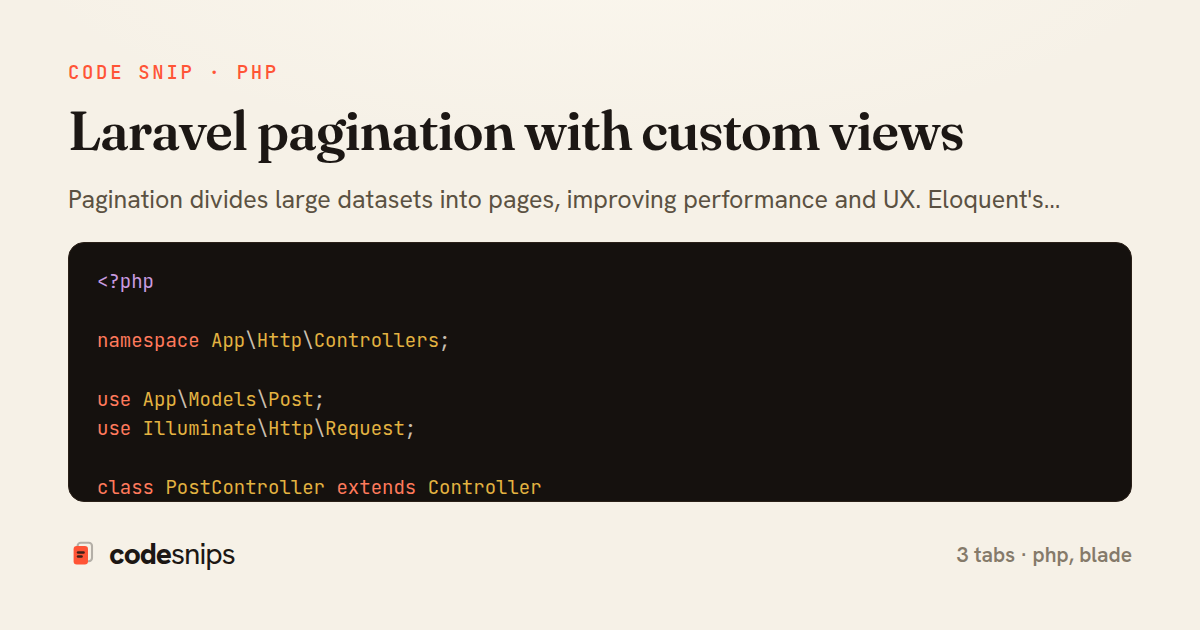
Pagination divides large datasets into pages, improving performance and UX. Eloquent's paginate() method returns a paginator with data and metadata. The links() method renders pagination UI. I customize per-page counts with paginate(50). Simple pagination uses simplePaginate() for next/prev only. Cursor pagination with cursorPaginate() handles infinite scrolling efficiently. Custom pagination views override default Blade templates. API pagination returns JSON with meta and links. The onEachSide() method controls visible page numbers. Pagination preserves query strings via withQueryString(). For complex queries, paginateResults() calculates totals manually. This handles millions of records efficiently.
Related snips
ruby
class PostsController < ApplicationController
  def index
    @posts = Post.includes(:author)
                 .order(created_at: :desc)
                 .page(params[:page])
                 .per(10)
Turbo Frames: infinite scroll with lazy-loading frame
rails
turbo
hotwire
by codesnips
4 tabs
php
<?php

namespace App\Providers;

use App\Contracts\PaymentGateway;
use App\Services\StripePaymentGateway;
Laravel service container and dependency injection
laravel
dependency-injection
service-container
by Carlos Mendez
2 tabs
json
{
  "private": true,
  "scripts": {
    "dev": "vite",
    "build": "vite build"
  },
Laravel mix/Vite for asset compilation
laravel
vite
assets
by Carlos Mendez
4 tabs
php
<?php

use Illuminate\Database\Migrations\Migration;
use Illuminate\Database\Schema\Blueprint;
use Illuminate\Support\Facades\Schema;
Laravel database migrations for schema management
laravel
migrations
database
by Carlos Mendez
3 tabs
ruby
module Paginatable
  extend ActiveSupport::Concern

  MAX_PER_PAGE = 100
  DEFAULT_PER_PAGE = 25
API Pagination Headers (Link + Total)
rails
pagination
rest-api
by codesnips
3 tabs
php
<?php

namespace App\Http\Requests;

use Illuminate\Foundation\Http\FormRequest;
use Illuminate\Validation\Rule;
Laravel form requests for validation
laravel
validation
form-requests
by Carlos Mendez
2 tabs
Share this code
Here's the card — post it anywhere.