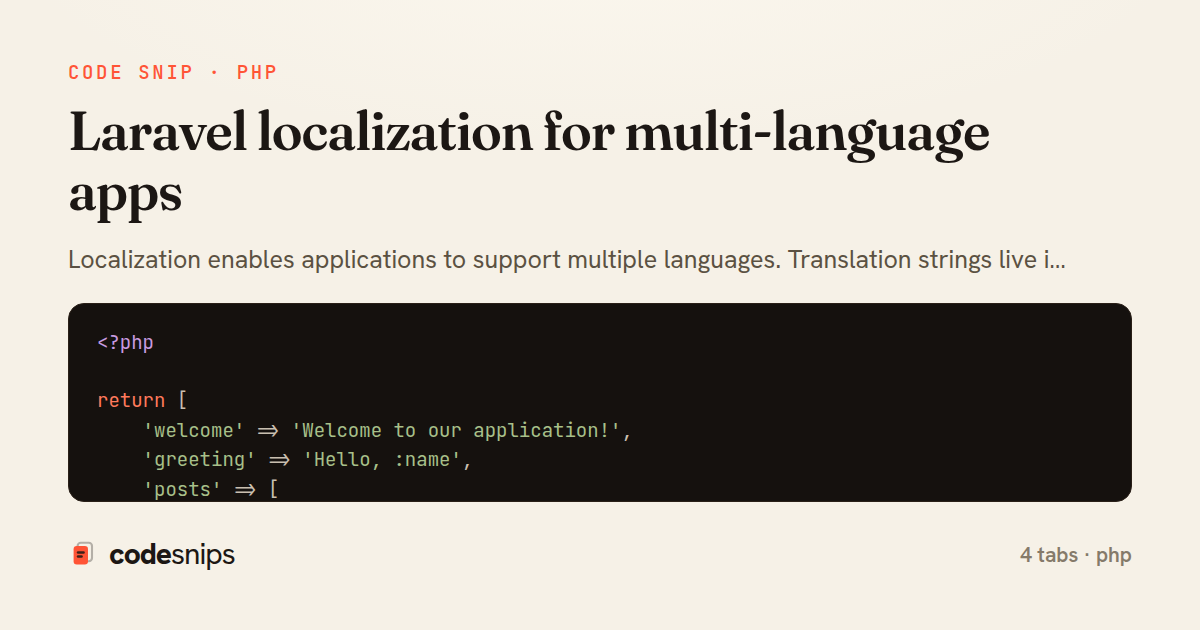
<?php

return [
    'welcome' => 'Welcome to our application!',
    'greeting' => 'Hello, :name',
    'posts' => [
        'created' => 'Post created successfully',
        'updated' => 'Post updated successfully',
        'deleted' => 'Post deleted successfully',
    ],
    'items_count' => '{0} No items|{1} One item|[2,*] :count items',
    'time_ago' => ':time ago',
];
<?php

return [
    'welcome' => '¡Bienvenido a nuestra aplicación!',
    'greeting' => 'Hola, :name',
    'posts' => [
        'created' => 'Publicación creada exitosamente',
        'updated' => 'Publicación actualizada exitosamente',
        'deleted' => 'Publicación eliminada exitosamente',
    ],
    'items_count' => '{0} Sin artículos|{1} Un artículo|[2,*] :count artículos',
    'time_ago' => 'hace :time',
];
<?php

namespace App\Http\Middleware;

use Closure;
use Illuminate\Http\Request;
use Illuminate\Support\Facades\App;

class SetLocale
{
    public function handle(Request $request, Closure $next)
    {
        // Check URL parameter
        if ($request->has('lang')) {
            $locale = $request->get('lang');
            session(['locale' => $locale]);
        }

        // Get from session or user preference
        $locale = session('locale')
            ?? $request->user()?->locale
            ?? config('app.locale');

        // Validate locale
        if (in_array($locale, config('app.available_locales'))) {
            App::setLocale($locale);
        }

        return $next($request);
    }
}
<?php

// Simple translation
echo __('messages.welcome');

// With parameters
echo __('messages.greeting', ['name' => 'Carlos']);

// Nested keys
echo __('messages.posts.created');

// Pluralization
echo trans_choice('messages.items_count', 0); // "No items"
echo trans_choice('messages.items_count', 1); // "One item"
echo trans_choice('messages.items_count', 5); // "5 items"

// In Blade
@lang('messages.welcome')
{{ __('messages.greeting', ['name' => $user->name]) }}

// JSON translations
echo __('This is a simple string');

// Change locale
App::setLocale('es');

// Get current locale
$locale = App::getLocale();

// Carbon localization
$date = now()->locale('es')->diffForHumans(); // "hace 2 horas"
Localization enables applications to support multiple languages. Translation strings live in lang/ directories organized by locale. I use the __() helper or @lang directive for translations. The trans_choice() function handles pluralization rules. Laravel determines locale from requests, user preferences, or config. The App::setLocale() method changes language dynamically. Translation files support arrays, parameters, and pluralization. For database-driven translations, packages like laravel-translatable work well. Validation messages auto-translate via language files. Date/time localization uses Carbon with setLocale(). This architecture makes adding languages trivial—just add translation files without touching code.
Related snips
<?php

namespace App\Providers;

use App\Contracts\PaymentGateway;
use App\Services\StripePaymentGateway;
Laravel service container and dependency injection
{
  "private": true,
  "scripts": {
    "dev": "vite",
    "build": "vite build"
  },
Laravel mix/Vite for asset compilation
<?php

use Illuminate\Database\Migrations\Migration;
use Illuminate\Database\Schema\Blueprint;
use Illuminate\Support\Facades\Schema;
Laravel database migrations for schema management
<?php

namespace App\Http\Requests;

use Illuminate\Foundation\Http\FormRequest;
use Illuminate\Validation\Rule;
Laravel form requests for validation
<?php

use Illuminate\Database\Migrations\Migration;
use Illuminate\Database\Schema\Blueprint;
use Illuminate\Support\Facades\Schema;
Laravel soft deletes for data retention
<?php

namespace App\Notifications;

use App\Models\Post;
use Illuminate\Bus\Queueable;
Laravel notifications for multi-channel messaging
Share this code
Here's the card — post it anywhere.