swift
132 lines · 2 tabs
Sofia Martinez
Jan 2026
2 tabs
import XCTest
import Combine
@testable import MyApp

class PostsViewModelTests: XCTestCase {
    var viewModel: PostsViewModel!
    var mockNetworkService: MockNetworkService!
    var cancellables: Set<AnyCancellable>!

    override func setUp() {
        super.setUp()
        mockNetworkService = MockNetworkService()
        viewModel = PostsViewModel(networkService: mockNetworkService)
        cancellables = []
    }

    override func tearDown() {
        viewModel = nil
        mockNetworkService = nil
        cancellables = nil
        super.tearDown()
    }

    func testLoadPostsSuccess() {
        // Arrange
        let expectedPosts = [
            Post(id: 1, title: "Test Post", body: "Body", authorId: 1)
        ]
        mockNetworkService.postsToReturn = expectedPosts

        let expectation = XCTestExpectation(description: "Posts loaded")

        viewModel.$posts
            .dropFirst() // Skip initial empty state
            .sink { posts in
                XCTAssertEqual(posts.count, 1)
                XCTAssertEqual(posts.first?.title, "Test Post")
                expectation.fulfill()
            }
            .store(in: &cancellables)

        // Act
        viewModel.loadPosts()

        // Assert
        wait(for: [expectation], timeout: 1.0)
        XCTAssertFalse(viewModel.isLoading)
        XCTAssertNil(viewModel.errorMessage)
    }

    func testLoadPostsFailure() {
        // Arrange
        mockNetworkService.shouldFail = true

        let expectation = XCTestExpectation(description: "Error received")

        viewModel.$errorMessage
            .dropFirst()
            .sink { error in
                if error != nil {
                    expectation.fulfill()
                }
            }
            .store(in: &cancellables)

        // Act
        viewModel.loadPosts()

        // Assert
        wait(for: [expectation], timeout: 1.0)
        XCTAssertNotNil(viewModel.errorMessage)
        XCTAssertTrue(viewModel.posts.isEmpty)
    }

    func testSearchDebounce() {
        // Test that search is debounced
        let expectation = XCTestExpectation(description: "Search executed once")
        expectation.expectedFulfillmentCount = 1

        mockNetworkService.searchCallCount = 0

        // Act - rapid changes
        viewModel.searchQuery = "t"
        viewModel.searchQuery = "te"
        viewModel.searchQuery = "tes"
        viewModel.searchQuery = "test"

        DispatchQueue.main.asyncAfter(deadline: .now() + 0.5) {
            // Assert - only one search call after debounce
            XCTAssertEqual(self.mockNetworkService.searchCallCount, 1)
            expectation.fulfill()
        }

        wait(for: [expectation], timeout: 1.0)
    }
}
import Foundation
import Combine

class MockNetworkService: NetworkServiceProtocol {
    var postsToReturn: [Post] = []
    var shouldFail = false
    var searchCallCount = 0

    func fetchPosts() -> AnyPublisher<[Post], Error> {
        if shouldFail {
            return Fail(error: URLError(.badServerResponse))
                .eraseToAnyPublisher()
        }

        return Just(postsToReturn)
            .setFailureType(to: Error.self)
            .eraseToAnyPublisher()
    }

    func searchPosts(query: String) -> AnyPublisher<[Post], Error> {
        searchCallCount += 1

        if shouldFail {
            return Fail(error: URLError(.badServerResponse))
                .eraseToAnyPublisher()
        }

        let filtered = postsToReturn.filter { post in
            post.title.localizedCaseInsensitiveContains(query)
        }

        return Just(filtered)
            .setFailureType(to: Error.self)
            .eraseToAnyPublisher()
    }
}
2 files · swift
Explain with highlit
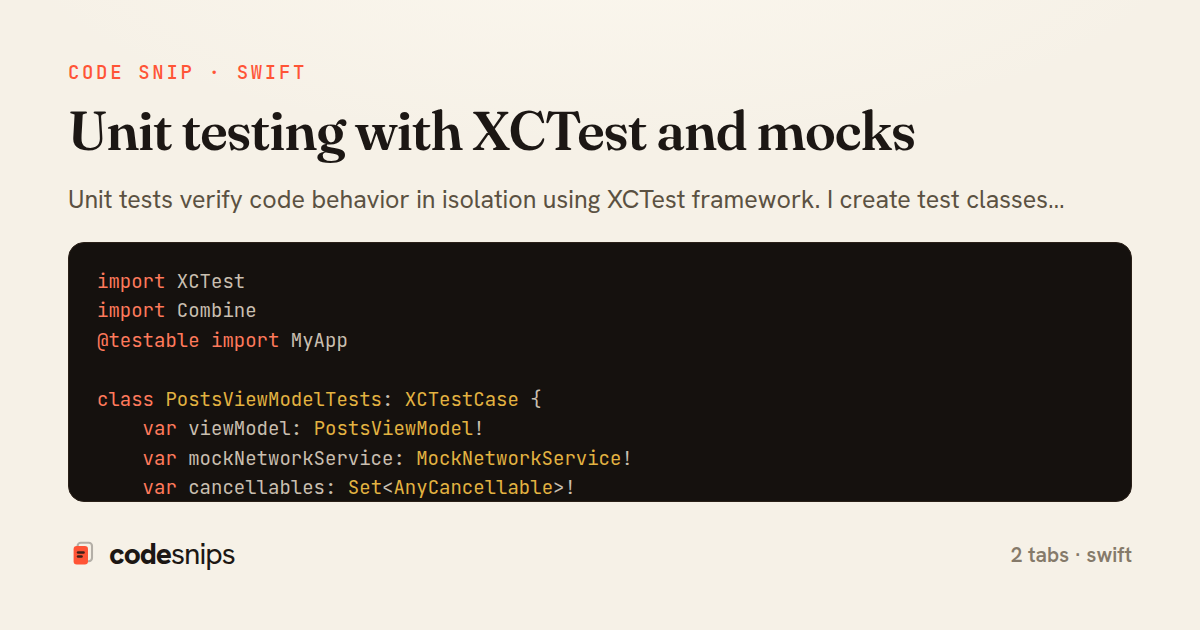
Unit tests verify code behavior in isolation using XCTest framework. I create test classes inheriting from XCTestCase with test prefixed methods. Each test has arrange-act-assert structure: set up dependencies, execute code, verify results with XCTAssert methods. For testing ViewModels, I inject mock dependencies through initializers to control external behavior. Mocks implement protocols, returning predetermined values or tracking method calls. Async tests use expectations—create with expectation(description:), fulfill when async completes, wait with waitForExpectations. Test-driven development guides design toward testable, decoupled code. Running tests frequently catches regressions early.
Related snips
ruby
class CommentsController < ApplicationController
  before_action :set_post

  def create
    @comment = @post.comments.build(comment_params)
System test: asserting Turbo Stream responses
rails
hotwire
turbo
by codesnips
4 tabs
swift
import Combine
import Foundation

class SearchViewModel: ObservableObject {
    @Published var searchQuery = ""
    @Published var results: [SearchResult] = []
Combine operators for data transformation
swift
combine
reactive
by Sofia Martinez
1 tab
swift
import SwiftUI

struct ContentView: View {
    @State private var username = ""
    @State private var isLoggedIn = false
    @StateObject private var viewModel = LoginViewModel()
SwiftUI declarative UI with state management
swift
swiftui
ios
by Sofia Martinez
2 tabs
rust
use my_crate::add;

#[test]
fn test_public_api() {
    assert_eq!(add(3, 4), 7);
}
Integration tests in tests/ directory
rust
testing
integration
by Marcus Chen
1 tab
swift
import SwiftUI

struct CardModifier: ViewModifier {
    var backgroundColor: Color = .white
    var cornerRadius: CGFloat = 12
    var shadowRadius: CGFloat = 5
Custom SwiftUI view modifiers for reusability
swift
swiftui
ios
by Sofia Martinez
2 tabs
kotlin
package com.example.myapp.data.repository

import com.example.myapp.data.local.PostDao
import com.example.myapp.data.local.PostEntity
import com.example.myapp.data.remote.ApiService
import com.example.myapp.models.Post
Unit testing with JUnit and MockK
kotlin
android
testing
by Alex Chen
2 tabs
Share this code
Here's the card — post it anywhere.