swift
117 lines · 1 tab
Sofia Martinez
Jan 2026
1 tab
import Foundation
import UIKit

class ImageProcessor {
    // Background processing with main thread updates
    func processImage(_ image: UIImage, completion: @escaping (UIImage?) -> Void) {
        DispatchQueue.global(qos: .userInitiated).async {
            // Heavy processing on background thread
            let processedImage = self.applyFilters(to: image)

            // Return to main thread for UI updates
            DispatchQueue.main.async {
                completion(processedImage)
            }
        }
    }

    private func applyFilters(to image: UIImage) -> UIImage? {
        // Simulate heavy processing
        Thread.sleep(forTimeInterval: 2)
        return image
    }
}

// Dispatch groups for coordinating multiple tasks
class DataSynchronizer {
    func syncAllData(completion: @escaping (Bool) -> Void) {
        let group = DispatchGroup()
        var hasError = false

        group.enter()
        fetchPosts { success in
            if !success { hasError = true }
            group.leave()
        }

        group.enter()
        fetchComments { success in
            if !success { hasError = true }
            group.leave()
        }

        group.enter()
        fetchUsers { success in
            if !success { hasError = true }
            group.leave()
        }

        group.notify(queue: .main) {
            completion(!hasError)
        }
    }

    private func fetchPosts(completion: @escaping (Bool) -> Void) {
        DispatchQueue.global().async {
            Thread.sleep(forTimeInterval: 1)
            completion(true)
        }
    }

    private func fetchComments(completion: @escaping (Bool) -> Void) {
        DispatchQueue.global().async {
            Thread.sleep(forTimeInterval: 1)
            completion(true)
        }
    }

    private func fetchUsers(completion: @escaping (Bool) -> Void) {
        DispatchQueue.global().async {
            Thread.sleep(forTimeInterval: 1)
            completion(true)
        }
    }
}

// Custom serial queue for thread-safe access
class ThreadSafeCache<Key: Hashable, Value> {
    private var cache: [Key: Value] = [:]
    private let queue = DispatchQueue(label: "com.myapp.cache", attributes: .concurrent)

    func get(_ key: Key) -> Value? {
        queue.sync {
            cache[key]
        }
    }

    func set(_ value: Value, forKey key: Key) {
        queue.async(flags: .barrier) {
            self.cache[key] = value
        }
    }

    func remove(_ key: Key) {
        queue.async(flags: .barrier) {
            self.cache.removeValue(forKey: key)
        }
    }
}

// Debouncing with dispatch work items
class SearchDebouncer {
    private var workItem: DispatchWorkItem?
    private let delay: TimeInterval

    init(delay: TimeInterval = 0.3) {
        self.delay = delay
    }

    func debounce(action: @escaping () -> Void) {
        workItem?.cancel()

        let newWorkItem = DispatchWorkItem(block: action)
        workItem = newWorkItem

        DispatchQueue.main.asyncAfter(deadline: .now() + delay, execute: newWorkItem)
    }
}
1 file · swift
Explain with highlit
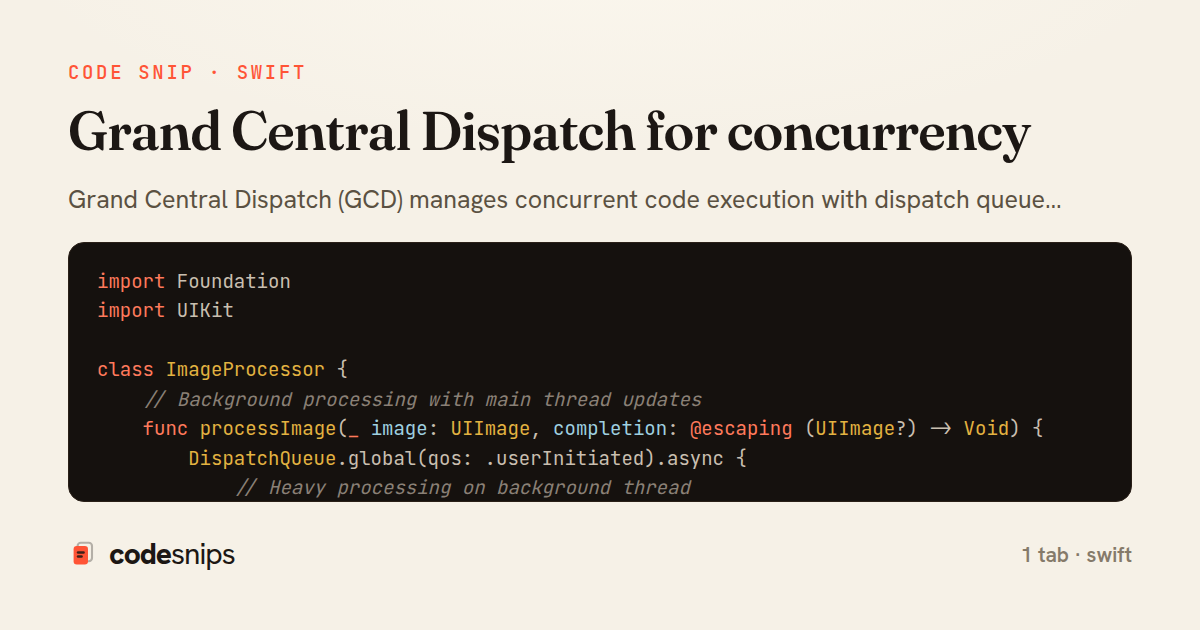
Grand Central Dispatch (GCD) manages concurrent code execution with dispatch queues. The main queue handles UI updates—I use DispatchQueue.main.async to return to main thread after background work. Global queues provide concurrent background execution with different quality of service levels: .userInteractive, .userInitiated, .utility, and .background. Custom queues offer fine-grained control over concurrency. Dispatch groups coordinate multiple async tasks, waiting for all to complete with group.notify(). Semaphores limit concurrent access to resources. For modern Swift, async/await is preferred, but GCD remains essential for legacy code and certain use cases like debouncing and rate limiting.
Related snips
javascript
// Creating a Promise
const myPromise = new Promise((resolve, reject) => {
  const success = true;

  setTimeout(() => {
    if (success) {
Promises and async/await patterns for asynchronous JavaScript
javascript
promises
async-await
by Alex Chang
1 tab
rust
use crossbeam::channel::unbounded;
use std::thread;

fn main() {
    let (tx, rx) = unbounded();
Crossbeam for advanced concurrent data structures
rust
concurrency
lock-free
by Marcus Chen
1 tab
rust
use std::sync::mpsc;
use std::thread;

fn main() {
    let (tx, rx) = mpsc::channel();
Channels (mpsc) for message passing between threads
rust
concurrency
channels
by Marcus Chen
1 tab
typescript
export type Settled<R> =
  | { status: 'fulfilled'; value: R }
  | { status: 'rejected'; reason: unknown };

export interface ConcurrencyOptions {
  limit: number;
Simple concurrency limiter for batch operations
node
concurrency
async
by codesnips
2 tabs
swift
import Combine
import Foundation

class SearchViewModel: ObservableObject {
    @Published var searchQuery = ""
    @Published var results: [SearchResult] = []
Combine operators for data transformation
swift
combine
reactive
by Sofia Martinez
1 tab
swift
import SwiftUI

struct ContentView: View {
    @State private var username = ""
    @State private var isLoggedIn = false
    @StateObject private var viewModel = LoginViewModel()
SwiftUI declarative UI with state management
swift
swiftui
ios
by Sofia Martinez
2 tabs
Share this code
Here's the card — post it anywhere.