kotlin
144 lines · 3 tabs
Alex Chen
Jan 2026
3 tabs
package com.example.myapp

import android.app.Application
import dagger.hilt.android.HiltAndroidApp

@HiltAndroidApp
class MyApplication : Application() {
    override fun onCreate() {
        super.onCreate()
        // Application initialization
    }
}
package com.example.myapp.di

import com.example.myapp.data.repository.*
import dagger.Binds
import dagger.Module
import dagger.hilt.InstallIn
import dagger.hilt.components.SingletonComponent
import javax.inject.Singleton

@Module
@InstallIn(SingletonComponent::class)
abstract class RepositoryModule {

    @Binds
    @Singleton
    abstract fun bindPostRepository(
        impl: PostRepositoryImpl
    ): PostRepository

    @Binds
    @Singleton
    abstract fun bindUserRepository(
        impl: UserRepositoryImpl
    ): UserRepository
}

@Module
@InstallIn(SingletonComponent::class)
object DataModule {

    @Provides
    @Singleton
    fun provideDatabase(
        @ApplicationContext context: Context
    ): AppDatabase = AppDatabase.getDatabase(context)

    @Provides
    @Singleton
    fun providePostDao(database: AppDatabase): PostDao =
        database.postDao()

    @Provides
    @Singleton
    fun provideCommentDao(database: AppDatabase): CommentDao =
        database.commentDao()
}
package com.example.myapp.data.repository

import com.example.myapp.data.local.PostDao
import com.example.myapp.data.remote.ApiService
import kotlinx.coroutines.flow.Flow
import kotlinx.coroutines.flow.map
import javax.inject.Inject
import javax.inject.Singleton

interface PostRepository {
    suspend fun fetchPosts(): Result<List<Post>>
    fun observePosts(): Flow<List<Post>>
    suspend fun getPost(id: Int): Result<Post>
    suspend fun createPost(post: Post): Result<Post>
}

@Singleton
class PostRepositoryImpl @Inject constructor(
    private val apiService: ApiService,
    private val postDao: PostDao,
    private val mapper: PostMapper
) : PostRepository {

    override suspend fun fetchPosts(): Result<List<Post>> = try {
        val response = apiService.getPosts()
        val posts = response.posts

        // Cache to database
        postDao.insertAll(posts.map { mapper.toEntity(it) })

        Result.success(posts)
    } catch (e: Exception) {
        // Return cached data on error
        val cachedPosts = postDao.getAllPosts().map { mapper.fromEntity(it) }
        if (cachedPosts.isNotEmpty()) {
            Result.success(cachedPosts)
        } else {
            Result.failure(e)
        }
    }

    override fun observePosts(): Flow<List<Post>> =
        postDao.observePosts()
            .map { entities -> entities.map { mapper.fromEntity(it) } }

    override suspend fun getPost(id: Int): Result<Post> = try {
        val response = apiService.getPost(id)
        Result.success(response.post)
    } catch (e: Exception) {
        postDao.getPost(id)?.let {
            Result.success(mapper.fromEntity(it))
        } ?: Result.failure(e)
    }

    override suspend fun createPost(post: Post): Result<Post> = try {
        val request = CreatePostRequest(
            title = post.title,
            body = post.body
        )
        val response = apiService.createPost(request)
        postDao.insert(mapper.toEntity(response.post))
        Result.success(response.post)
    } catch (e: Exception) {
        Result.failure(e)
    }
}

class PostMapper @Inject constructor() {
    fun toEntity(post: Post): PostEntity = PostEntity(
        id = post.id,
        title = post.title,
        body = post.body,
        authorId = post.authorId,
        createdAt = post.createdAt,
        likesCount = post.likesCount
    )

    fun fromEntity(entity: PostEntity): Post = Post(
        id = entity.id,
        title = entity.title,
        body = entity.body,
        authorId = entity.authorId,
        createdAt = entity.createdAt,
        likesCount = entity.likesCount
    )
}
3 files · kotlin
Explain with highlit
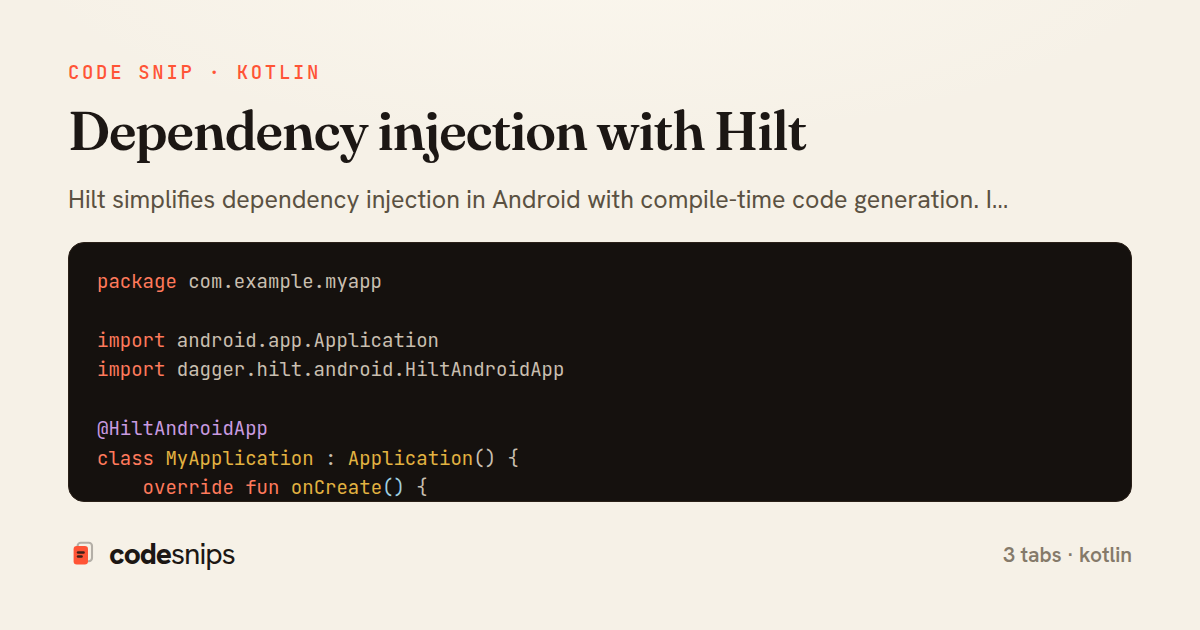
Hilt simplifies dependency injection in Android with compile-time code generation. I annotate Application class with @HiltAndroidApp and activities/fragments with @AndroidEntryPoint. Modules marked with @Module and @InstallIn define how to provide dependencies. @Provides methods in modules create instances, while @Binds connects interfaces to implementations. @Singleton ensures single instance app-wide. @ViewModelInject or @HiltViewModel injects ViewModels. Hilt handles scopes automatically—Activity, Fragment, View, ViewModel. Field injection uses @Inject on properties. Constructor injection is preferred for testability. Hilt integrates with Jetpack components and reduces boilerplate compared to Dagger.
Related snips
kotlin
package com.example.myapp.ui

import androidx.lifecycle.*
import kotlinx.coroutines.launch

class UserViewModel(
LiveData transformations and mediators
kotlin
android
livedata
by Alex Chen
1 tab
php
<?php

namespace App\Providers;

use App\Contracts\PaymentGateway;
use App\Services\StripePaymentGateway;
Laravel service container and dependency injection
laravel
dependency-injection
service-container
by Carlos Mendez
2 tabs
kotlin
package com.example.myapp.utils

import android.os.Build
import android.os.StrictMode
import android.os.Trace
import timber.log.Timber
Performance optimization and profiling
kotlin
android
performance
by Alex Chen
2 tabs
kotlin
package com.example.myapp.widget

import android.app.PendingIntent
import android.appwidget.AppWidgetManager
import android.appwidget.AppWidgetProvider
import android.content.Context
App widgets for home screen
kotlin
android
widget
by Alex Chen
2 tabs
kotlin
package com.example.myapp.data.repository

import com.example.myapp.data.local.PostDao
import com.example.myapp.data.local.PostEntity
import com.example.myapp.data.remote.ApiService
import com.example.myapp.models.Post
Unit testing with JUnit and MockK
kotlin
android
testing
by Alex Chen
2 tabs
kotlin
package com.example.myapp.utils

import android.app.NotificationChannel
import android.app.NotificationChannelGroup
import android.app.NotificationManager
import android.app.PendingIntent
Notification channels and categories
kotlin
android
notifications
by Alex Chen
1 tab
Share this code
Here's the card — post it anywhere.