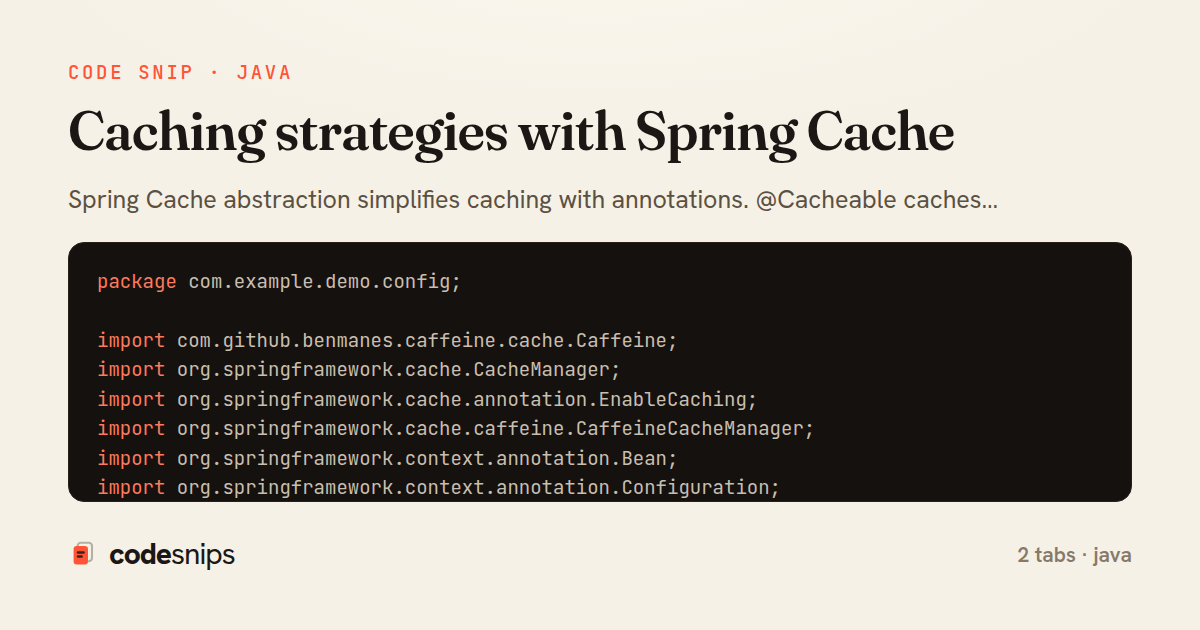
package com.example.demo.config;

import com.github.benmanes.caffeine.cache.Caffeine;
import org.springframework.cache.CacheManager;
import org.springframework.cache.annotation.EnableCaching;
import org.springframework.cache.caffeine.CaffeineCacheManager;
import org.springframework.context.annotation.Bean;
import org.springframework.context.annotation.Configuration;

import java.util.concurrent.TimeUnit;

@Configuration
@EnableCaching
public class CacheConfig {

    @Bean
    public CacheManager cacheManager() {
        CaffeineCacheManager cacheManager = new CaffeineCacheManager("users", "posts");
        cacheManager.setCaffeine(Caffeine.newBuilder()
            .expireAfterWrite(10, TimeUnit.MINUTES)
            .maximumSize(1000)
            .recordStats());
        return cacheManager;
    }
}
package com.example.demo.service;

import com.example.demo.model.User;
import com.example.demo.repository.UserRepository;
import org.springframework.cache.annotation.*;
import org.springframework.stereotype.Service;

import java.util.List;
import java.util.Optional;

@Service
@CacheConfig(cacheNames = "users")
public class CachedUserService {

    private final UserRepository userRepository;

    public CachedUserService(UserRepository userRepository) {
        this.userRepository = userRepository;
    }

    @Cacheable(key = "#id")
    public Optional<User> findById(Long id) {
        System.out.println("Fetching user from database: " + id);
        return userRepository.findById(id);
    }

    @Cacheable(key = "#email")
    public Optional<User> findByEmail(String email) {
        return userRepository.findByEmail(email);
    }

    @Cacheable
    public List<User> findAll() {
        return userRepository.findAll();
    }

    @CachePut(key = "#user.id")
    public User save(User user) {
        return userRepository.save(user);
    }

    @Caching(evict = {
        @CacheEvict(key = "#id"),
        @CacheEvict(allEntries = true, cacheNames = "users")
    })
    public void deleteById(Long id) {
        userRepository.deleteById(id);
    }

    @CacheEvict(allEntries = true)
    public void clearCache() {
        System.out.println("Clearing all user cache");
    }

    @Cacheable(key = "#query", condition = "#query.length() > 3")
    public List<User> search(String query) {
        return userRepository.findByNameContainingIgnoreCase(query);
    }

    @Cacheable(key = "#id", unless = "#result == null")
    public User findActiveUser(Long id) {
        return userRepository.findById(id)
            .filter(User::isActive)
            .orElse(null);
    }
}
Spring Cache abstraction simplifies caching with annotations. @Cacheable caches method results—subsequent calls with same arguments return cached values. @CachePut always executes methods and updates cache. @CacheEvict removes entries or clears entire caches. Cache providers include Caffeine, Redis, Ehcache, or simple in-memory maps. @EnableCaching activates caching infrastructure. Cache names organize data by domain. Condition and unless parameters provide fine-grained control. KeyGenerator customizes cache keys. Caching dramatically improves performance for expensive operations—database queries, API calls, calculations. Time-to-live (TTL) prevents stale data. Redis enables distributed caching across service instances. Proper caching balances performance gains against data freshness requirements.
Related snips
module Api
  module V1
    class UsersController < BaseController
      def show
        user = User.includes(:profile).find(params[:id])
ETags for conditional requests and caching
require "csv"

class PeopleCsvStream
  include Enumerable

  HEADERS = %w[id full_name email signed_up_at plan].freeze
Resilient CSV Export as a Streamed Response
type User {
    id: ID!
    name: String!
    email: String!
    posts: [Post!]!
    createdAt: String!
GraphQL API with Spring Boot
Rails.application.configure do
  config.after_initialize do
    Bullet.enable = true
    Bullet.alert = false
    Bullet.bullet_logger = true
    Bullet.console = true
N+1 query detection with Bullet gem
json.array! @posts do |post|
  json.cache! ['v1', post], expires_in: 1.hour do
    json.id post.id
    json.title post.title
    json.excerpt post.excerpt
    json.published_at post.published_at
Fragment caching for expensive JSON serialization
package com.example.starter.config;

import com.example.starter.properties.CustomProperties;
import com.example.starter.service.CustomService;
import org.springframework.boot.autoconfigure.AutoConfiguration;
import org.springframework.boot.autoconfigure.condition.ConditionalOnClass;
Custom Spring Boot starters
Share this code
Here's the card — post it anywhere.