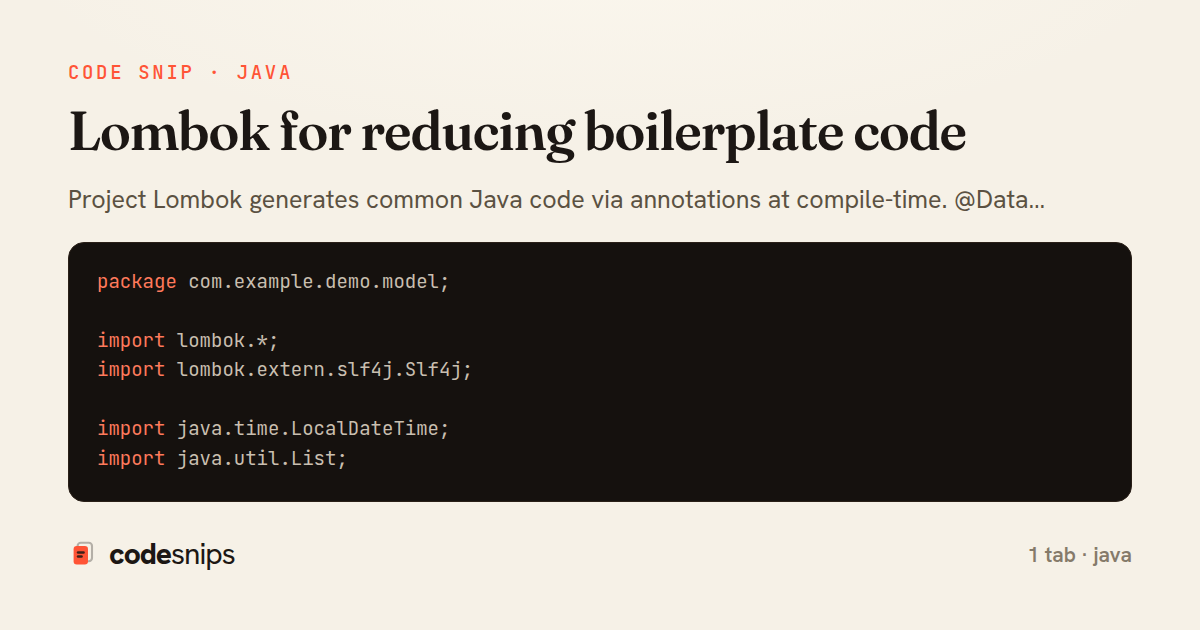
package com.example.demo.model;

import lombok.*;
import lombok.extern.slf4j.Slf4j;

import java.time.LocalDateTime;
import java.util.List;

// Complete data class with all common methods
@Data
public class Product {
    private Long id;
    private String name;
    private String description;
    private double price;
    private int stock;
    private LocalDateTime createdAt;
}

// Builder pattern
@Data
@Builder
@NoArgsConstructor
@AllArgsConstructor
public class Order {
    private Long id;
    private Long userId;
    private List<OrderItem> items;

    @Builder.Default
    private String status = "PENDING";

    @Builder.Default
    private LocalDateTime createdAt = LocalDateTime.now();
}

// Immutable value object
@Value
public class Money {
    double amount;
    String currency;

    public Money add(Money other) {
        if (!currency.equals(other.currency)) {
            throw new IllegalArgumentException("Currency mismatch");
        }
        return new Money(amount + other.amount, currency);
    }
}

// With method for immutable updates
@Value
@With
public class UserSettings {
    String theme;
    String language;
    boolean notifications;
}

// Required args constructor for dependency injection
@RequiredArgsConstructor
@Slf4j
public class OrderService {
    private final OrderRepository orderRepository;
    private final PaymentService paymentService;

    public Order processOrder(Order order) {
        log.info("Processing order: {}", order.getId());

        try {
            paymentService.charge(order);
            order.setStatus("PAID");
            log.debug("Payment successful for order: {}", order.getId());
        } catch (Exception e) {
            log.error("Payment failed for order: {}", order.getId(), e);
            order.setStatus("FAILED");
        }

        return orderRepository.save(order);
    }
}

// Getter only (read-only)
@Getter
@AllArgsConstructor
public class ReadOnlyModel {
    private final Long id;
    private final String name;
}

// Custom toString
@ToString(exclude = "password")
@EqualsAndHashCode(onlyExplicitlyIncluded = true)
public class User {
    @EqualsAndHashCode.Include
    private Long id;

    private String username;
    private String password;
    private String email;
}

// Cleanup resources automatically
public class ResourceExample {
    public void processFile(String path) {
        @Cleanup val inputStream = new FileInputStream(path);
        // Stream automatically closed
    }
}

// Synchronized methods
public class ThreadSafeCounter {
    private int count = 0;

    @Synchronized
    public void increment() {
        count++;
    }

    @Synchronized
    public int getCount() {
        return count;
    }
}
Project Lombok generates common Java code via annotations at compile-time. @Data creates getters, setters, toString, equals, and hashCode. @Builder implements the builder pattern. @Slf4j provides logger instances. @NoArgsConstructor and @AllArgsConstructor generate constructors. @RequiredArgsConstructor creates constructors for final fields. @Value makes immutable classes. @With creates copies with modified fields. Lombok reduces hundreds of lines of boilerplate, improving maintainability. IDE plugins enable code navigation. Configuration via lombok.config customizes behavior. While powerful, I use Lombok judiciously—overuse can obscure code behavior. The tool integrates seamlessly with Spring Boot, making DTOs and entities concise. Lombok enhances developer productivity without runtime dependencies.
Related snips
type User {
    id: ID!
    name: String!
    email: String!
    posts: [Post!]!
    createdAt: String!
GraphQL API with Spring Boot
package com.example.starter.config;

import com.example.starter.properties.CustomProperties;
import com.example.starter.service.CustomService;
import org.springframework.boot.autoconfigure.AutoConfiguration;
import org.springframework.boot.autoconfigure.condition.ConditionalOnClass;
Custom Spring Boot starters
package com.example.demo.config;

import org.apache.kafka.clients.consumer.ConsumerConfig;
import org.apache.kafka.clients.producer.ProducerConfig;
import org.apache.kafka.common.serialization.StringDeserializer;
import org.apache.kafka.common.serialization.StringSerializer;
Messaging with Apache Kafka
package com.example.demo.controller;

import com.example.demo.dto.FileMetadata;
import com.example.demo.service.FileStorageService;
import org.springframework.core.io.Resource;
import org.springframework.http.HttpHeaders;
File upload and download handling
CREATE TABLE users (
    id BIGSERIAL PRIMARY KEY,
    username VARCHAR(100) NOT NULL UNIQUE,
    email VARCHAR(255) NOT NULL UNIQUE,
    password VARCHAR(255) NOT NULL,
    created_at TIMESTAMP NOT NULL DEFAULT CURRENT_TIMESTAMP,
Database migration with Flyway
package com.example.demo.config;

import org.springframework.context.annotation.Configuration;
import org.springframework.messaging.simp.config.MessageBrokerRegistry;
import org.springframework.web.socket.config.annotation.EnableWebSocketMessageBroker;
import org.springframework.web.socket.config.annotation.StompEndpointRegistry;
WebSocket for real-time communication
Share this code
Here's the card — post it anywhere.