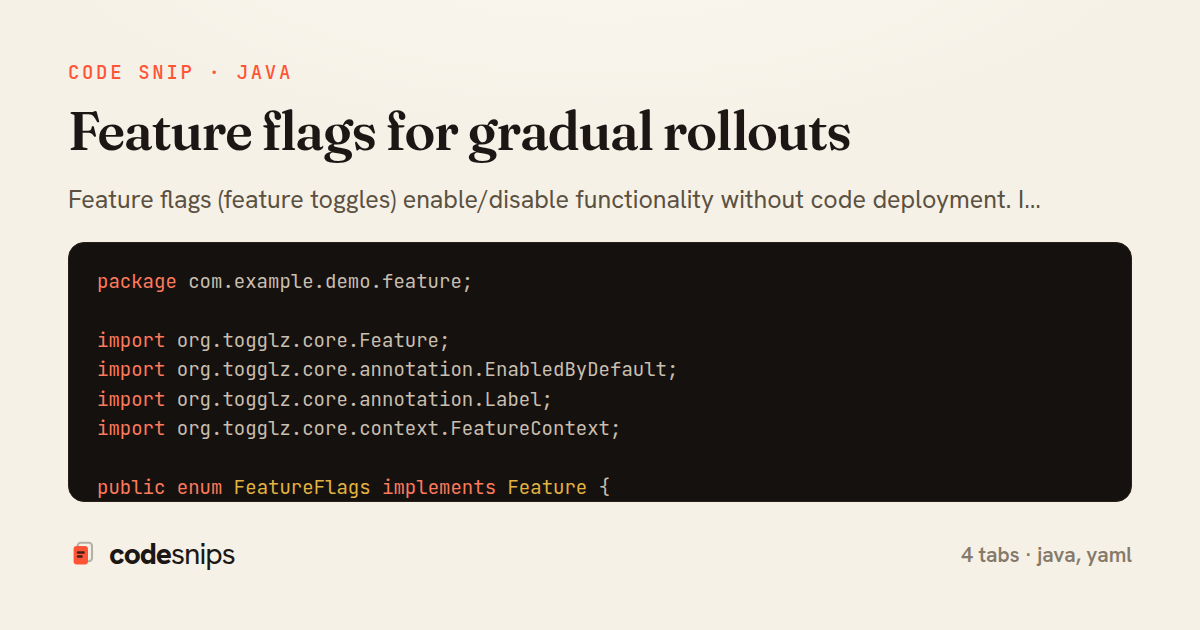
package com.example.demo.feature;

import org.togglz.core.Feature;
import org.togglz.core.annotation.EnabledByDefault;
import org.togglz.core.annotation.Label;
import org.togglz.core.context.FeatureContext;

public enum FeatureFlags implements Feature {

    @EnabledByDefault
    @Label("New User Dashboard")
    NEW_USER_DASHBOARD,

    @Label("Payment Integration V2")
    PAYMENT_V2,

    @Label("Advanced Search")
    ADVANCED_SEARCH,

    @EnabledByDefault
    @Label("Email Notifications")
    EMAIL_NOTIFICATIONS;

    public boolean isActive() {
        return FeatureContext.getFeatureManager().isActive(this);
    }
}
package com.example.demo.config;

import com.example.demo.feature.FeatureFlags;
import org.springframework.context.annotation.Bean;
import org.springframework.context.annotation.Configuration;
import org.togglz.core.manager.EnumBasedFeatureProvider;
import org.togglz.core.spi.FeatureProvider;
import org.togglz.spring.security.SpringSecurityUserProvider;

@Configuration
public class TogglzConfig {

    @Bean
    public FeatureProvider featureProvider() {
        return new EnumBasedFeatureProvider(FeatureFlags.class);
    }

    @Bean
    public org.togglz.core.user.UserProvider userProvider() {
        return new SpringSecurityUserProvider("ROLE_ADMIN");
    }
}
package com.example.demo.service;

import com.example.demo.feature.FeatureFlags;
import org.springframework.stereotype.Service;

@Service
public class UserService {

    private final PaymentServiceV1 paymentV1;
    private final PaymentServiceV2 paymentV2;

    public UserService(PaymentServiceV1 paymentV1, PaymentServiceV2 paymentV2) {
        this.paymentV1 = paymentV1;
        this.paymentV2 = paymentV2;
    }

    public String getUserDashboard(Long userId) {
        if (FeatureFlags.NEW_USER_DASHBOARD.isActive()) {
            return generateNewDashboard(userId);
        } else {
            return generateOldDashboard(userId);
        }
    }

    public void processPayment(PaymentRequest request) {
        if (FeatureFlags.PAYMENT_V2.isActive()) {
            paymentV2.process(request);
        } else {
            paymentV1.process(request);
        }
    }

    public List<User> searchUsers(String query) {
        if (FeatureFlags.ADVANCED_SEARCH.isActive()) {
            return advancedSearch(query);
        } else {
            return basicSearch(query);
        }
    }

    private String generateNewDashboard(Long userId) {
        // New dashboard implementation
        return "new-dashboard";
    }

    private String generateOldDashboard(Long userId) {
        // Old dashboard implementation
        return "old-dashboard";
    }

    private List<User> advancedSearch(String query) {
        // Advanced search with filters, fuzzy matching
        return List.of();
    }

    private List<User> basicSearch(String query) {
        // Simple search
        return List.of();
    }
}
togglz:
  enabled: true
  console:
    enabled: true
    path: /togglz-console
    secured: true
  features:
    NEW_USER_DASHBOARD:
      enabled: true
    PAYMENT_V2:
      enabled: false
    ADVANCED_SEARCH:
      enabled: true
      strategy: gradual-rollout
      param:
        percentage: 20
Feature flags (feature toggles) enable/disable functionality without code deployment. I use libraries like Togglz or FF4J for flag management. Flags support A/B testing, canary releases, and emergency kill switches. Strategy pattern determines flag states—user-based, percentage-based, date-based. Admin UI manages flags in production. Database or configuration stores flag states. Flags reduce deployment risk by decoupling releases from deployments. Remove flags after feature stabilization to avoid technical debt. Feature flags enable trunk-based development and continuous deployment. They're essential for modern DevOps practices, allowing teams to ship code continuously while controlling feature exposure. Proper flag management prevents flag sprawl and maintains code quality.
Related snips
type User {
    id: ID!
    name: String!
    email: String!
    posts: [Post!]!
    createdAt: String!
GraphQL API with Spring Boot
package com.example.starter.config;

import com.example.starter.properties.CustomProperties;
import com.example.starter.service.CustomService;
import org.springframework.boot.autoconfigure.AutoConfiguration;
import org.springframework.boot.autoconfigure.condition.ConditionalOnClass;
Custom Spring Boot starters
class AddSettingsToAccounts < ActiveRecord::Migration[7.1]
  disable_ddl_transaction!

  def change
    add_column :accounts, :settings, :jsonb, null: false, default: {}
Postgres JSONB Partial Index for Feature Flags
package com.example.demo.config;

import org.apache.kafka.clients.consumer.ConsumerConfig;
import org.apache.kafka.clients.producer.ProducerConfig;
import org.apache.kafka.common.serialization.StringDeserializer;
import org.apache.kafka.common.serialization.StringSerializer;
Messaging with Apache Kafka
class FeatureFlag < ApplicationRecord
  validates :key, presence: true, uniqueness: true
  validates :percentage, inclusion: { in: 0..100 }

  after_commit :expire_cache
Safer Feature Flagging: Cache + DB Fallback
package com.example.demo.controller;

import com.example.demo.dto.FileMetadata;
import com.example.demo.service.FileStorageService;
import org.springframework.core.io.Resource;
import org.springframework.http.HttpHeaders;
File upload and download handling
Share this code
Here's the card — post it anywhere.