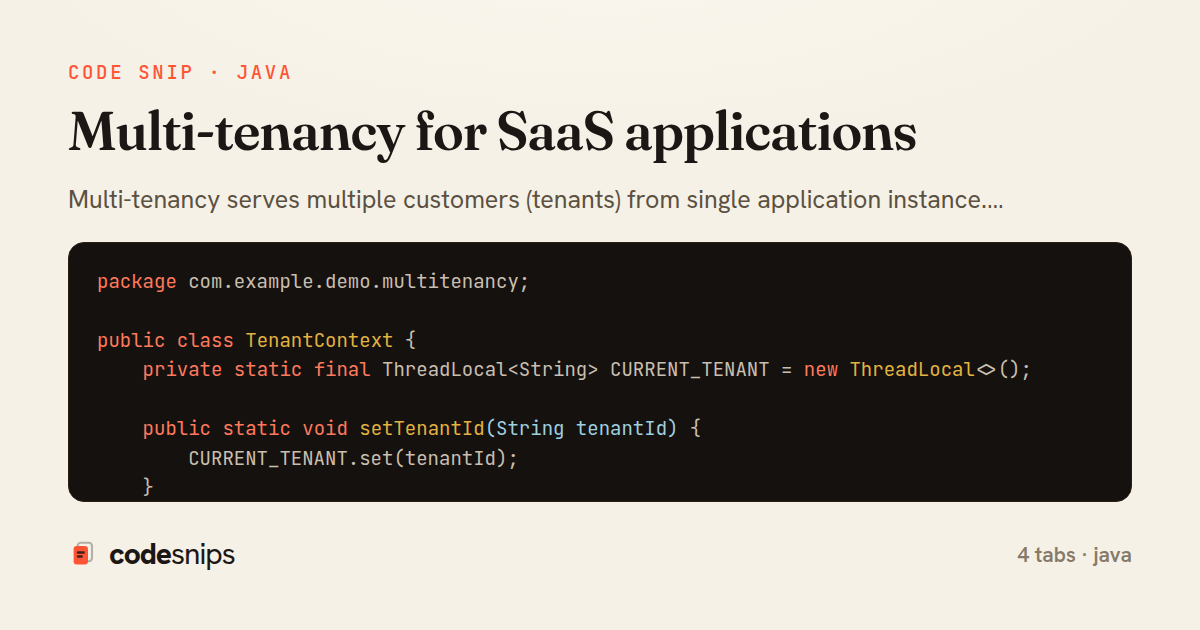
package com.example.demo.multitenancy;

public class TenantContext {
    private static final ThreadLocal<String> CURRENT_TENANT = new ThreadLocal<>();

    public static void setTenantId(String tenantId) {
        CURRENT_TENANT.set(tenantId);
    }

    public static String getTenantId() {
        return CURRENT_TENANT.get();
    }

    public static void clear() {
        CURRENT_TENANT.remove();
    }
}
package com.example.demo.multitenancy;

import jakarta.servlet.http.HttpServletRequest;
import jakarta.servlet.http.HttpServletResponse;
import org.springframework.stereotype.Component;
import org.springframework.web.servlet.HandlerInterceptor;

@Component
public class TenantInterceptor implements HandlerInterceptor {

    private static final String TENANT_HEADER = "X-Tenant-ID";

    @Override
    public boolean preHandle(HttpServletRequest request,
                           HttpServletResponse response,
                           Object handler) {
        String tenantId = request.getHeader(TENANT_HEADER);

        if (tenantId == null) {
            // Alternatively, extract from subdomain
            String host = request.getServerName();
            tenantId = extractTenantFromHost(host);
        }

        if (tenantId != null) {
            TenantContext.setTenantId(tenantId);
        } else {
            response.setStatus(HttpServletResponse.SC_BAD_REQUEST);
            return false;
        }

        return true;
    }

    @Override
    public void afterCompletion(HttpServletRequest request,
                              HttpServletResponse response,
                              Object handler,
                              Exception ex) {
        TenantContext.clear();
    }

    private String extractTenantFromHost(String host) {
        // Extract tenant from subdomain: tenant.myapp.com
        if (host.contains(".")) {
            return host.split("\\.")[0];
        }
        return null;
    }
}
package com.example.demo.model;

import jakarta.persistence.*;
import org.hibernate.annotations.Filter;
import org.hibernate.annotations.FilterDef;
import org.hibernate.annotations.ParamDef;

@Entity
@Table(name = "products")
@FilterDef(
    name = "tenantFilter",
    parameters = @ParamDef(name = "tenantId", type = String.class)
)
@Filter(
    name = "tenantFilter",
    condition = "tenant_id = :tenantId"
)
public class Product {

    @Id
    @GeneratedValue(strategy = GenerationType.IDENTITY)
    private Long id;

    @Column(name = "tenant_id", nullable = false)
    private String tenantId;

    private String name;
    private String description;
    private Double price;

    @PrePersist
    @PreUpdate
    public void setTenant() {
        this.tenantId = TenantContext.getTenantId();
    }

    // Getters and setters
}
package com.example.demo.config;

import com.example.demo.multitenancy.TenantContext;
import jakarta.persistence.EntityManager;
import org.hibernate.Session;
import org.springframework.stereotype.Component;

@Component
public class TenantFilter {

    private final EntityManager entityManager;

    public TenantFilter(EntityManager entityManager) {
        this.entityManager = entityManager;
    }

    public void enableFilter() {
        String tenantId = TenantContext.getTenantId();
        if (tenantId != null) {
            Session session = entityManager.unwrap(Session.class);
            session.enableFilter("tenantFilter")
                .setParameter("tenantId", tenantId);
        }
    }
}
Multi-tenancy serves multiple customers (tenants) from single application instance. Schema-per-tenant isolates data in separate databases. Shared schema with tenant ID column partitions data within tables. Discriminator-based approach uses JPA filters. Tenant resolution uses subdomain, header, or authentication. TenantIdentifierResolver determines current tenant. Connection routing switches datasources per tenant. Spring's @TenantId or custom interceptors inject tenant context. Security ensures tenant isolation—no cross-tenant data leaks. Multi-tenancy reduces infrastructure costs while providing data isolation. Proper design balances security, performance, and maintenance. It's essential for B2B SaaS applications serving enterprise customers.
Related snips
type User {
    id: ID!
    name: String!
    email: String!
    posts: [Post!]!
    createdAt: String!
GraphQL API with Spring Boot
package com.example.starter.config;

import com.example.starter.properties.CustomProperties;
import com.example.starter.service.CustomService;
import org.springframework.boot.autoconfigure.AutoConfiguration;
import org.springframework.boot.autoconfigure.condition.ConditionalOnClass;
Custom Spring Boot starters
package com.example.demo.config;

import org.apache.kafka.clients.consumer.ConsumerConfig;
import org.apache.kafka.clients.producer.ProducerConfig;
import org.apache.kafka.common.serialization.StringDeserializer;
import org.apache.kafka.common.serialization.StringSerializer;
Messaging with Apache Kafka
class Document < ApplicationRecord
  belongs_to :owner, class_name: "User"
  has_many :visibilities, class_name: "DocumentVisibility", dependent: :delete_all

  scope :public_documents, -> { where(is_public: true) }
Polymorphic “Visible To” Scope with Arel
package com.example.demo.controller;

import com.example.demo.dto.FileMetadata;
import com.example.demo.service.FileStorageService;
import org.springframework.core.io.Resource;
import org.springframework.http.HttpHeaders;
File upload and download handling
-- Pattern 1: Shared schema with tenant_id column

CREATE TABLE tenants (
  id SERIAL PRIMARY KEY,
  name VARCHAR(100) NOT NULL,
  slug VARCHAR(50) UNIQUE NOT NULL,
Multi-tenancy database patterns and strategies
Share this code
Here's the card — post it anywhere.