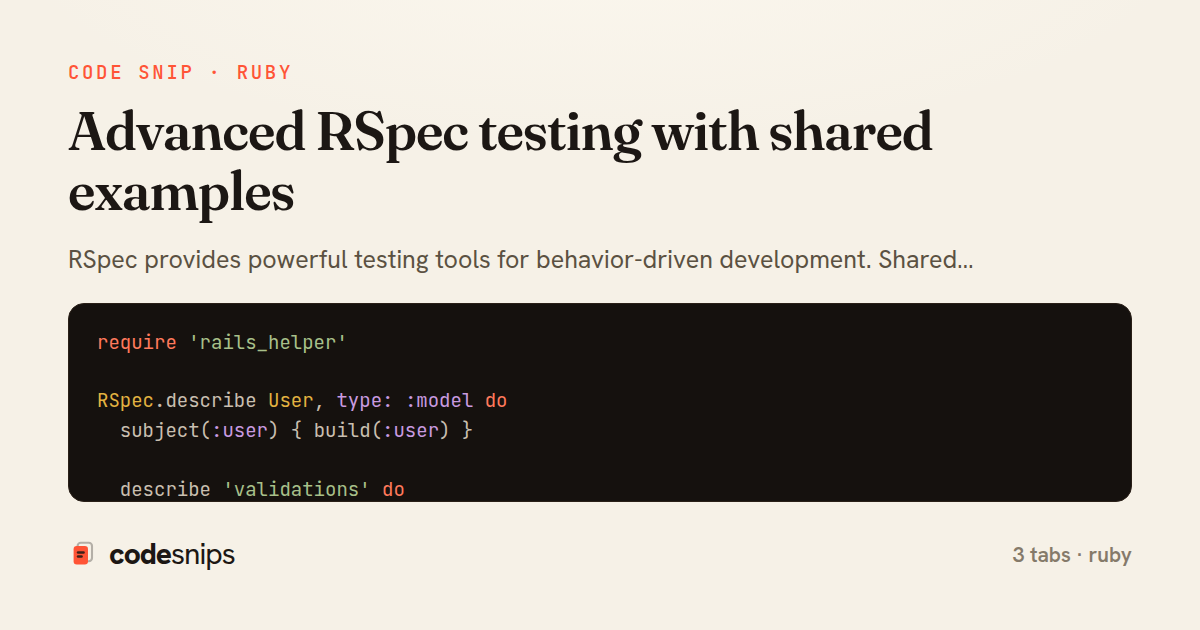
require 'rails_helper'

RSpec.describe User, type: :model do
  subject(:user) { build(:user) }

  describe 'validations' do
    it { should validate_presence_of(:email) }
    it { should validate_uniqueness_of(:email).case_insensitive }
    it { should validate_presence_of(:name) }

    context 'when email format is invalid' do
      before { user.email = 'invalid-email' }

      it 'is invalid' do
        expect(user).not_to be_valid
        expect(user.errors[:email]).to include('is invalid')
      end
    end
  end

  describe 'associations' do
    it { should have_many(:posts).dependent(:destroy) }
    it { should have_one(:profile).dependent(:destroy) }
    it { should have_many(:comments) }
  end

  describe '#full_name' do
    let(:user) { build(:user, first_name: 'John', last_name: 'Doe') }

    it 'returns the concatenated first and last name' do
      expect(user.full_name).to eq('John Doe')
    end

    context 'when last name is missing' do
      let(:user) { build(:user, first_name: 'John', last_name: nil) }

      it 'returns only the first name' do
        expect(user.full_name).to eq('John')
      end
    end
  end

  describe '#activate!' do
    it 'changes status to active' do
      expect { user.activate! }
        .to change(user, :status).from('pending').to('active')
    end

    it 'sets activated_at timestamp' do
      freeze_time do
        user.activate!
        expect(user.activated_at).to eq(Time.current)
      end
    end

    it 'sends activation email' do
      expect(UserMailer).to receive(:activation_email)
        .with(user).and_call_original

      expect { user.activate! }
        .to have_enqueued_mail(UserMailer, :activation_email)
    end
  end

  describe 'scopes' do
    let!(:active_user) { create(:user, status: 'active') }
    let!(:inactive_user) { create(:user, status: 'inactive') }

    describe '.active' do
      it 'returns only active users' do
        expect(User.active).to contain_exactly(active_user)
      end
    end
  end
end
# spec/support/shared_examples/timestampable.rb
RSpec.shared_examples 'timestampable' do
  it { should respond_to(:created_at) }
  it { should respond_to(:updated_at) }

  it 'sets created_at on creation' do
    freeze_time do
      subject.save!
      expect(subject.created_at).to eq(Time.current)
    end
  end

  it 'updates updated_at on save' do
    subject.save!
    freeze_time do
      subject.update!(name: 'Updated')
      expect(subject.updated_at).to eq(Time.current)
    end
  end
end

# spec/support/shared_examples/soft_deletable.rb
RSpec.shared_examples 'soft deletable' do
  describe '#soft_delete!' do
    it 'sets deleted_at timestamp' do
      freeze_time do
        subject.soft_delete!
        expect(subject.deleted_at).to eq(Time.current)
      end
    end

    it 'does not remove record from database' do
      expect { subject.soft_delete! }
        .not_to change(described_class, :count)
    end
  end

  describe '.active' do
    let!(:deleted_record) { create(described_class.name.underscore.to_sym) }

    before { deleted_record.soft_delete! }

    it 'excludes soft deleted records' do
      expect(described_class.active).not_to include(deleted_record)
    end
  end
end

# Usage in specs:
# RSpec.describe Post do
#   it_behaves_like 'timestampable'
#   it_behaves_like 'soft deletable'
# end
require 'rails_helper'

RSpec.describe UserRegistrationService do
  subject(:service) { described_class.new(user_params, notifier: notifier) }

  let(:user_params) { attributes_for(:user) }
  let(:notifier) { instance_double(UserNotifier) }

  describe '#call' do
    before do
      allow(notifier).to receive(:send_welcome_email)
      allow(Analytics).to receive(:track)
    end

    context 'with valid parameters' do
      it 'creates a new user' do
        expect { service.call }
          .to change(User, :count).by(1)
      end

      it 'creates a user profile' do
        result = service.call
        expect(result.user.profile).to be_present
      end

      it 'sends welcome email' do
        service.call
        expect(notifier).to have_received(:send_welcome_email)
      end

      it 'tracks registration event' do
        service.call
        expect(Analytics).to have_received(:track)
          .with(hash_including(event: 'user_registered'))
      end

      it 'returns successful result' do
        result = service.call
        expect(result).to be_success
        expect(result.user).to be_a(User)
      end
    end

    context 'with invalid parameters' do
      let(:user_params) { { email: 'invalid' } }

      it 'does not create a user' do
        expect { service.call }
          .not_to change(User, :count)
      end

      it 'returns failed result with errors' do
        result = service.call
        expect(result).to be_failure
        expect(result.errors).not_to be_empty
      end
    end
  end
end
RSpec provides powerful testing tools for behavior-driven development. Shared examples reduce duplication across similar specs—I extract common behavior into reusable examples. Contexts organize tests by different scenarios. Let blocks lazily evaluate test data, improving performance. Subject defines the object under test. Before hooks set up test state; after hooks clean up. I use described_class for class references, enabling easy refactoring. Mocking and stubbing with double, allow, and expect isolate unit tests. Custom matchers improve test readability. Aggregate failures show all failures, not just the first. RSpec's expressiveness makes tests serve as living documentation. Well-structured specs ensure confidence in refactoring and feature additions.
Related snips
class CommentsController < ApplicationController
  before_action :set_post

  def create
    @comment = @post.comments.build(comment_params)
System test: asserting Turbo Stream responses
class Money
  include Comparable

  attr_reader :amount, :currency

  def initialize(amount, currency = 'USD')
Value objects for domain modeling
# app/mailers/user_mailer.rb
class UserMailer < ApplicationMailer
  default from: 'noreply@example.com'

  def welcome_email(user)
    @user = user
ActionMailer advanced patterns for transactional emails
# BAD: N+1 query problem
@users = User.all
@users.each do |user|
  puts user.posts.count  # Fires query for each user!
end
ActiveRecord query optimization and N+1 prevention
use my_crate::add;

#[test]
fn test_public_api() {
    assert_eq!(add(3, 4), 7);
}
Integration tests in tests/ directory
# Installation
# rails active_storage:install
# rails db:migrate

# config/storage.yml
local:
ActiveStorage for file uploads and attachments
Share this code
Here's the card — post it anywhere.