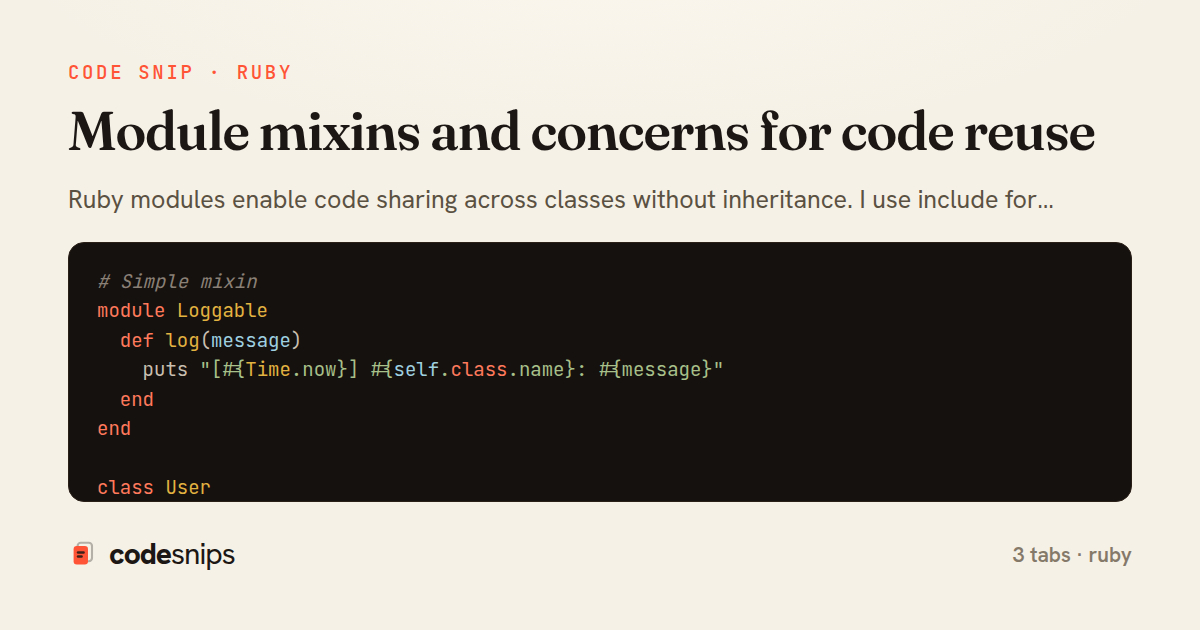
# Simple mixin
module Loggable
  def log(message)
    puts "[#{Time.now}] #{self.class.name}: #{message}"
  end
end

class User
  include Loggable

  def save
    log("Saving user...")
    # Save logic
  end
end

user = User.new
user.save  # => [2026-02-02 10:30:00] User: Saving user...

# Module with class and instance methods
module Trackable
  def self.included(base)
    base.extend(ClassMethods)
    base.include(InstanceMethods)
  end

  module ClassMethods
    def track_event(event_name)
      puts "Tracking class event: #{event_name}"
    end
  end

  module InstanceMethods
    def track(event_name)
      puts "Tracking instance event: #{event_name} for #{self.class.name}"
    end
  end
end

class Order
  include Trackable
end

Order.track_event('order_created')  # Class method
Order.new.track('item_added')       # Instance method

# Prepend example (module methods called before class)
module Validator
  def save
    puts "Validating before save..."
    super  # Calls original save method
  end
end

class Product
  prepend Validator

  def save
    puts "Saving product..."
  end
end

Product.new.save
# Validating before save...
# Saving product...
# app/models/concerns/timestampable.rb
module Timestampable
  extend ActiveSupport::Concern

  included do
    # Runs in the context of the including class
    before_create :set_created_timestamp
    before_update :set_updated_timestamp
  end

  private

  def set_created_timestamp
    self.created_at ||= Time.current
  end

  def set_updated_timestamp
    self.updated_at = Time.current
  end
end

# app/models/concerns/soft_deletable.rb
module SoftDeletable
  extend ActiveSupport::Concern

  included do
    scope :active, -> { where(deleted_at: nil) }
    scope :deleted, -> { where.not(deleted_at: nil) }

    default_scope { active }
  end

  class_methods do
    def restore_all
      update_all(deleted_at: nil)
    end
  end

  def soft_delete!
    update!(deleted_at: Time.current)
  end

  def restore!
    update!(deleted_at: nil)
  end

  def deleted?
    deleted_at.present?
  end
end

# app/models/concerns/searchable.rb
module Searchable
  extend ActiveSupport::Concern

  included do
    scope :search, ->(term) {
      return all if term.blank?

      where(
        searchable_columns.map { |col| "#{col} ILIKE :term" }.join(' OR '),
        term: "%#{term}%"
      )
    }
  end

  class_methods do
    def searchable_columns
      column_names.select { |col| [:string, :text].include?(columns_hash[col].type) }
    end
  end
end

# Usage in models
class Post < ApplicationRecord
  include SoftDeletable
  include Searchable
end

Post.search('ruby')
Post.active
post.soft_delete!
# Concern with dependencies on other concerns
module Publishable
  extend ActiveSupport::Concern

  included do
    include SoftDeletable  # Requires SoftDeletable

    validates :published_at, presence: true, if: :published?

    scope :published, -> { where.not(published_at: nil).active }
    scope :draft, -> { where(published_at: nil) }

    before_save :set_published_at, if: :publishing?
  end

  def publish!
    update!(published_at: Time.current)
  end

  def unpublish!
    update!(published_at: nil)
  end

  def published?
    published_at.present?
  end

  private

  def publishing?
    published_at_changed? && published_at.present?
  end

  def set_published_at
    self.published_at ||= Time.current
  end
end

# Concern with configuration
module Sluggable
  extend ActiveSupport::Concern

  included do
    before_validation :generate_slug, on: :create
    validates :slug, presence: true, uniqueness: true
  end

  class_methods do
    def slug_from(attribute)
      @slug_source = attribute
    end

    def slug_source
      @slug_source || :title
    end
  end

  private

  def generate_slug
    source = send(self.class.slug_source)
    self.slug = source.to_s.parameterize
  end
end

# Usage:
class Article < ApplicationRecord
  include Sluggable

  slug_from :title
end
Ruby modules enable code sharing across classes without inheritance. I use include for instance methods, extend for class methods. prepend inserts module before class in method lookup. Concerns organize shared behavior—validations, scopes, associations. included hook runs when module is included. ClassMethods nested module adds class methods. Modules maintain Single Responsibility and DRY principles. ActiveSupport::Concern simplifies dependencies between concerns. I extract common patterns into modules, making them reusable. Modules compose better than inheritance for shared behavior. Understanding Ruby's method lookup chain—object class, included modules, superclass—enables effective module design. Modules are fundamental to Rails' architecture.
Related snips
class CommentsController < ApplicationController
  before_action :set_post

  def create
    @comment = @post.comments.build(comment_params)
System test: asserting Turbo Stream responses
class Money
  include Comparable

  attr_reader :amount, :currency

  def initialize(amount, currency = 'USD')
Value objects for domain modeling
class Post < ApplicationRecord
  belongs_to :author, class_name: 'User'
  has_many :comments, dependent: :destroy

  scope :published, -> { where.not(published_at: nil).where('published_at <= ?', Time.current) }
  scope :draft, -> { where(published_at: nil) }
ActiveRecord scopes for reusable query logic
module Api
  module V1
    class UsersController < BaseController
      def show
        user = User.includes(:profile).find(params[:id])
ETags for conditional requests and caching
class PostsController < ApplicationController
  def index
    @posts = Post.includes(:author)
                 .order(created_at: :desc)
                 .page(params[:page])
                 .per(10)
Turbo Frames: infinite scroll with lazy-loading frame
require "csv"

class PeopleCsvStream
  include Enumerable

  HEADERS = %w[id full_name email signed_up_at plan].freeze
Resilient CSV Export as a Streamed Response
Share this code
Here's the card — post it anywhere.