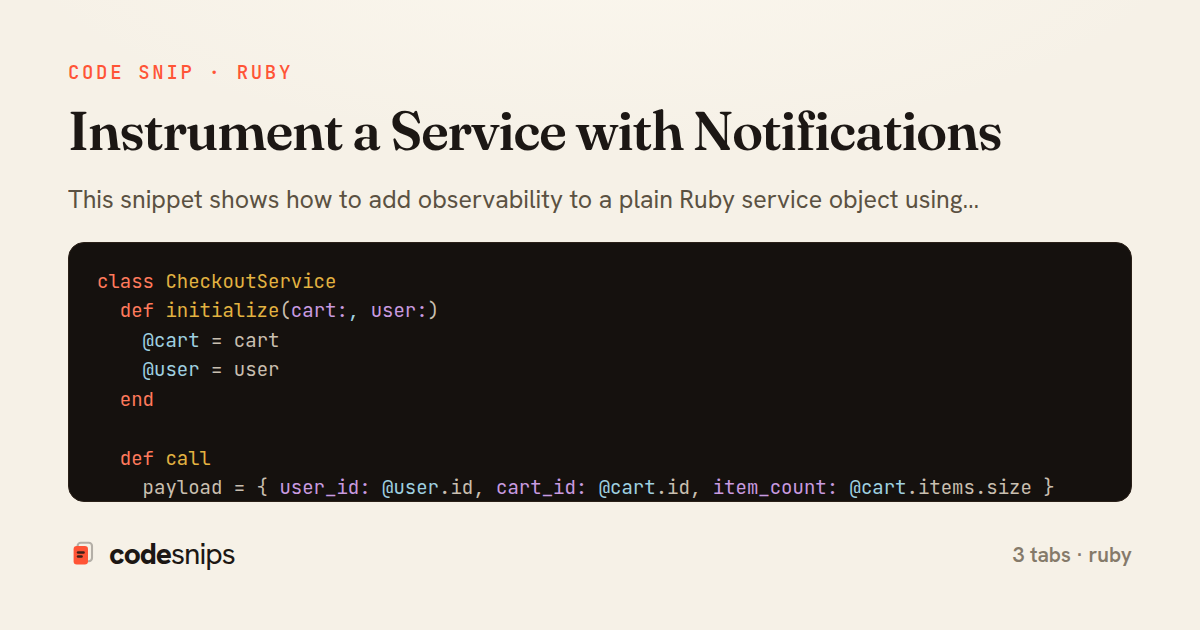
class CheckoutService
  def initialize(cart:, user:)
    @cart = cart
    @user = user
  end

  def call
    payload = { user_id: @user.id, cart_id: @cart.id, item_count: @cart.items.size }

    ActiveSupport::Notifications.instrument("checkout.commerce", payload) do
      order = Order.create!(user: @user, total_cents: @cart.total_cents)
      @cart.items.each { |item| order.line_items.create!(from: item) }
      PaymentGateway.charge!(order)

      payload[:order_id] = order.id
      payload[:total_cents] = order.total_cents
      order
    end
  end
end
class CheckoutMetricsSubscriber
def self.attach
ActiveSupport::Notifications.subscribe("checkout.commerce") do |event|
tags = ["user:#{event.payload[:user_id]}"]
if event.payload[:exception]
StatsD.increment("checkout.failed", tags: tags)
else
StatsD.increment("checkout.succeeded", tags: tags)
StatsD.gauge("checkout.item_count", event.payload[:item_count], tags: tags)
end
StatsD.timing("checkout.duration", event.duration, tags: tags)
end
end
endRails.application.config.after_initialize do
CheckoutMetricsSubscriber.attach
ActiveSupport::Notifications.subscribe("checkout.commerce") do |event|
if (error = event.payload[:exception])
Rails.logger.error(
"[checkout] failed for user=#{event.payload[:user_id]} " \
"in #{event.duration.round(1)}ms: #{error.join(': ')}"
)
else
Rails.logger.tagged("checkout") do
Rails.logger.info(
"order=#{event.payload[:order_id]} " \
"items=#{event.payload[:item_count]} " \
"took=#{event.duration.round(1)}ms"
)
end
end
end
endThis snippet shows how to add observability to a plain Ruby service object using ActiveSupport::Notifications, the same pub/sub bus Rails uses internally for events like sql.active_record and process_action.action_controller. The core idea is decoupling: the service emits named events with a payload, and any number of subscribers react to them without the service knowing who is listening. This keeps timing, metrics, and logging concerns out of the business logic.
In CheckoutService, the work is wrapped in ActiveSupport::Notifications.instrument. That call yields to the block, records a monotonic start and finish time, and publishes a single checkout.commerce event carrying a payload hash. The block mutates payload after the work runs so subscribers can see the resulting order_id and item count — a common trick, since the same hash reference passed to instrument is delivered to subscribers. If the block raises, instrument still fires the event but adds an :exception and :exception_object entry to the payload, so failures are observable too.
The naming convention matters: events are named action.component (dot-separated, most-specific-first-ish), because subscribers can match either an exact string or a regex. checkout.commerce fits the pattern Rails expects.
In CheckoutMetricsSubscriber, ActiveSupport::Notifications.subscribe receives an ActiveSupport::Notifications::Event when passed a block with a single argument, which conveniently exposes event.duration in milliseconds and the event.payload. Here it forwards a timing metric and an error counter to a StatsD-style client, branching on whether payload[:exception] is present. Registering the subscriber once at boot (in an initializer) is important — subscribing repeatedly leaks listeners.
In checkout_instrumentation.rb, the initializer wires everything together and also attaches a lightweight tagged logger subscription inline, demonstrating that multiple independent subscribers can observe the same event. The main trade-off of this pattern is indirection: control flow is harder to trace because emitters and handlers are separate, and a slow synchronous subscriber will slow the instrumented call. It is the right tool when cross-cutting concerns should stay orthogonal to domain code.
Related snips
package api

import (
  "net/http"
  "runtime/debug"
)
Expose build metadata for debugging deploys
class CommentsController < ApplicationController
  before_action :set_post

  def create
    @comment = @post.comments.build(comment_params)
System test: asserting Turbo Stream responses
class Post < ApplicationRecord
  belongs_to :author, class_name: 'User'
  has_many :comments, dependent: :destroy

  scope :published, -> { where.not(published_at: nil).where('published_at <= ?', Time.current) }
  scope :draft, -> { where(published_at: nil) }
ActiveRecord scopes for reusable query logic
module Api
  module V1
    class UsersController < BaseController
      def show
        user = User.includes(:profile).find(params[:id])
ETags for conditional requests and caching
class PostsController < ApplicationController
  def index
    @posts = Post.includes(:author)
                 .order(created_at: :desc)
                 .page(params[:page])
                 .per(10)
Turbo Frames: infinite scroll with lazy-loading frame
require "csv"

class PeopleCsvStream
  include Enumerable

  HEADERS = %w[id full_name email signed_up_at plan].freeze
Resilient CSV Export as a Streamed Response
Share this code
Here's the card — post it anywhere.