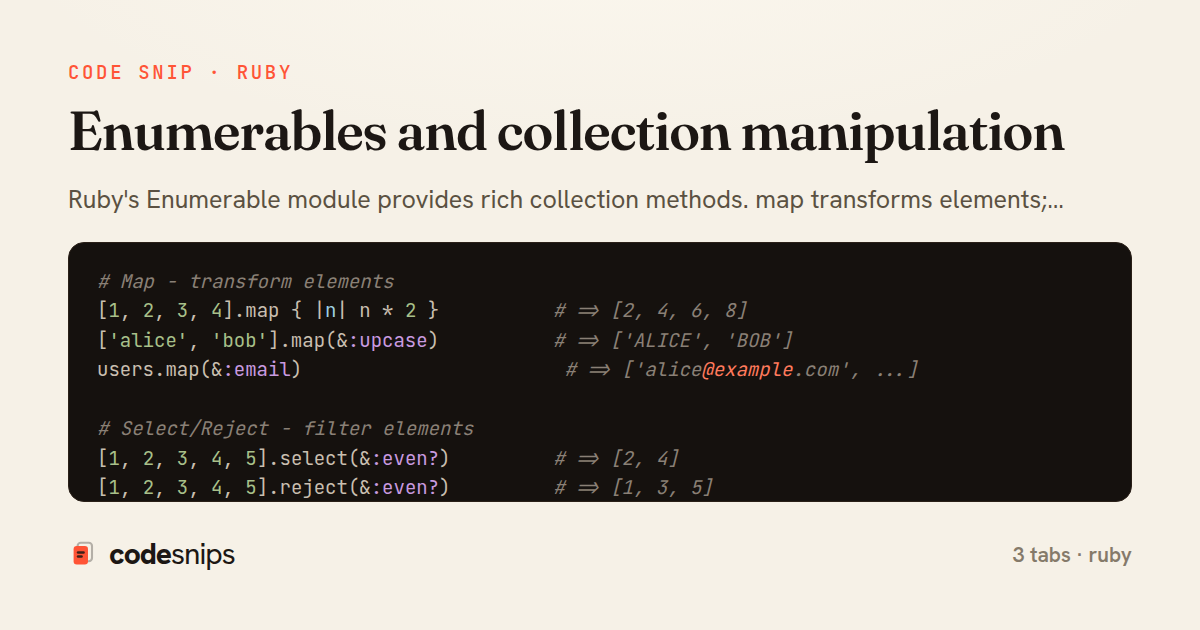
# Map - transform elements
[1, 2, 3, 4].map { |n| n * 2 }          # => [2, 4, 6, 8]
['alice', 'bob'].map(&:upcase)          # => ['ALICE', 'BOB']
users.map(&:email)                       # => ['alice@example.com', ...]

# Select/Reject - filter elements
[1, 2, 3, 4, 5].select(&:even?)         # => [2, 4]
[1, 2, 3, 4, 5].reject(&:even?)         # => [1, 3, 5]
users.select { |u| u.active? }

# Reduce - aggregate values
[1, 2, 3, 4].reduce(:+)                 # => 10
[1, 2, 3, 4].reduce(0) { |sum, n| sum + n }  # => 10
items.reduce(0) { |total, item| total + item.price }

# Find - return first match
[1, 2, 3, 4].find(&:even?)              # => 2
users.find { |u| u.email == 'alice@example.com' }

# Group by - partition into hash
users.group_by(&:role)
# => { 'admin' => [<User>, ...], 'user' => [...] }

words = ['apple', 'apricot', 'banana', 'blueberry']
words.group_by { |word| word[0] }
# => { 'a' => ['apple', 'apricot'], 'b' => ['banana', 'blueberry'] }

# Partition - split into two arrays
numbers = [1, 2, 3, 4, 5, 6]
even, odd = numbers.partition(&:even?)
# even => [2, 4, 6], odd => [1, 3, 5]

# Any/All/None - test conditions
[1, 2, 3].any?(&:even?)                 # => true
[2, 4, 6].all?(&:even?)                 # => true
[1, 3, 5].none?(&:even?)                # => true

# Count - count matching elements
[1, 2, 3, 4].count(&:even?)             # => 2

# Tally - count occurrences (Ruby 2.7+)
['a', 'b', 'a', 'c', 'b', 'a'].tally
# => { 'a' => 3, 'b' => 2, 'c' => 1 }
# Sort by multiple criteria
users.sort_by { |u| [u.last_name, u.first_name] }

# Min/Max by criteria
users.min_by(&:age)
users.max_by { |u| u.posts.count }

# Take/Drop
users.take(5)                           # First 5 users
users.drop(5)                           # All except first 5

# Each with object - build custom result
(1..5).each_with_object([]) { |n, arr| arr << n * 2 }
# => [2, 4, 6, 8, 10]

# Chunk - group consecutive elements
[1, 1, 2, 2, 2, 3, 1].chunk(&:itself).to_a
# => [[1, [1, 1]], [2, [2, 2, 2]], [3, [3]], [1, [1]]]

# Slice - take elements in groups
[1, 2, 3, 4, 5, 6].each_slice(2).to_a
# => [[1, 2], [3, 4], [5, 6]]

# Zip - combine arrays
names = ['Alice', 'Bob', 'Charlie']
ages = [25, 30, 35]
names.zip(ages)
# => [['Alice', 25], ['Bob', 30], ['Charlie', 35]]

# Flat map - map then flatten
[[1, 2], [3, 4]].flat_map { |arr| arr.map { |n| n * 2 } }
# => [2, 4, 6, 8]

users.flat_map(&:posts)  # All posts from all users

# Lazy enumerables - defer execution
(1..Float::INFINITY).lazy
  .select(&:even?)
  .take(10)
  .to_a
# => [2, 4, 6, 8, 10, 12, 14, 16, 18, 20]

# Useful for large datasets
User.find_each.lazy
  .select(&:active?)
  .map(&:email)
  .first(100)
# Calculate statistics
def statistics(numbers)
  {
    count: numbers.count,
    sum: numbers.sum,
    mean: numbers.sum.to_f / numbers.count,
    min: numbers.min,
    max: numbers.max,
    median: numbers.sort[numbers.count / 2]
  }
end

# Group and sum
transactions = [
  { category: 'food', amount: 50 },
  { category: 'transport', amount: 20 },
  { category: 'food', amount: 30 }
]

transactions
  .group_by { |t| t[:category] }
  .transform_values { |group| group.sum { |t| t[:amount] } }
# => { 'food' => 80, 'transport' => 20 }

# Find duplicates
emails = ['a@example.com', 'b@example.com', 'a@example.com', 'c@example.com']
emails.select { |email| emails.count(email) > 1 }.uniq
# => ['a@example.com']

# Frequency map
words = 'the quick brown fox jumps over the lazy dog'.split
word_freq = words.each_with_object(Hash.new(0)) do |word, hash|
  hash[word] += 1
end
# => { 'the' => 2, 'quick' => 1, ... }

# Pipeline transformation
result = User.active
  .group_by(&:department)
  .transform_values { |users| users.map(&:salary).sum }
  .sort_by { |_, total| -total }
  .first(5)
  .to_h
# Top 5 departments by total salary
Ruby's Enumerable module provides rich collection methods. map transforms elements; select/reject filter. reduce aggregates values. find returns first match; find_all returns all matches. group_by partitions by criteria. partition splits into two arrays. any?, all?, none? test conditions. sort_by orders by criteria. uniq removes duplicates. flatten flattens nested arrays. zip combines arrays. Chaining methods creates expressive pipelines. Lazy enumerables defer computation until needed. Symbol-to-proc (&:method_name) shorthand improves readability. Understanding enumerables enables functional programming style—no explicit loops, declarative data transformation. Mastery of Enumerable is essential for idiomatic Ruby.
Related snips
class Money
  include Comparable

  attr_reader :amount, :currency

  def initialize(amount, currency = 'USD')
Value objects for domain modeling
# app/mailers/user_mailer.rb
class UserMailer < ApplicationMailer
  default from: 'noreply@example.com'

  def welcome_email(user)
    @user = user
ActionMailer advanced patterns for transactional emails
# BAD: N+1 query problem
@users = User.all
@users.each do |user|
  puts user.posts.count  # Fires query for each user!
end
ActiveRecord query optimization and N+1 prevention
# Installation
# rails active_storage:install
# rails db:migrate

# config/storage.yml
local:
ActiveStorage for file uploads and attachments
# app/channels/chat_channel.rb
class ChatChannel < ApplicationCable::Channel
  def subscribed
    # Subscribe to a specific room
    room = Room.find(params[:room_id])
ActionCable for real-time WebSocket communication
# app/validators/order_validator.rb
class OrderValidator < ActiveModel::Validator
  def validate(record)
    validate_order_total(record)
    validate_items_availability(record)
    validate_shipping_address(record)
Custom validators and validation patterns
Share this code
Here's the card — post it anywhere.