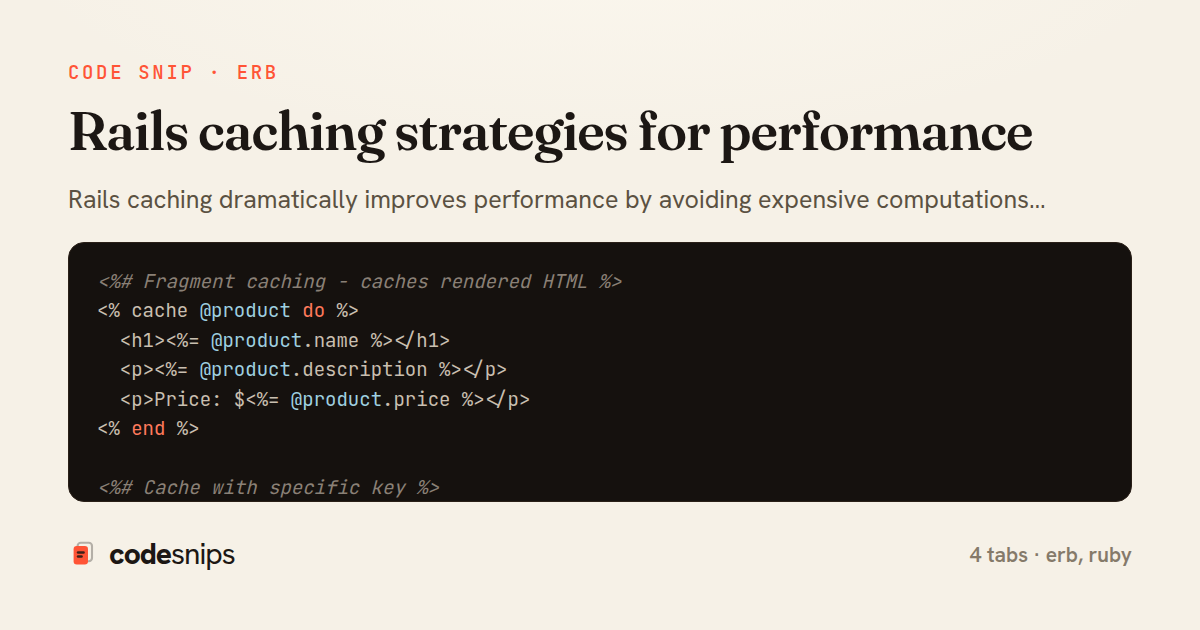
<%# Fragment caching - caches rendered HTML %>
<% cache @product do %>
  <h1><%= @product.name %></h1>
  <p><%= @product.description %></p>
  <p>Price: $<%= @product.price %></p>
<% end %>

<%# Cache with specific key %>
<% cache ['products', @product.id, @product.updated_at] do %>
  <%= render @product %>
<% end %>

<%# Russian doll caching - nested fragments %>
<% cache @post do %>
  <h1><%= @post.title %></h1>

  <% cache ['comments', @post.comments.maximum(:updated_at)] do %>
    <% @post.comments.each do |comment| %>
      <% cache comment do %>
        <%= render comment %>
      <% end %>
    <% end %>
  <% end %>
<% end %>

<%# Conditional caching %>
<% cache_if user_signed_in?, @product do %>
  <%= render 'detailed_product', product: @product %>
<% end %>

<%# Collection caching %>
<%= render partial: 'products/product', collection: @products, cached: true %>
# Fetch or compute pattern
def expensive_computation(user_id)
  Rails.cache.fetch("user/#{user_id}/stats", expires_in: 1.hour) do
    # This block only runs on cache miss
    calculate_user_statistics(user_id)
  end
end

# Write to cache
Rails.cache.write('user/123/profile', user.profile, expires_in: 30.minutes)

# Read from cache
profile = Rails.cache.read('user/123/profile')

# Delete from cache
Rails.cache.delete('user/123/profile')

# Multi-key operations
Rails.cache.read_multi('user/1', 'user/2', 'user/3')
Rails.cache.write_multi({ 'user/1' => data1, 'user/2' => data2 })

# Increment/Decrement (for counters)
Rails.cache.increment('page_views')
Rails.cache.decrement('items_in_stock')

# Conditional write
Rails.cache.fetch('key', race_condition_ttl: 5.seconds) do
  # Prevents cache stampede
  expensive_operation
end

# Cache exists check
if Rails.cache.exist?('key')
  Rails.cache.read('key')
else
  # Cache miss logic
end
class Post < ApplicationRecord
  belongs_to :user, touch: true  # Updates post's updated_at when user changes
  has_many :comments, dependent: :destroy

  # Counter cache
  has_many :comments, dependent: :destroy
  belongs_to :user, counter_cache: true  # Adds posts_count to users table

  # Cached method
  def expensive_calculation
    Rails.cache.fetch([cache_key, __method__]) do
      # Complex calculation here
      sleep(2)
      'result'
    end
  end

  # Cache key with version
  def cache_key_with_version
    "posts/#{id}-#{updated_at.to_i}/v2"
  end

  # Clear cache on update
  after_commit :clear_cache

  private

  def clear_cache
    Rails.cache.delete([cache_key, 'expensive_calculation'])
  end
end

# Query caching (automatic in Rails for same query in request)
Post.where(published: true).load  # Hits database
Post.where(published: true).load  # Returns cached result

# Disable query cache
Post.uncached do
  Post.where(published: true).load  # Always hits database
end

# Cache across requests with scopes
class Product < ApplicationRecord
  def self.featured
    Rails.cache.fetch('products/featured', expires_in: 1.hour) do
      where(featured: true).includes(:images).to_a
    end
  end
end

# ETags for HTTP caching (in controller)
class ProductsController < ApplicationController
  def show
    @product = Product.find(params[:id])

    fresh_when(@product)  # Sets ETag and Last-Modified
    # or
    if stale?(@product)
      respond_to do |format|
        format.html
        format.json { render json: @product }
      end
    end
  end
end
# config/environments/production.rb
config.cache_store = :redis_cache_store, {
  url: ENV['REDIS_URL'],
  connect_timeout: 30,
  read_timeout: 0.2,
  write_timeout: 0.2,
  reconnect_attempts: 1,
  error_handler: -> (method:, returning:, exception:) {
    Rails.logger.error("Redis cache error: #{exception.message}")
  },
  namespace: 'myapp',
  expires_in: 1.hour
}

# Use different cache stores
config.cache_store = :memory_store, { size: 64.megabytes }
config.cache_store = :file_store, Rails.root.join('tmp/cache')
config.cache_store = :mem_cache_store, 'localhost:11211'
config.cache_store = :null_store  # Disable caching

# Multiple cache stores
config.cache_store = :multi_store, :memory_store, :redis_cache_store
Rails caching dramatically improves performance by avoiding expensive computations and queries. Fragment caching caches view partials. Russian doll caching nests cache fragments for efficient invalidation. Low-level caching stores arbitrary data. Rails.cache.fetch simplifies cache-or-compute pattern. Cache keys use model touch for automatic invalidation. I use memcached or Redis for distributed caching. Counter caches avoid COUNT queries. Query result caching prevents duplicate queries in request. HTTP caching with ETags and Last-Modified headers reduces server load. Cache sweepers invalidate stale data. Proper caching strategy balances freshness against performance. Understanding cache invalidation is crucial—Phil Karlton said naming and cache invalidation are the two hard problems in computer science.
Related snips
class CommentsController < ApplicationController
  before_action :set_post

  def create
    @comment = @post.comments.build(comment_params)
System test: asserting Turbo Stream responses
class Money
  include Comparable

  attr_reader :amount, :currency

  def initialize(amount, currency = 'USD')
Value objects for domain modeling
class Post < ApplicationRecord
  belongs_to :author, class_name: 'User'
  has_many :comments, dependent: :destroy

  scope :published, -> { where.not(published_at: nil).where('published_at <= ?', Time.current) }
  scope :draft, -> { where(published_at: nil) }
ActiveRecord scopes for reusable query logic
module Api
  module V1
    class UsersController < BaseController
      def show
        user = User.includes(:profile).find(params[:id])
ETags for conditional requests and caching
class PostsController < ApplicationController
  def index
    @posts = Post.includes(:author)
                 .order(created_at: :desc)
                 .page(params[:page])
                 .per(10)
Turbo Frames: infinite scroll with lazy-loading frame
require "csv"

class PeopleCsvStream
  include Enumerable

  HEADERS = %w[id full_name email signed_up_at plan].freeze
Resilient CSV Export as a Streamed Response
Share this code
Here's the card — post it anywhere.