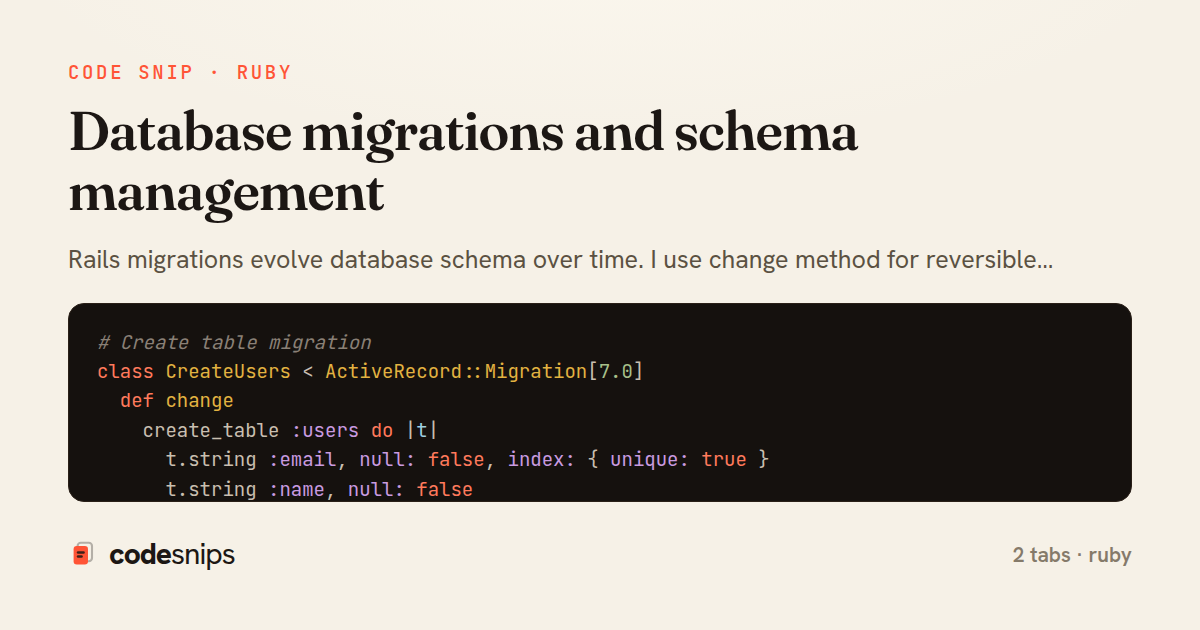
# Create table migration
class CreateUsers < ActiveRecord::Migration[7.0]
  def change
    create_table :users do |t|
      t.string :email, null: false, index: { unique: true }
      t.string :name, null: false
      t.string :password_digest
      t.string :role, default: 'user'
      t.integer :posts_count, default: 0
      t.timestamp :last_login_at
      t.timestamps
    end

    add_index :users, :email
    add_index :users, :role
  end
end

# Add column migration
class AddAvatarToUsers < ActiveRecord::Migration[7.0]
  def change
    add_column :users, :avatar_url, :string
    add_column :users, :bio, :text
  end
end

# Remove column
class RemoveAvatarFromUsers < ActiveRecord::Migration[7.0]
  def change
    remove_column :users, :avatar_url, :string
  end
end

# Rename column
class RenameUserNameToFullName < ActiveRecord::Migration[7.0]
  def change
    rename_column :users, :name, :full_name
  end
end

# Change column type
class ChangeUserBioToText < ActiveRecord::Migration[7.0]
  def change
    change_column :users, :bio, :text
  end
end

# Add foreign key
class AddUserIdToPosts < ActiveRecord::Migration[7.0]
  def change
    add_reference :posts, :user, null: false, foreign_key: true, index: true
  end
end
# Custom index
class AddCompoundIndexToPosts < ActiveRecord::Migration[7.0]
  def change
    add_index :posts, [:user_id, :status]
    add_index :posts, [:status, :created_at], where: "status = 'published'"

    # Full-text search index (PostgreSQL)
    add_index :posts, :content, using: :gin,
      opclass: :gin_trgm_ops  # Requires pg_trgm extension
  end
end

# Data migration
class MigrateUserRoles < ActiveRecord::Migration[7.0]
  def up
    User.where(admin: true).update_all(role: 'admin')
    User.where(admin: false).update_all(role: 'user')

    remove_column :users, :admin
  end

  def down
    add_column :users, :admin, :boolean, default: false

    User.where(role: 'admin').update_all(admin: true)
  end
end

# Reversible block for complex operations
class AddStatusToUsers < ActiveRecord::Migration[7.0]
  def change
    add_column :users, :status, :string

    reversible do |dir|
      dir.up do
        User.update_all(status: 'active')
      end

      dir.down do
        # Cleanup logic
      end
    end

    change_column_null :users, :status, false
  end
end

# Add constraint
class AddConstraintToUsers < ActiveRecord::Migration[7.0]
  def change
    add_check_constraint :users, "age >= 18", name: "users_age_check"

    # Uniqueness constraint
    add_index :users, :email, unique: true
  end
end

# Create join table
class CreateJoinTableUsersGroups < ActiveRecord::Migration[7.0]
  def change
    create_join_table :users, :groups do |t|
      t.index :user_id
      t.index :group_id
      t.timestamps
    end
  end
end

# Enable PostgreSQL extension
class EnablePgExtensions < ActiveRecord::Migration[7.0]
  def change
    enable_extension 'uuid-ossp'
    enable_extension 'pg_trgm'  # Trigram matching for LIKE queries
    enable_extension 'hstore'   # Key-value storage
  end
end

# Create enum type (PostgreSQL)
class CreatePostStatusEnum < ActiveRecord::Migration[7.0]
  def up
    execute <<-SQL
      CREATE TYPE post_status AS ENUM ('draft', 'published', 'archived');
    SQL

    add_column :posts, :status, :post_status, default: 'draft'
  end

  def down
    remove_column :posts, :status

    execute <<-SQL
      DROP TYPE post_status;
    SQL
  end
end
Rails migrations evolve database schema over time. I use change method for reversible migrations. Migrations create tables, add/remove columns, add indices. up and down methods provide explicit control. Irreversible migrations like data transformations need manual down. Database constraints—foreign keys, uniqueness, not null—ensure integrity. Indices speed queries—I add them to foreign keys and frequently queried columns. migrate:rollback undoes migrations. db:migrate:status shows applied migrations. Migrations are version-controlled, enabling team coordination. I keep migrations small and focused. Understanding SQL helps write efficient schema changes. Proper indexing dramatically improves production query performance.
Related snips
class CommentsController < ApplicationController
  before_action :set_post

  def create
    @comment = @post.comments.build(comment_params)
System test: asserting Turbo Stream responses
class Money
  include Comparable

  attr_reader :amount, :currency

  def initialize(amount, currency = 'USD')
Value objects for domain modeling
class Post < ApplicationRecord
  belongs_to :author, class_name: 'User'
  has_many :comments, dependent: :destroy

  scope :published, -> { where.not(published_at: nil).where('published_at <= ?', Time.current) }
  scope :draft, -> { where(published_at: nil) }
ActiveRecord scopes for reusable query logic
module Api
  module V1
    class UsersController < BaseController
      def show
        user = User.includes(:profile).find(params[:id])
ETags for conditional requests and caching
class PostsController < ApplicationController
  def index
    @posts = Post.includes(:author)
                 .order(created_at: :desc)
                 .page(params[:page])
                 .per(10)
Turbo Frames: infinite scroll with lazy-loading frame
require "csv"

class PeopleCsvStream
  include Enumerable

  HEADERS = %w[id full_name email signed_up_at plan].freeze
Resilient CSV Export as a Streamed Response
Share this code
Here's the card — post it anywhere.