# app/policies/post_policy.rb
class PostPolicy < ApplicationPolicy
  class Scope < Scope
    def resolve
      if user.admin?
        scope.all
      else
        scope.where(published: true)
          .or(scope.where(user: user))
      end
    end
  end

  def index?
    true  # Everyone can view post listings
  end

  def show?
    record.published? || record.user == user || user.admin?
  end

  def create?
    user.present?
  end

  def update?
    user.present? && (record.user == user || user.admin?)
  end

  def destroy?
    user.present? && (record.user == user || user.admin?)
  end

  def publish?
    user.admin? || (record.user == user && user.can_publish?)
  end

  # Custom permission
  def feature?
    user.admin?
  end

  # Attribute-level authorization
  def permitted_attributes
    if user.admin?
      [:title, :content, :published, :featured, :category_id]
    else
      [:title, :content]
    end
  end
end

# app/policies/application_policy.rb
class ApplicationPolicy
  attr_reader :user, :record

  def initialize(user, record)
    @user = user
    @record = record
  end

  def index?
    false
  end

  def show?
    false
  end

  def create?
    false
  end

  def new?
    create?
  end

  def update?
    false
  end

  def edit?
    update?
  end

  def destroy?
    false
  end

  class Scope
    attr_reader :user, :scope

    def initialize(user, scope)
      @user = user
      @scope = scope
    end

    def resolve
      raise NotImplementedError
    end
  end
end
# Controller usage
class PostsController < ApplicationController
  after_action :verify_authorized, except: :index
  after_action :verify_policy_scoped, only: :index

  def index
    @posts = policy_scope(Post).page(params[:page])
  end

  def show
    @post = Post.find(params[:id])
    authorize @post
  end

  def create
    @post = Post.new(permitted_attributes(Post))
    authorize @post

    if @post.save
      redirect_to @post
    else
      render :new
    end
  end

  def update
    @post = Post.find(params[:id])
    authorize @post

    if @post.update(permitted_attributes(@post))
      redirect_to @post
    else
      render :edit
    end
  end

  def destroy
    @post = Post.find(params[:id])
    authorize @post
    @post.destroy
    redirect_to posts_path
  end

  def publish
    @post = Post.find(params[:id])
    authorize @post, :publish?

    @post.update(published: true)
    redirect_to @post
  end
end

# Application controller setup
class ApplicationController < ActionController::Base
  include Pundit::Authorization

  rescue_from Pundit::NotAuthorizedError, with: :user_not_authorized

  private

  def user_not_authorized
    flash[:alert] = "You are not authorized to perform this action."
    redirect_to(request.referrer || root_path)
  end
end

# View helpers
<% if policy(@post).update? %>
  <%= link_to 'Edit', edit_post_path(@post) %>
<% end %>

<% if policy(@post).destroy? %>
  <%= link_to 'Delete', @post, method: :delete %>
<% end %>

<% if policy(@post).publish? %>
  <%= link_to 'Publish', publish_post_path(@post), method: :post %>
<% end %>

# Policy testing (RSpec)
RSpec.describe PostPolicy do
  subject { described_class }

  let(:admin) { create(:user, :admin) }
  let(:user) { create(:user) }
  let(:post) { create(:post, user: user) }

  permissions :show? do
    it "allows admin to view any post" do
      expect(subject).to permit(admin, post)
    end

    it "allows owner to view their post" do
      expect(subject).to permit(user, post)
    end

    it "denies other users from viewing draft" do
      draft = create(:post, published: false)
      expect(subject).not_to permit(user, draft)
    end
  end

  permissions :update? do
    it "allows owner to update" do
      expect(subject).to permit(user, post)
    end

    it "denies non-owner" do
      other_user = create(:user)
      expect(subject).not_to permit(other_user, post)
    end
  end
end
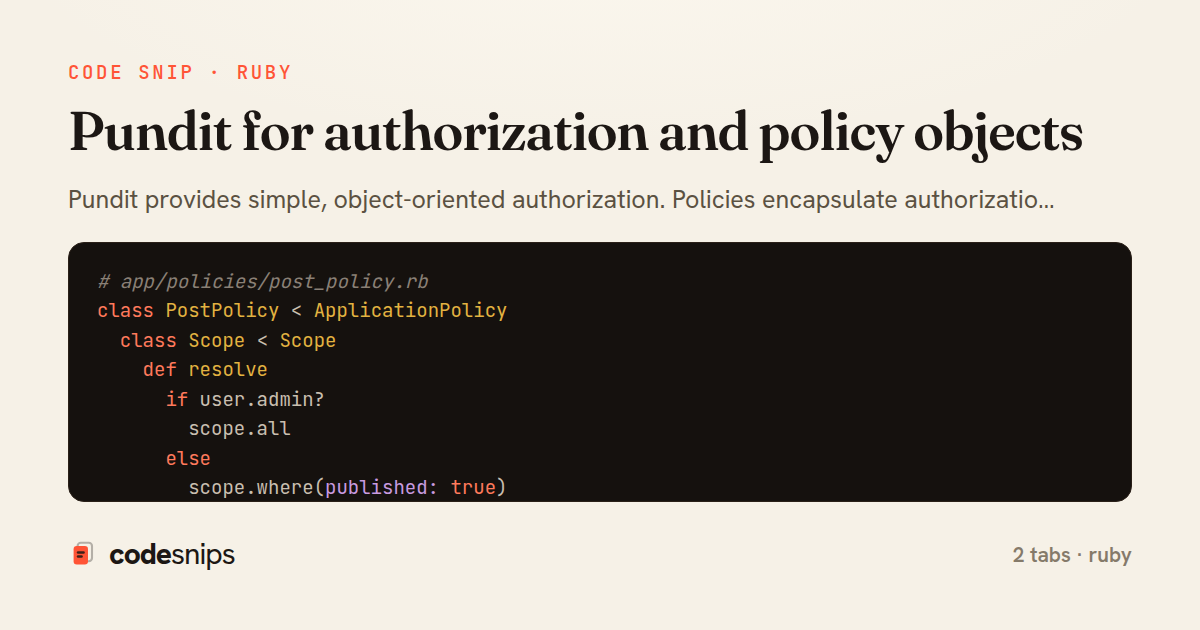
Pundit provides simple, object-oriented authorization. Policies encapsulate authorization rules in plain Ruby classes. Each model gets a policy class defining who can perform actions. I use Pundit for fine-grained permissions—different users see different data. Policies are easy to test—pure Ruby objects without Rails dependencies. Scopes filter collections based on permissions—users only see authorized records. Pundit integrates seamlessly with controllers via authorize helper. Policy errors raise Pundit::NotAuthorizedError, easily rescuable for proper responses. Policies keep authorization logic out of models and controllers. Understanding policy context—user and record—is key. Pundit scales better than CanCanCan for complex permissions, being more explicit and testable.
Related snips
class CommentsController < ApplicationController
  before_action :set_post

  def create
    @comment = @post.comments.build(comment_params)
System test: asserting Turbo Stream responses
class Money
  include Comparable

  attr_reader :amount, :currency

  def initialize(amount, currency = 'USD')
Value objects for domain modeling
class Post < ApplicationRecord
  belongs_to :author, class_name: 'User'
  has_many :comments, dependent: :destroy

  scope :published, -> { where.not(published_at: nil).where('published_at <= ?', Time.current) }
  scope :draft, -> { where(published_at: nil) }
ActiveRecord scopes for reusable query logic
payload = {
  sub: user.id,
  iss: 'https://auth.example.com',
  aud: 'codesnips-api',
  exp: 15.minutes.from_now.to_i,
  iat: Time.now.to_i,
JWT issuance and verification without common footguns
module Api
  module V1
    class UsersController < BaseController
      def show
        user = User.includes(:profile).find(params[:id])
ETags for conditional requests and caching
class PostsController < ApplicationController
  def index
    @posts = Post.includes(:author)
                 .order(created_at: :desc)
                 .page(params[:page])
                 .per(10)
Turbo Frames: infinite scroll with lazy-loading frame
Share this code
Here's the card — post it anywhere.