class Money
  include Comparable

  attr_reader :amount, :currency

  def initialize(amount, currency = 'USD')
    @amount = BigDecimal(amount.to_s)
    @currency = currency.upcase
    freeze  # Make immutable
  end

  def +(other)
    ensure_same_currency!(other)
    Money.new(amount + other.amount, currency)
  end

  def -(other)
    ensure_same_currency!(other)
    Money.new(amount - other.amount, currency)
  end

  def *(multiplier)
    Money.new(amount * multiplier, currency)
  end

  def /(divisor)
    Money.new(amount / divisor, currency)
  end

  def <=>(other)
    ensure_same_currency!(other)
    amount <=> other.amount
  end

  def ==(other)
    other.is_a?(Money) &&
      amount == other.amount &&
      currency == other.currency
  end
  alias eql? ==

  def hash
    [amount, currency].hash
  end

  def to_s
    "#{currency_symbol}#{formatted_amount}"
  end

  def to_f
    amount.to_f
  end

  def zero?
    amount.zero?
  end

  def positive?
    amount.positive?
  end

  def negative?
    amount.negative?
  end

  private

  def ensure_same_currency!(other)
    return if currency == other.currency

    raise ArgumentError,
      "Cannot operate on different currencies: #{currency} and #{other.currency}"
  end

  def currency_symbol
    { 'USD' => '$', 'EUR' => '€', 'GBP' => '£' }[currency] || currency
  end

  def formatted_amount
    format('%.2f', amount)
  end
end

# Usage
price = Money.new(19.99, 'USD')
tax = Money.new(2.50, 'USD')
total = price + tax
# => $22.49

discount = total * 0.10
final_price = total - discount

# Comparison
price > tax  # => true
[price, tax, discount].sort  # => sorted by amount

# Equality
Money.new(10, 'USD') == Money.new(10, 'USD')  # => true
Money.new(10, 'USD') == Money.new(10, 'EUR')  # => false

# Using in models
class Order < ApplicationRecord
  def total_price
    Money.new(total_cents / 100.0, 'USD')
  end

  def total_price=(money)
    self.total_cents = (money.amount * 100).to_i
  end
end

order = Order.new
order.total_price = Money.new(99.99)
order.total_price  # => $99.99
# Address value object
class Address
  attr_reader :street, :city, :state, :zip_code, :country

  def initialize(street:, city:, state:, zip_code:, country: 'USA')
    @street = street
    @city = city
    @state = state
    @zip_code = zip_code
    @country = country
    validate!
    freeze
  end

  def full_address
    "#{street}, #{city}, #{state} #{zip_code}, #{country}"
  end

  def ==(other)
    other.is_a?(Address) &&
      street == other.street &&
      city == other.city &&
      state == other.state &&
      zip_code == other.zip_code &&
      country == other.country
  end

  private

  def validate!
    raise ArgumentError, "Invalid address" if [street, city, state, zip_code].any?(&:blank?)
  end
end

# DateRange value object
class DateRange
  include Enumerable

  attr_reader :start_date, :end_date

  def initialize(start_date, end_date)
    @start_date = start_date.to_date
    @end_date = end_date.to_date

    raise ArgumentError, "End date must be after start date" if @end_date < @start_date

    freeze
  end

  def include?(date)
    date = date.to_date
    start_date <= date && date <= end_date
  end

  def days
    (end_date - start_date).to_i + 1
  end

  def each(&block)
    (start_date..end_date).each(&block)
  end

  def overlaps?(other)
    start_date <= other.end_date && end_date >= other.start_date
  end

  def ==(other)
    other.is_a?(DateRange) &&
      start_date == other.start_date &&
      end_date == other.end_date
  end

  def to_s
    "#{start_date} to #{end_date}"
  end
end

# Coordinate value object
class Coordinate
  include Comparable

  attr_reader :latitude, :longitude

  EARTH_RADIUS_KM = 6371

  def initialize(latitude, longitude)
    @latitude = latitude.to_f
    @longitude = longitude.to_f
    validate!
    freeze
  end

  def distance_to(other)
    # Haversine formula
    lat1 = to_radians(latitude)
    lat2 = to_radians(other.latitude)
    delta_lat = to_radians(other.latitude - latitude)
    delta_lon = to_radians(other.longitude - longitude)

    a = Math.sin(delta_lat / 2)**2 +
        Math.cos(lat1) * Math.cos(lat2) *
        Math.sin(delta_lon / 2)**2

    c = 2 * Math.atan2(Math.sqrt(a), Math.sqrt(1 - a))

    EARTH_RADIUS_KM * c
  end

  def ==(other)
    other.is_a?(Coordinate) &&
      latitude == other.latitude &&
      longitude == other.longitude
  end

  def to_s
    "#{latitude}, #{longitude}"
  end

  private

  def validate!
    unless latitude.between?(-90, 90) && longitude.between?(-180, 180)
      raise ArgumentError, "Invalid coordinates"
    end
  end

  def to_radians(degrees)
    degrees * Math::PI / 180
  end
end

# Usage
address = Address.new(
  street: '123 Main St',
  city: 'San Francisco',
  state: 'CA',
  zip_code: '94102'
)

range = DateRange.new('2024-01-01', '2024-01-31')
range.days  # => 31
range.include?(Date.today)
range.each { |date| puts date }

sf = Coordinate.new(37.7749, -122.4194)
la = Coordinate.new(34.0522, -118.2437)
distance = sf.distance_to(la)  # => ~559 km
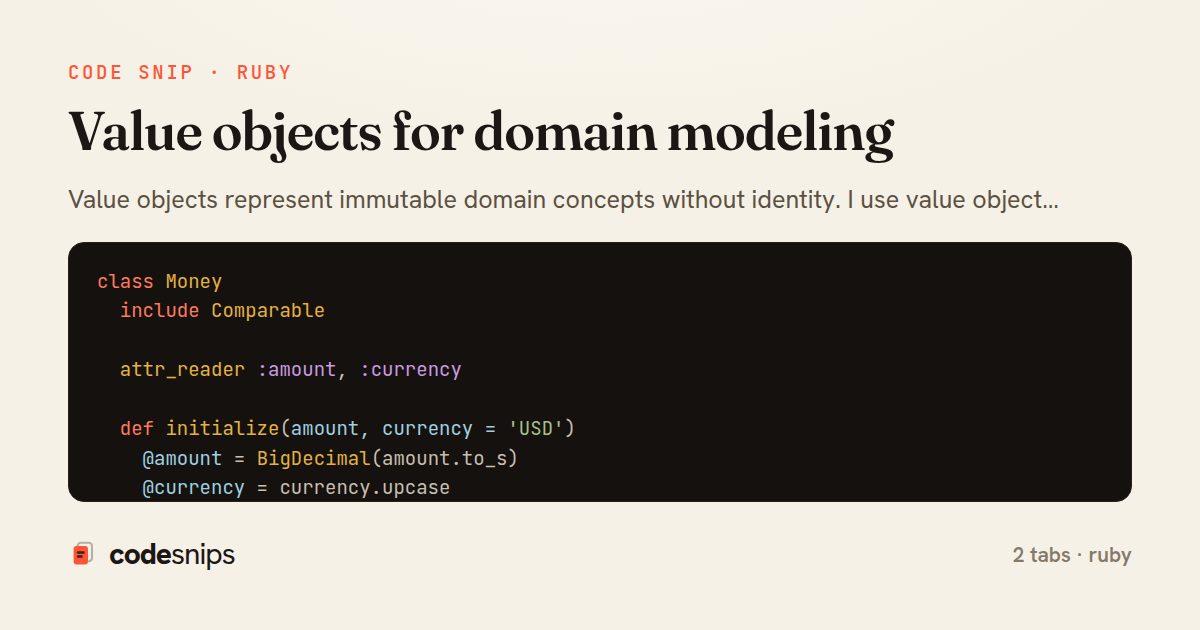
Value objects represent immutable domain concepts without identity. I use value objects for money, addresses, date ranges, coordinates. Value objects are compared by value, not identity—two identical addresses are equal. They're immutable—create new instances rather than modifying. Value objects encapsulate validation and behavior. Including Comparable enables sorting and comparison. Value objects reduce primitive obsession—Money instead of decimals, Address instead of strings. They make code expressive and type-safe. Testing value objects is straightforward—pure Ruby without dependencies. Understanding when to use value objects vs. entities improves domain modeling. Value objects are fundamental to Domain-Driven Design.
Related snips
# app/mailers/user_mailer.rb
class UserMailer < ApplicationMailer
  default from: 'noreply@example.com'

  def welcome_email(user)
    @user = user
ActionMailer advanced patterns for transactional emails
# BAD: N+1 query problem
@users = User.all
@users.each do |user|
  puts user.posts.count  # Fires query for each user!
end
ActiveRecord query optimization and N+1 prevention
# Installation
# rails active_storage:install
# rails db:migrate

# config/storage.yml
local:
ActiveStorage for file uploads and attachments
# app/channels/chat_channel.rb
class ChatChannel < ApplicationCable::Channel
  def subscribed
    # Subscribe to a specific room
    room = Room.find(params[:room_id])
ActionCable for real-time WebSocket communication
# app/validators/order_validator.rb
class OrderValidator < ActiveModel::Validator
  def validate(record)
    validate_order_total(record)
    validate_items_availability(record)
    validate_shipping_address(record)
Custom validators and validation patterns
class UserRegistrationService
  class Result
    attr_reader :user, :errors

    def initialize(success:, user: nil, errors: [])
      @success = success
Service objects for business logic encapsulation
Share this code
Here's the card — post it anywhere.