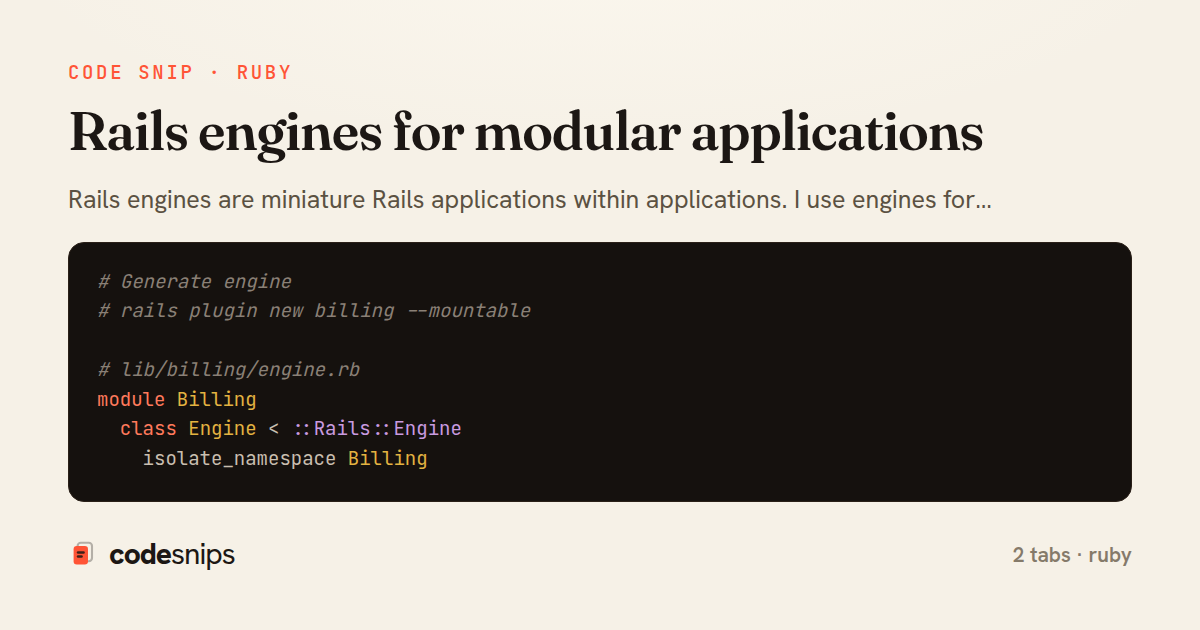
# Generate engine
# rails plugin new billing --mountable

# lib/billing/engine.rb
module Billing
  class Engine < ::Rails::Engine
    isolate_namespace Billing

    config.generators do |g|
      g.test_framework :rspec
      g.fixture_replacement :factory_bot
    end

    # Load migrations from engine
    initializer 'billing.load_migrations' do |app|
      unless app.root.to_s.match root.to_s
        config.paths['db/migrate'].expanded.each do |expanded_path|
          app.config.paths['db/migrate'] << expanded_path
        end
      end
    end

    # Load engine routes
    initializer 'billing.routes' do |app|
      app.routes.prepend do
        mount Billing::Engine => '/billing'
      end
    end
  end
end

# Engine routes (billing/config/routes.rb)
Billing::Engine.routes.draw do
  resources :subscriptions do
    member do
      post :cancel
      post :reactivate
    end
  end

  resources :invoices, only: [:index, :show]
  resources :payment_methods
end

# Engine controller
module Billing
  class SubscriptionsController < ApplicationController
    before_action :authenticate_user!

    def index
      @subscriptions = current_user.subscriptions
    end

    def create
      @subscription = current_user.subscriptions.build(subscription_params)

      if @subscription.save
        redirect_to billing.subscription_path(@subscription)
      else
        render :new
      end
    end

    def cancel
      @subscription = current_user.subscriptions.find(params[:id])
      @subscription.cancel!
      redirect_to billing.subscriptions_path
    end

    private

    def subscription_params
      params.require(:subscription).permit(:plan_id, :payment_method_id)
    end
  end
end

# Engine model
module Billing
  class Subscription < ApplicationRecord
    belongs_to :user, class_name: '::User'
    belongs_to :plan

    enum status: { active: 0, canceled: 1, expired: 2 }

    def cancel!
      update!(
        status: :canceled,
        canceled_at: Time.current
      )
    end
  end
end
# Parent app - mount engine in config/routes.rb
Rails.application.routes.draw do
  mount Billing::Engine => '/billing', as: 'billing'
  mount AdminPanel::Engine => '/admin'
end

# Accessing engine routes from parent app
billing.subscriptions_path
# => /billing/subscriptions

billing.subscription_path(@subscription)
# => /billing/subscriptions/1

# Accessing parent app routes from engine
main_app.root_path
main_app.user_path(@user)

# Sharing models between parent app and engine
# Parent app user model:
class User < ApplicationRecord
  has_many :subscriptions, class_name: 'Billing::Subscription'
end

# Engine accessing parent model:
module Billing
  class Subscription < ApplicationRecord
    belongs_to :user, class_name: '::User'
  end
end

# Engine configuration
# Parent app can configure engine in initializer
# config/initializers/billing.rb
Billing.configure do |config|
  config.stripe_api_key = ENV['STRIPE_API_KEY']
  config.webhook_secret = ENV['STRIPE_WEBHOOK_SECRET']
end

# lib/billing.rb (in engine)
module Billing
  class << self
    attr_accessor :configuration
  end

  def self.configure
    self.configuration ||= Configuration.new
    yield(configuration)
  end

  class Configuration
    attr_accessor :stripe_api_key, :webhook_secret

    def initialize
      @stripe_api_key = nil
      @webhook_secret = nil
    end
  end
end

# Installing engine migrations
# rake billing:install:migrations
# rake db:migrate

# Engine decorators/overrides
# Parent app can override engine behavior
# app/decorators/billing/subscription_decorator.rb
Billing::Subscription.class_eval do
  def custom_method
    # Add behavior to engine model
  end
end

# Engine dependencies in gemspec
# billing.gemspec
Gem::Specification.new do |spec|
  spec.name        = "billing"
  spec.version     = Billing::VERSION
  spec.authors     = ["Your Name"]
  spec.summary     = "Billing engine"

  spec.files = Dir["{app,config,db,lib}/**/*"]

  spec.add_dependency "rails", "~> 7.0"
  spec.add_dependency "stripe"

  spec.add_development_dependency "rspec-rails"
  spec.add_development_dependency "factory_bot_rails"
end

# Testing engine
# spec/dummy app is a minimal Rails app for testing
# billing/spec/rails_helper.rb
ENV['RAILS_ENV'] ||= 'test'
require File.expand_path('../dummy/config/environment.rb', __FILE__)

RSpec.describe Billing::Subscription do
  it 'cancels subscription' do
    subscription = create(:billing_subscription, status: :active)
    subscription.cancel!
    expect(subscription.status).to eq('canceled')
  end
end

# Publishing engine as gem
# gem build billing.gemspec
# gem push billing-0.1.0.gem
Rails engines are miniature Rails applications within applications. I use engines for extracting reusable functionality—authentication, billing, admin panels. Engines have their own models, controllers, views, routes, migrations. Mountable engines are fully isolated; regular engines share parent app's namespace. Engines enable modular monoliths—separation without microservices complexity. Testing engines independently ensures they're truly decoupled. Engines can be extracted to gems for sharing across projects. Engine migrations integrate with parent app via rake engine_name:install:migrations. Understanding engine isolation levels—full vs. partial—is key. Engines are powerful for large apps needing clear boundaries and reusability.
Related snips
class CommentsController < ApplicationController
  before_action :set_post

  def create
    @comment = @post.comments.build(comment_params)
System test: asserting Turbo Stream responses
class Money
  include Comparable

  attr_reader :amount, :currency

  def initialize(amount, currency = 'USD')
Value objects for domain modeling
class Post < ApplicationRecord
  belongs_to :author, class_name: 'User'
  has_many :comments, dependent: :destroy

  scope :published, -> { where.not(published_at: nil).where('published_at <= ?', Time.current) }
  scope :draft, -> { where(published_at: nil) }
ActiveRecord scopes for reusable query logic
module Api
  module V1
    class UsersController < BaseController
      def show
        user = User.includes(:profile).find(params[:id])
ETags for conditional requests and caching
class PostsController < ApplicationController
  def index
    @posts = Post.includes(:author)
                 .order(created_at: :desc)
                 .page(params[:page])
                 .per(10)
Turbo Frames: infinite scroll with lazy-loading frame
require "csv"

class PeopleCsvStream
  include Enumerable

  HEADERS = %w[id full_name email signed_up_at plan].freeze
Resilient CSV Export as a Streamed Response
Share this code
Here's the card — post it anywhere.