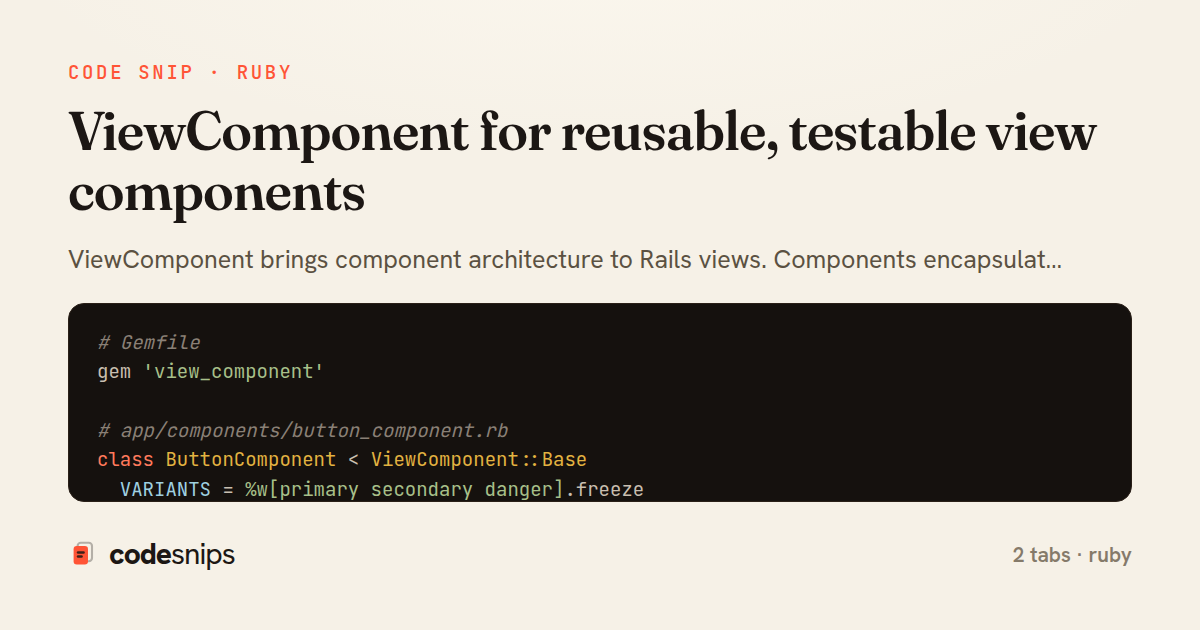
# Gemfile
gem 'view_component'

# app/components/button_component.rb
class ButtonComponent < ViewComponent::Base
  VARIANTS = %w[primary secondary danger].freeze
  SIZES = %w[small medium large].freeze

  def initialize(variant: 'primary', size: 'medium', type: 'button', **options)
    @variant = variant
    @size = size
    @type = type
    @options = options
  end

  def call
    content_tag :button, content, class: classes, type: @type, **@options
  end

  private

  def classes
    [
      'btn',
      "btn-#{@variant}",
      "btn-#{@size}",
      @options[:class]
    ].compact.join(' ')
  end
end

# app/components/button_component.html.erb
<button class="<%= classes %>" type="<%= @type %>">
  <%= content %>
</button>

# Using in views
<%= render ButtonComponent.new(variant: 'primary', size: 'large') do %>
  Click Me
<% end %>

<%= render ButtonComponent.new(variant: 'danger', type: 'submit') do %>
  Delete Account
<% end %>

# Component with slots
class CardComponent < ViewComponent::Base
  renders_one :header
  renders_one :footer
  renders_many :actions

  def initialize(title: nil)
    @title = title
  end
end

# app/components/card_component.html.erb
<div class="card">
  <% if header? %>
    <div class="card-header">
      <%= header %>
    </div>
  <% end %>

  <div class="card-body">
    <%= content %>
  </div>

  <% if footer? %>
    <div class="card-footer">
      <%= footer %>
    </div>
  <% end %>

  <% if actions? %>
    <div class="card-actions">
      <% actions.each do |action| %>
        <%= action %>
      <% end %>
    </div>
  <% end %>
</div>

# Using card with slots
<%= render CardComponent.new do |card| %>
  <% card.with_header do %>
    <h3>Card Title</h3>
  <% end %>

  <p>Card content here</p>

  <% card.with_footer do %>
    <small>Updated 2 hours ago</small>
  <% end %>

  <% card.with_action do %>
    <%= link_to "Edit", edit_path %>
  <% end %>

  <% card.with_action do %>
    <%= link_to "Delete", delete_path %>
  <% end %>
<% end %>
# Component with helpers
class UserAvatarComponent < ViewComponent::Base
  def initialize(user:, size: 'medium')
    @user = user
    @size = size
  end

  def call
    image_tag avatar_url, class: "avatar avatar-#{@size}", alt: @user.name
  end

  private

  def avatar_url
    @user.avatar_url.presence || default_avatar_url
  end

  def default_avatar_url
    helpers.asset_path('default-avatar.png')
  end
end

# Component with collections
class PostListComponent < ViewComponent::Base
  def initialize(posts:)
    @posts = posts
  end

  def render?
    @posts.any?
  end
end

# app/components/post_list_component.html.erb
<div class="post-list">
  <%= render(PostComponent.with_collection(@posts)) %>
</div>

# Individual post component
class PostComponent < ViewComponent::Base
  with_collection_parameter :post

  def initialize(post:)
    @post = post
  end
end

# Component previews for development
# test/components/previews/button_component_preview.rb
class ButtonComponentPreview < ViewComponent::Preview
  def default
    render ButtonComponent.new do
      "Default Button"
    end
  end

  def primary
    render ButtonComponent.new(variant: 'primary', size: 'large') do
      "Primary Button"
    end
  end

  def all_variants
    render_with_template
  end
end

# test/components/previews/button_component_preview/all_variants.html.erb
<% ButtonComponent::VARIANTS.each do |variant| %>
  <div style="margin: 10px;">
    <%= render ButtonComponent.new(variant: variant) do %>
      <%= variant.titleize %> Button
    <% end %>
  </div>
<% end %>

# Access previews at /rails/view_components

# Testing components
require 'test_helper'

class ButtonComponentTest < ViewComponent::TestCase
  def test_renders_button
    render_inline(ButtonComponent.new) { "Click me" }

    assert_selector "button.btn", text: "Click me"
  end

  def test_applies_variant_class
    render_inline(ButtonComponent.new(variant: 'primary')) { "Submit" }

    assert_selector "button.btn-primary"
  end

  def test_applies_size_class
    render_inline(ButtonComponent.new(size: 'large')) { "Big Button" }

    assert_selector "button.btn-large"
  end
end

# RSpec testing
RSpec.describe CardComponent, type: :component do
  it "renders card with header and footer" do
    render_inline(CardComponent.new) do |card|
      card.with_header { "Title" }
      card.with_footer { "Footer" }
      "Content"
    end

    expect(page).to have_css('.card-header', text: 'Title')
    expect(page).to have_css('.card-body', text: 'Content')
    expect(page).to have_css('.card-footer', text: 'Footer')
  end
end

# Polymorphic components
class AlertComponent < ViewComponent::Base
  TYPES = {
    success: { icon: '✓', color: 'green' },
    error: { icon: '✗', color: 'red' },
    warning: { icon: '⚠', color: 'yellow' },
    info: { icon: 'ℹ', color: 'blue' }
  }.freeze

  def initialize(type: :info, dismissible: false)
    @type = type
    @dismissible = dismissible
  end

  def icon
    TYPES[@type][:icon]
  end

  def color_class
    "alert-#{TYPES[@type][:color]}"
  end
end
ViewComponent brings component architecture to Rails views. Components encapsulate markup, logic, and tests in Ruby classes. I use ViewComponents for reusable UI elements—buttons, cards, modals, alerts. Components accept parameters via initializer, keeping views clean. Previews enable visual development—see all component variants without running app. Testing components is fast—unit tests without controllers or integration setup. ViewComponents render faster than partials—compiled to Ruby methods. Slots allow flexible content composition—header, body, footer. Components support variant rendering for different contexts. Understanding when to use components vs. partials improves architecture. ViewComponents are Rails' answer to React components, keeping logic server-side.
Related snips
class CommentsController < ApplicationController
  before_action :set_post

  def create
    @comment = @post.comments.build(comment_params)
System test: asserting Turbo Stream responses
class Money
  include Comparable

  attr_reader :amount, :currency

  def initialize(amount, currency = 'USD')
Value objects for domain modeling
class Post < ApplicationRecord
  belongs_to :author, class_name: 'User'
  has_many :comments, dependent: :destroy

  scope :published, -> { where.not(published_at: nil).where('published_at <= ?', Time.current) }
  scope :draft, -> { where(published_at: nil) }
ActiveRecord scopes for reusable query logic
module Api
  module V1
    class UsersController < BaseController
      def show
        user = User.includes(:profile).find(params[:id])
ETags for conditional requests and caching
class PostsController < ApplicationController
  def index
    @posts = Post.includes(:author)
                 .order(created_at: :desc)
                 .page(params[:page])
                 .per(10)
Turbo Frames: infinite scroll with lazy-loading frame
require "csv"

class PeopleCsvStream
  include Enumerable

  HEADERS = %w[id full_name email signed_up_at plan].freeze
Resilient CSV Export as a Streamed Response
Share this code
Here's the card — post it anywhere.