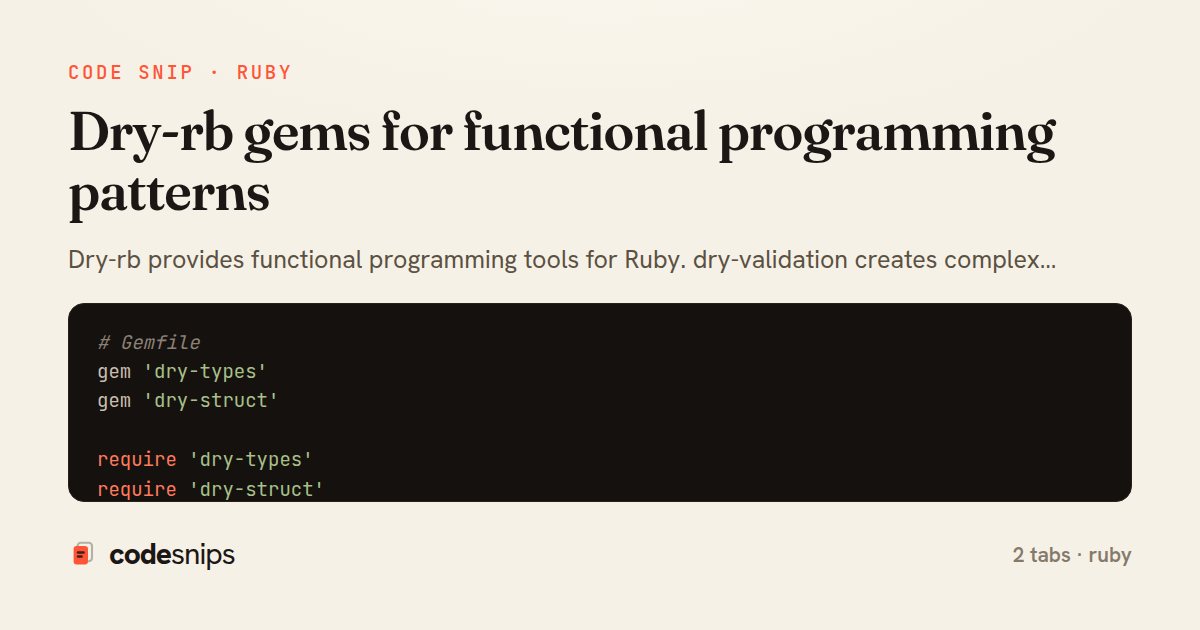
# Gemfile
gem 'dry-types'
gem 'dry-struct'

require 'dry-types'
require 'dry-struct'

module Types
  include Dry.Types()
end

# Define typed struct
class User < Dry::Struct
  attribute :name, Types::String
  attribute :email, Types::String
  attribute :age, Types::Integer.optional
  attribute :role, Types::String.enum('user', 'admin', 'moderator')
  attribute :active, Types::Bool.default(true)
end

# Create instance
user = User.new(
  name: 'John Doe',
  email: 'john@example.com',
  age: 30,
  role: 'admin'
)

user.name   # => "John Doe"
user.active # => true (default)

# Structs are immutable
user.name = "Jane"  # NoMethodError

# Type errors caught at initialization
User.new(name: 123)  # Dry::Struct::Error (type mismatch)

# Optional attributes
User.new(name: 'John', email: 'john@example.com', role: 'user')
# age is nil (optional)

# Custom types
module Types
  Email = String.constrained(format: /\A[\w+\-.]+@[a-z\d\-]+(\.[a-z\d\-]+)*\.[a-z]+\z/i)
  PositiveInteger = Integer.constrained(gt: 0)
  Name = String.constrained(min_size: 2, max_size: 100)
end

class ValidatedUser < Dry::Struct
  attribute :name, Types::Name
  attribute :email, Types::Email
  attribute :age, Types::PositiveInteger.optional
end

# Type coercion
module Types
  CoercibleString = Coercible::String
  CoercibleInteger = Coercible::Integer
end

class Post < Dry::Struct
  transform_keys(&:to_sym)  # Auto-convert string keys to symbols

  attribute :id, Types::CoercibleInteger
  attribute :title, Types::CoercibleString
  attribute :published, Types::Params::Bool  # Coerces "1", "true", etc.
end

Post.new(id: "123", title: 123, published: "1")
# Auto-coerces to: id: 123, title: "123", published: true

# Sum types (union types)
module Types
  StringOrInteger = String | Integer
  StringOrNil = String.optional  # String | Nil
end

class FlexibleStruct < Dry::Struct
  attribute :value, Types::StringOrInteger
end

FlexibleStruct.new(value: "hello")  # OK
FlexibleStruct.new(value: 42)       # OK
FlexibleStruct.new(value: true)     # Error

# Nested structs
class Address < Dry::Struct
  attribute :street, Types::String
  attribute :city, Types::String
  attribute :zip, Types::String
end

class UserWithAddress < Dry::Struct
  attribute :name, Types::String
  attribute :address, Address
  attribute :tags, Types::Array.of(Types::String)
end

user = UserWithAddress.new(
  name: 'John',
  address: { street: '123 Main', city: 'NYC', zip: '10001' },
  tags: ['developer', 'ruby']
)
# Gemfile
gem 'dry-monads'
gem 'dry-validation'

require 'dry-monads'

class CreateUser
  include Dry::Monads[:result, :do]

  def call(params)
    values = yield validate(params)
    user = yield create_user(values)
    yield send_welcome_email(user)

    Success(user)
  end

  private

  def validate(params)
    if params[:email].present? && params[:name].present?
      Success(params)
    else
      Failure(:invalid_params)
    end
  end

  def create_user(params)
    user = User.create(params)
    user.persisted? ? Success(user) : Failure(:user_creation_failed)
  end

  def send_welcome_email(user)
    UserMailer.welcome_email(user).deliver_later
    Success(true)
  rescue => e
    Failure(:email_failed)
  end
end

# Usage
result = CreateUser.new.call(name: 'John', email: 'john@example.com')

case result
when Success
  puts "User created: #{result.value!.name}"
when Failure
  puts "Error: #{result.failure}"
end

# Pattern matching
result = CreateUser.new.call(params)

result.fmap { |user| UserSerializer.new(user).as_json }
      .or { |error| { error: error } }

# Maybe monad
class UserFinder
  include Dry::Monads[:maybe]

  def call(id)
    user = User.find_by(id: id)
    user ? Some(user) : None()
  end
end

finder = UserFinder.new

finder.call(123)
  .fmap { |user| user.email }
  .fmap { |email| email.upcase }
  .value_or('No user found')

# Try monad
include Dry::Monads[:try]

result = Try { JSON.parse(data) }

result.to_result  # Convert to Result monad

# Dry-validation
require 'dry-validation'

class UserContract < Dry::Validation::Contract
  params do
    required(:name).filled(:string)
    required(:email).filled(:string)
    required(:age).filled(:integer)
    optional(:bio).maybe(:string)
  end

  rule(:email) do
    key.failure('must be valid email') unless value.match?(/\A[\w+\-.]+@/)
  end

  rule(:age) do
    key.failure('must be at least 18') if value < 18
  end

  rule(:name, :email) do
    if User.exists?(name: values[:name], email: values[:email])
      key.failure('user already exists')
    end
  end
end

contract = UserContract.new
result = contract.call(name: 'John', email: 'invalid', age: 15)

if result.success?
  user = User.create(result.to_h)
else
  result.errors.to_h
  # => { email: ['must be valid email'], age: ['must be at least 18'] }
end

# Complex validation
class OrderContract < Dry::Validation::Contract
  params do
    required(:items).array(:hash) do
      required(:product_id).filled(:integer)
      required(:quantity).filled(:integer)
    end
    required(:shipping_address).hash do
      required(:street).filled(:string)
      required(:city).filled(:string)
      required(:zip).filled(:string)
    end
  end

  rule('items.each.quantity') do
    key.failure('must be positive') if value <= 0
  end
end
Dry-rb provides functional programming tools for Ruby. dry-validation creates complex validation schemas with type checking. dry-types defines strict types—coercion, constraints, sum types. I use dry-struct for immutable data structures with typed attributes. dry-monads brings Result, Maybe, Try monads for error handling without exceptions. dry-transaction composes operations into workflows. Dry gems reduce bugs through explicitness and immutability. They enable railway-oriented programming—success/failure tracks. Understanding monads simplifies complex business logic. Dry gems integrate well with Rails—service objects, form objects. They represent Ruby moving toward type safety while staying dynamic. Dry-rb balances functional programming with Ruby pragmatism.
Related snips
class Money
  include Comparable

  attr_reader :amount, :currency

  def initialize(amount, currency = 'USD')
Value objects for domain modeling
class SignupForm
  include ActiveModel::Model
  include ActiveModel::Attributes

  attribute :account_name, :string
  attribute :email, :string
Shallow Controller, Deep Params: Form Object Pattern
# app/mailers/user_mailer.rb
class UserMailer < ApplicationMailer
  default from: 'noreply@example.com'

  def welcome_email(user)
    @user = user
ActionMailer advanced patterns for transactional emails
# BAD: N+1 query problem
@users = User.all
@users.each do |user|
  puts user.posts.count  # Fires query for each user!
end
ActiveRecord query optimization and N+1 prevention
<!DOCTYPE html>
<html lang="en">
<head>
  <meta charset="UTF-8">
  <title>Form Validation Example</title>
  <style>
HTML forms with validation and accessibility
# Installation
# rails active_storage:install
# rails db:migrate

# config/storage.yml
local:
ActiveStorage for file uploads and attachments
Share this code
Here's the card — post it anywhere.