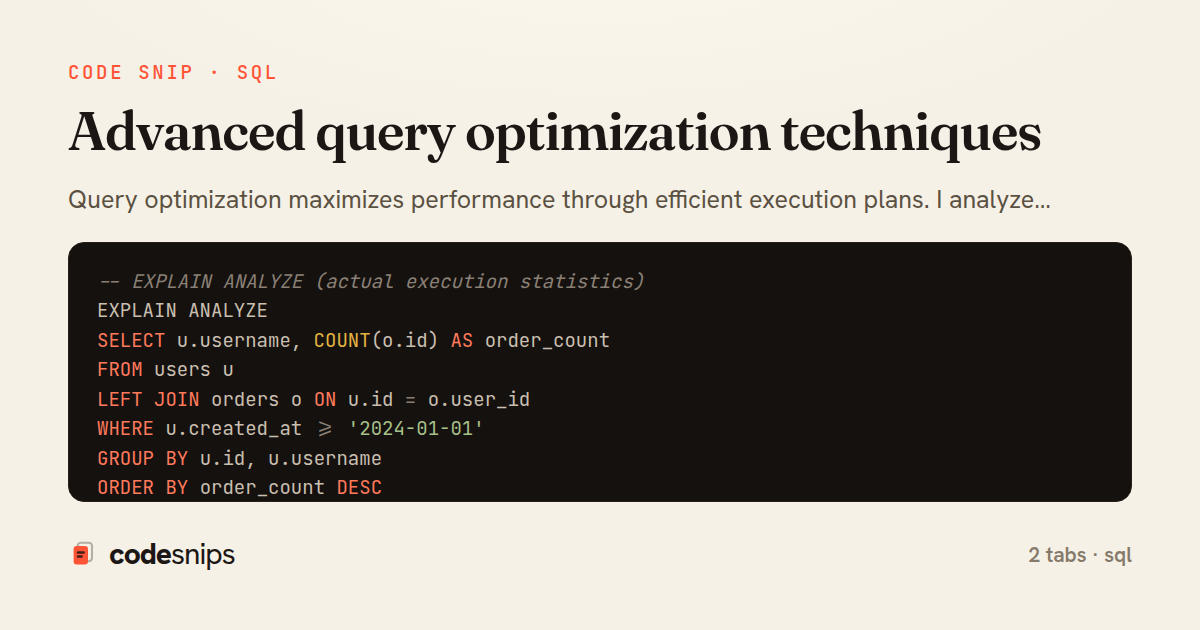
-- EXPLAIN ANALYZE (actual execution statistics)
EXPLAIN ANALYZE
SELECT u.username, COUNT(o.id) AS order_count
FROM users u
LEFT JOIN orders o ON u.id = o.user_id
WHERE u.created_at >= '2024-01-01'
GROUP BY u.id, u.username
ORDER BY order_count DESC
LIMIT 10;

-- Key metrics to watch:
-- Planning Time: Time spent planning query
-- Execution Time: Time spent executing
-- Rows: Estimated vs actual rows
-- Cost: Planner's cost estimate

-- Covering index (includes all needed columns)
CREATE INDEX idx_orders_user_id_created_at
  ON orders (user_id, created_at)
  INCLUDE (total, status);

-- Query uses index-only scan (no table access)
SELECT user_id, created_at, total, status
FROM orders
WHERE user_id = 123
ORDER BY created_at DESC;

-- Partial index (smaller, faster)
CREATE INDEX idx_orders_active
  ON orders (user_id, created_at)
  WHERE status = 'active';

-- Only active orders in index
SELECT * FROM orders
WHERE user_id = 123
  AND status = 'active'
ORDER BY created_at DESC;

-- Expression index
CREATE INDEX idx_users_lower_email
  ON users (LOWER(email));

-- Case-insensitive search uses index
SELECT * FROM users
WHERE LOWER(email) = 'user@example.com';

-- Avoid SELECT * (fetch only needed columns)
-- Bad:
SELECT * FROM users WHERE id = 123;

-- Good:
SELECT id, username, email FROM users WHERE id = 123;

-- Limit early to reduce processing
-- Bad:
SELECT * FROM (
  SELECT * FROM large_table ORDER BY created_at DESC
) sub
LIMIT 10;

-- Good:
SELECT * FROM large_table
ORDER BY created_at DESC
LIMIT 10;

-- Join optimization: smaller table first
-- Bad join order:
SELECT *
FROM huge_table h
JOIN small_table s ON h.id = s.huge_id;

-- Better: Let planner decide, but ensure statistics are current
ANALYZE huge_table;
ANALYZE small_table;

-- Subquery to CTE transformation
-- Subquery (may execute multiple times):
SELECT
  u.username,
  (SELECT COUNT(*) FROM orders WHERE user_id = u.id) AS order_count
FROM users u;

-- CTE (executes once):
WITH order_counts AS (
  SELECT user_id, COUNT(*) AS count
  FROM orders
  GROUP BY user_id
)
SELECT u.username, COALESCE(oc.count, 0) AS order_count
FROM users u
LEFT JOIN order_counts oc ON u.id = oc.user_id;

-- EXISTS vs IN
-- EXISTS (often faster, stops at first match):
SELECT username
FROM users u
WHERE EXISTS (
  SELECT 1 FROM orders o
  WHERE o.user_id = u.id AND o.status = 'completed'
);

-- IN (may be slower for large result sets):
SELECT username
FROM users
WHERE id IN (
  SELECT DISTINCT user_id FROM orders WHERE status = 'completed'
);

-- UNION ALL vs UNION
-- UNION ALL (no deduplication, faster):
SELECT id, name FROM products_active
UNION ALL
SELECT id, name FROM products_archived;

-- UNION (deduplicates, slower):
SELECT id, name FROM products_active
UNION
SELECT id, name FROM products_archived;

-- Batch updates (avoid row-by-row)
-- Bad:
-- UPDATE products SET price = price * 1.1 WHERE id = 1;
-- UPDATE products SET price = price * 1.1 WHERE id = 2;
-- ...

-- Good:
UPDATE products
SET price = price * 1.1
WHERE category_id = 5;

-- Filter before join
-- Bad:
SELECT o.*
FROM orders o
JOIN users u ON o.user_id = u.id
WHERE o.created_at >= '2024-01-01';

-- Better:
SELECT o.*
FROM (
  SELECT * FROM orders
  WHERE created_at >= '2024-01-01'
) o
JOIN users u ON o.user_id = u.id;

-- Or use CTE for clarity:
WITH recent_orders AS (
  SELECT * FROM orders
  WHERE created_at >= '2024-01-01'
)
SELECT o.*
FROM recent_orders o
JOIN users u ON o.user_id = u.id;
-- Partition pruning
EXPLAIN ANALYZE
SELECT * FROM measurements
WHERE measured_at >= '2024-01-01'
  AND measured_at < '2024-02-01';
-- Only scans measurements_2024_01 partition

-- Index scan vs bitmap scan vs sequential scan
SET enable_seqscan = OFF;  -- Force index usage (testing only)
SET enable_seqscan = ON;   -- Re-enable

-- Parallel query execution
SET max_parallel_workers_per_gather = 4;

EXPLAIN ANALYZE
SELECT COUNT(*) FROM large_table;
-- May use parallel sequential scan

-- Disable parallel for small queries
SET parallel_tuple_cost = 1000;

-- Prepared statements (plan caching)
PREPARE user_lookup (INT) AS
  SELECT username, email FROM users WHERE id = $1;

EXECUTE user_lookup(123);
EXECUTE user_lookup(456);

DEALLOCATE user_lookup;

-- Query hints (PostgreSQL doesn't support, but plan can be influenced)
-- Force nested loop join
SET enable_hashjoin = OFF;
SET enable_mergejoin = OFF;
-- Run query
-- Reset
SET enable_hashjoin = ON;
SET enable_mergejoin = ON;

-- Work_mem tuning (per-query memory)
-- Affects sorts, hash joins
SHOW work_mem;  -- Default: 4MB

-- Increase for specific query
SET work_mem = '256MB';
SELECT * FROM large_table ORDER BY created_at DESC LIMIT 1000;
RESET work_mem;

-- Effective_cache_size (planner hint)
SET effective_cache_size = '8GB';
-- Tells planner how much data likely cached

-- Materialized CTE (force execution before join)
WITH expensive_calc AS MATERIALIZED (
  SELECT user_id, SUM(total) AS lifetime_value
  FROM orders
  GROUP BY user_id
)
SELECT u.username, ec.lifetime_value
FROM users u
JOIN expensive_calc ec ON u.id = ec.user_id
WHERE ec.lifetime_value > 1000;

-- Index condition vs filter condition
EXPLAIN ANALYZE
SELECT * FROM orders
WHERE user_id = 123        -- Index condition
  AND status = 'completed'  -- Filter condition (if not in index)
  AND total > 100;          -- Filter condition

-- Add to index to push more to index condition
CREATE INDEX idx_orders_user_status_total
  ON orders (user_id, status, total);

-- Now all conditions are index conditions

-- Avoiding function calls in WHERE (prevents index usage)
-- Bad:
SELECT * FROM users WHERE EXTRACT(YEAR FROM created_at) = 2024;

-- Good:
SELECT * FROM users
WHERE created_at >= '2024-01-01'
  AND created_at < '2025-01-01';

-- OR to UNION transformation
-- Bad (may not use indexes efficiently):
SELECT * FROM products
WHERE category_id = 5 OR featured = true;

-- Better:
SELECT * FROM products WHERE category_id = 5
UNION
SELECT * FROM products WHERE featured = true;

-- Avoid OFFSET for pagination (slow on large offsets)
-- Bad:
SELECT * FROM products ORDER BY id LIMIT 10 OFFSET 100000;

-- Good (keyset pagination):
SELECT * FROM products
WHERE id > 100000
ORDER BY id
LIMIT 10;

-- Cardinality estimation
SELECT
  tablename,
  attname,
  n_distinct,
  correlation
FROM pg_stats
WHERE tablename = 'orders'
  AND schemaname = 'public';

-- If n_distinct is wrong, update statistics
ALTER TABLE orders ALTER COLUMN status SET STATISTICS 1000;
ANALYZE orders;

-- Join removal (unused join)
-- Planner may remove this join if only users.id is used
SELECT u.id
FROM users u
LEFT JOIN orders o ON u.id = o.user_id;

-- Multi-column statistics (correlated columns)
CREATE STATISTICS orders_user_status_stats (dependencies)
  ON user_id, status FROM orders;

ANALYZE orders;

-- Now planner understands correlation between user_id and status

-- Query result caching (application level)
/*
const cacheKey = `user:${userId}:orders`;
let orders = await cache.get(cacheKey);

if (!orders) {
  orders = await db.query('SELECT * FROM orders WHERE user_id = $1', [userId]);
  await cache.set(cacheKey, orders, 300); // 5 min TTL
}
*/

-- Statement timeout (prevent runaway queries)
SET statement_timeout = '30s';

-- Query locks table
LOCK TABLE products IN ACCESS SHARE MODE;

-- Monitoring slow queries
SELECT
  query,
  mean_exec_time,
  calls,
  total_exec_time
FROM pg_stat_statements
WHERE mean_exec_time > 1000  -- > 1 second
ORDER BY mean_exec_time DESC
LIMIT 20;
Query optimization maximizes performance through efficient execution plans. I analyze queries with EXPLAIN ANALYZE. Understanding sequential scans vs index scans guides optimization. Join order affects performance dramatically. Subquery optimization via CTEs or lateral joins. Avoiding SELECT * reduces I/O. Limiting result sets early improves efficiency. Covering indexes eliminate table lookups. Partial indexes reduce index size. Expression indexes handle computed columns. Understanding query planner statistics prevents poor plans. Prepared statements cache execution plans. Partition pruning skips irrelevant partitions. Proper optimization transforms slow queries into fast ones. Query optimization is iterative—measure, optimize, verify improvement.
Related snips
-- Simple function
CREATE OR REPLACE FUNCTION get_full_name(
  first_name VARCHAR,
  last_name VARCHAR
)
RETURNS VARCHAR AS $$
Stored procedures and functions in PostgreSQL
# Vulnerable: user input is concatenated directly into SQL.
email = params[:email]
password = params[:password]

sql = "SELECT * FROM users WHERE email = '#{email}' AND password_hash = '#{password}'"
user = ActiveRecord::Base.connection.execute(sql).first
SQL injection prevention with unsafe and safe query patterns
# BAD: N+1 query problem
@users = User.all
@users.each do |user|
  puts user.posts.count  # Fires query for each user!
end
ActiveRecord query optimization and N+1 prevention
from django.db.models import Count, Avg, Sum, Q, F
from django.views.generic import TemplateView
from products.models import Product, Order, OrderItem


class DashboardView(TemplateView):
Django aggregation with annotate for statistics
package com.example.myapp.utils

import android.os.Build
import android.os.StrictMode
import android.os.Trace
import timber.log.Timber
Performance optimization and profiling
const withBundleAnalyzer = require('@next/bundle-analyzer')({
  enabled: process.env.ANALYZE === 'true',
  openAnalyzer: true,
});

/** @type {import('next').NextConfig} */
Next.js bundle analyzer for targeted performance work
Share this code
Here's the card — post it anywhere.