sql
254 lines · 2 tabs
Maria Garcia
Feb 2026
2 tabs
-- Partition-based archival strategy

-- Create partitioned table
CREATE TABLE logs (
  id BIGSERIAL,
  level VARCHAR(20),
  message TEXT,
  created_at TIMESTAMP NOT NULL,
  PRIMARY KEY (id, created_at)
) PARTITION BY RANGE (created_at);

-- Create monthly partitions
CREATE TABLE logs_2024_01 PARTITION OF logs
  FOR VALUES FROM ('2024-01-01') TO ('2024-02-01');

CREATE TABLE logs_2024_02 PARTITION OF logs
  FOR VALUES FROM ('2024-02-01') TO ('2024-03-01');

-- Archive old partition
-- 1. Detach partition (quick operation)
ALTER TABLE logs DETACH PARTITION logs_2024_01;

-- 2. Export to file
COPY logs_2024_01 TO '/archive/logs_2024_01.csv' WITH (FORMAT csv, HEADER);

-- Or compress while exporting
COPY logs_2024_01 TO PROGRAM 'gzip > /archive/logs_2024_01.csv.gz'
WITH (FORMAT csv);

-- 3. Drop partition
DROP TABLE logs_2024_01;

-- Automated archival function
CREATE OR REPLACE FUNCTION archive_old_partitions(
  table_name TEXT,
  retention_months INT,
  archive_path TEXT
)
RETURNS VOID AS $$
DECLARE
  partition_record RECORD;
  cutoff_date DATE;
BEGIN
  cutoff_date := CURRENT_DATE - (retention_months || ' months')::INTERVAL;

  FOR partition_record IN
    SELECT
      c.relname AS partition_name,
      pg_get_expr(c.relpartbound, c.oid) AS partition_bound
    FROM pg_class c
    JOIN pg_inherits i ON c.oid = i.inhrelid
    JOIN pg_class p ON i.inhparent = p.oid
    WHERE p.relname = table_name
      AND c.relname ~ '\d{4}_\d{2}$'
      AND c.relname < table_name || '_' || TO_CHAR(cutoff_date, 'YYYY_MM')
  LOOP
    RAISE NOTICE 'Archiving partition: %', partition_record.partition_name;

    -- Detach
    EXECUTE format('ALTER TABLE %I DETACH PARTITION %I',
                  table_name, partition_record.partition_name);

    -- Export
    EXECUTE format(
      'COPY %I TO PROGRAM ''gzip > %s/%I.csv.gz'' WITH (FORMAT csv)',
      partition_record.partition_name,
      archive_path,
      partition_record.partition_name
    );

    -- Drop
    EXECUTE format('DROP TABLE %I', partition_record.partition_name);
  END LOOP;
END;
$$ LANGUAGE plpgsql;

-- Run archival
SELECT archive_old_partitions('logs', 12, '/archive');

-- Soft delete pattern
ALTER TABLE users ADD COLUMN deleted_at TIMESTAMP;
CREATE INDEX idx_users_deleted_at ON users(deleted_at);

-- Soft delete
UPDATE users SET deleted_at = CURRENT_TIMESTAMP WHERE id = 123;

-- Query active records only
SELECT * FROM users WHERE deleted_at IS NULL;

-- Archive soft-deleted records
CREATE TABLE users_archive (LIKE users INCLUDING ALL);

INSERT INTO users_archive
SELECT * FROM users
WHERE deleted_at < CURRENT_DATE - INTERVAL '90 days';

DELETE FROM users
WHERE deleted_at < CURRENT_DATE - INTERVAL '90 days';

-- Audit log with automatic archival
CREATE TABLE audit_log (
  id BIGSERIAL PRIMARY KEY,
  table_name VARCHAR(50),
  record_id INT,
  action VARCHAR(20),
  old_data JSONB,
  new_data JSONB,
  user_id INT,
  created_at TIMESTAMP DEFAULT CURRENT_TIMESTAMP
);

-- Partition by month
CREATE TABLE audit_log_2024_01 PARTITION OF audit_log
  FOR VALUES FROM ('2024-01-01') TO ('2024-02-01');

-- Retention policy: Keep 2 years
SELECT add_retention_policy('audit_log', INTERVAL '2 years');

-- Compressed archive table
CREATE TABLE orders_archive (
  id BIGINT PRIMARY KEY,
  user_id INT,
  total DECIMAL(10,2),
  status VARCHAR(20),
  created_at TIMESTAMP,
  archived_at TIMESTAMP DEFAULT CURRENT_TIMESTAMP
);

-- Enable compression (TimescaleDB)
ALTER TABLE orders_archive SET (
  timescaledb.compress,
  timescaledb.compress_segmentby = 'user_id',
  timescaledb.compress_orderby = 'created_at DESC'
);

-- Archive completed orders older than 1 year
WITH archived AS (
  INSERT INTO orders_archive (id, user_id, total, status, created_at)
  SELECT id, user_id, total, status, created_at
  FROM orders
  WHERE status = 'completed'
    AND created_at < CURRENT_DATE - INTERVAL '1 year'
  RETURNING id
)
DELETE FROM orders
WHERE id IN (SELECT id FROM archived);
-- Restore archived partition

-- 1. Create partition table
CREATE TABLE logs_2024_01 (LIKE logs INCLUDING ALL);

-- 2. Import data
COPY logs_2024_01 FROM PROGRAM 'gunzip < /archive/logs_2024_01.csv.gz'
WITH (FORMAT csv, HEADER);

-- 3. Attach partition
ALTER TABLE logs ATTACH PARTITION logs_2024_01
  FOR VALUES FROM ('2024-01-01') TO ('2024-02-01');

-- Query across active and archived data
CREATE VIEW logs_with_archive AS
SELECT * FROM logs
UNION ALL
SELECT * FROM logs_archive
WHERE created_at >= CURRENT_DATE - INTERVAL '30 days';

-- Foreign table for archived data (query without importing)
CREATE EXTENSION file_fdw;
CREATE SERVER archive_server FOREIGN DATA WRAPPER file_fdw;

CREATE FOREIGN TABLE logs_2024_01_archive (
  id BIGINT,
  level VARCHAR(20),
  message TEXT,
  created_at TIMESTAMP
)
SERVER archive_server
OPTIONS (
  filename '/archive/logs_2024_01.csv',
  format 'csv',
  header 'true'
);

-- Query foreign table
SELECT * FROM logs_2024_01_archive WHERE level = 'ERROR';

-- Data lifecycle states
CREATE TYPE data_lifecycle AS ENUM ('active', 'warm', 'cold', 'archived');

ALTER TABLE documents ADD COLUMN lifecycle data_lifecycle DEFAULT 'active';

-- Move to warm storage (less frequently accessed)
UPDATE documents
SET lifecycle = 'warm'
WHERE last_accessed_at < CURRENT_DATE - INTERVAL '90 days'
  AND lifecycle = 'active';

-- Move to cold storage
UPDATE documents
SET lifecycle = 'cold'
WHERE last_accessed_at < CURRENT_DATE - INTERVAL '1 year'
  AND lifecycle = 'warm';

-- Archive to external storage
INSERT INTO documents_archive
SELECT * FROM documents
WHERE lifecycle = 'cold'
  AND updated_at < CURRENT_DATE - INTERVAL '2 years';

UPDATE documents
SET lifecycle = 'archived',
    content = NULL  -- Clear large content column
WHERE lifecycle = 'cold'
  AND updated_at < CURRENT_DATE - INTERVAL '2 years';

-- Compliance retention tracking
CREATE TABLE retention_policies (
  table_name VARCHAR(100) PRIMARY KEY,
  retention_days INT NOT NULL,
  compliance_requirement VARCHAR(100),
  last_archived TIMESTAMP
);

INSERT INTO retention_policies VALUES
('audit_log', 2555, 'SOX', NULL),  -- 7 years
('transactions', 2555, 'SOX', NULL),
('user_activity', 90, 'GDPR', NULL);

-- Archival report
SELECT
  t.tablename,
  pg_size_pretty(pg_total_relation_size('public.'||t.tablename)) AS current_size,
  rp.retention_days,
  rp.compliance_requirement,
  COUNT(*) FILTER (
    WHERE created_at < CURRENT_DATE - (rp.retention_days || ' days')::INTERVAL
  ) AS records_to_archive
FROM pg_tables t
JOIN retention_policies rp ON t.tablename = rp.table_name
LEFT JOIN LATERAL (
  EXECUTE format('SELECT created_at FROM %I', t.tablename)
) records ON true
WHERE t.schemaname = 'public'
GROUP BY t.tablename, rp.retention_days, rp.compliance_requirement;

-- Scheduled archival job (pg_cron)
SELECT cron.schedule(
  'monthly-archival',
  '0 3 1 * *',  -- 3 AM on 1st of month
  $$
  SELECT archive_old_partitions('logs', 12, '/archive');
  SELECT archive_old_partitions('metrics', 6, '/archive');
  $$
);
2 files · sql
Explain with highlit
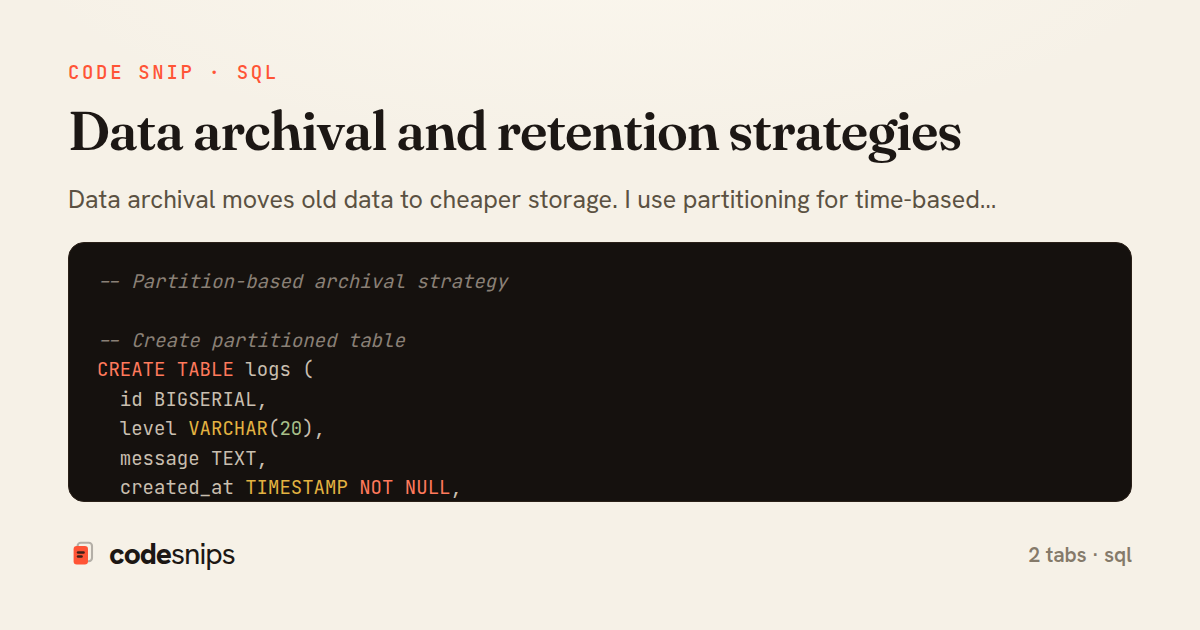
Data archival moves old data to cheaper storage. I use partitioning for time-based archival. Detach old partitions, export to S3, drop table. Archive tables store historical data with reduced indexes. Understanding retention policies prevents runaway growth. Cold storage uses compression for space savings. Soft deletes mark records for later archival. Audit requirements dictate retention periods. Restoring archived data requires documented procedures. Proper archival balances compliance, cost, performance. Essential for log data, transactions, historical records. PostgreSQL table inheritance simplifies archival workflows.
Related snips
sql
-- Simple function
CREATE OR REPLACE FUNCTION get_full_name(
  first_name VARCHAR,
  last_name VARCHAR
)
RETURNS VARCHAR AS $$
Stored procedures and functions in PostgreSQL
postgresql
stored-procedures
functions
by Maria Garcia
2 tabs
ruby
# Vulnerable: user input is concatenated directly into SQL.
email = params[:email]
password = params[:password]

sql = "SELECT * FROM users WHERE email = '#{email}' AND password_hash = '#{password}'"
user = ActiveRecord::Base.connection.execute(sql).first
SQL injection prevention with unsafe and safe query patterns
sql-injection
owasp
database
by Kai Nakamura
3 tabs
sql
-- EXPLAIN ANALYZE (actual execution statistics)
EXPLAIN ANALYZE
SELECT u.username, COUNT(o.id) AS order_count
FROM users u
LEFT JOIN orders o ON u.id = o.user_id
WHERE u.created_at >= '2024-01-01'
Advanced query optimization techniques
database
optimization
query-performance
by Maria Garcia
2 tabs
python
from django.db.models import Count, Avg, Sum, Q, F
from django.views.generic import TemplateView
from products.models import Product, Order, OrderItem


class DashboardView(TemplateView):
Django aggregation with annotate for statistics
django
python
database
by Priya Sharma
1 tab
ruby
class ReportQuery
  SQL = <<~SQL.freeze
    SELECT date_trunc('day', events.created_at) AS day,
           count(*) AS total,
           count(*) FILTER (WHERE events.kind = 'purchase') AS purchases
    FROM events
Safe Raw SQL with exec_query + Binds
rails
activerecord
sql
by codesnips
2 tabs
php
<?php

use Illuminate\Database\Migrations\Migration;
use Illuminate\Database\Schema\Blueprint;
use Illuminate\Support\Facades\Schema;
Laravel database migrations for schema management
laravel
migrations
database
by Carlos Mendez
3 tabs
Share this code
Here's the card — post it anywhere.