sql
303 lines · 2 tabs
Maria Garcia
Feb 2026
2 tabs
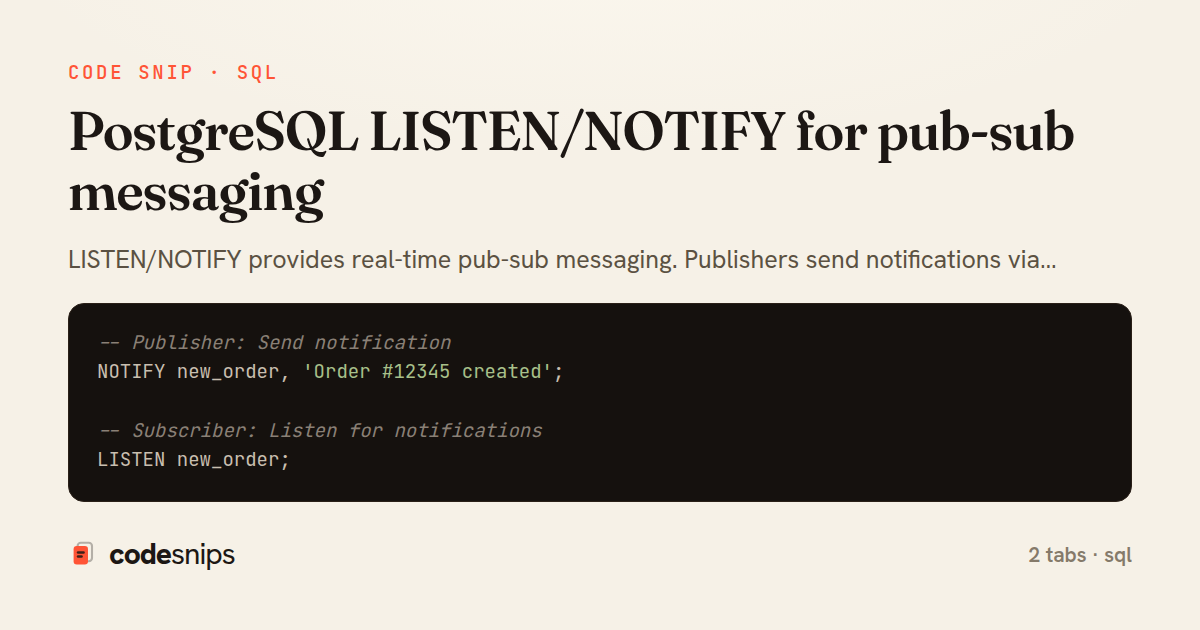
-- Publisher: Send notification
NOTIFY new_order, 'Order #12345 created';

-- Subscriber: Listen for notifications
LISTEN new_order;

-- In another connection, will receive notification
-- Client libraries handle notification delivery

-- Unlisten
UNLISTEN new_order;
UNLISTEN *;  -- Unlisten all channels

-- Send notification with JSON payload
SELECT pg_notify(
  'user_updates',
  json_build_object(
    'user_id', 123,
    'action', 'updated',
    'timestamp', NOW()
  )::TEXT
);

-- Trigger-based notifications
CREATE OR REPLACE FUNCTION notify_new_order()
RETURNS TRIGGER AS $$
BEGIN
  PERFORM pg_notify(
    'new_order',
    json_build_object(
      'order_id', NEW.id,
      'user_id', NEW.user_id,
      'total', NEW.total,
      'created_at', NEW.created_at
    )::TEXT
  );
  RETURN NEW;
END;
$$ LANGUAGE plpgsql;

CREATE TRIGGER order_notification
AFTER INSERT ON orders
FOR EACH ROW
EXECUTE FUNCTION notify_new_order();

-- Now every insert sends notification
INSERT INTO orders (user_id, total) VALUES (123, 99.99);
-- Listeners receive: {"order_id": 456, "user_id": 123, ...}

-- Cache invalidation pattern
CREATE OR REPLACE FUNCTION notify_cache_invalidation()
RETURNS TRIGGER AS $$
BEGIN
  PERFORM pg_notify(
    'cache_invalidate',
    json_build_object(
      'table', TG_TABLE_NAME,
      'id', NEW.id,
      'operation', TG_OP
    )::TEXT
  );
  RETURN NEW;
END;
$$ LANGUAGE plpgsql;

CREATE TRIGGER users_cache_invalidation
AFTER INSERT OR UPDATE OR DELETE ON users
FOR EACH ROW
EXECUTE FUNCTION notify_cache_invalidation();

-- Application listens and clears cache
/*
// Node.js example
const client = new Client();
await client.connect();

client.on('notification', (msg) => {
  const payload = JSON.parse(msg.payload);
  console.log('Cache invalidation:', payload);

  // Clear cache
  cache.del(`user:${payload.id}`);
});

await client.query('LISTEN cache_invalidate');
*/

-- Real-time dashboard updates
CREATE OR REPLACE FUNCTION notify_metrics_update()
RETURNS TRIGGER AS $$
BEGIN
  PERFORM pg_notify(
    'metrics_update',
    json_build_object(
      'metric_name', NEW.metric_name,
      'value', NEW.value,
      'timestamp', NEW.timestamp
    )::TEXT
  );
  RETURN NEW;
END;
$$ LANGUAGE plpgsql;

CREATE TRIGGER metrics_notification
AFTER INSERT ON metrics
FOR EACH ROW
EXECUTE FUNCTION notify_metrics_update();

-- Transactional notifications
BEGIN;

INSERT INTO orders (user_id, total) VALUES (123, 99.99);
-- Notification not sent yet

COMMIT;
-- Notification sent after commit

-- If rolled back:
BEGIN;
INSERT INTO orders (user_id, total) VALUES (123, 99.99);
ROLLBACK;
-- Notification NOT sent

-- Multiple channels
LISTEN orders;
LISTEN inventory;
LISTEN user_activity;

-- Conditional notifications
CREATE OR REPLACE FUNCTION notify_high_value_order()
RETURNS TRIGGER AS $$
BEGIN
  IF NEW.total > 1000 THEN
    PERFORM pg_notify(
      'high_value_order',
      json_build_object('order_id', NEW.id, 'total', NEW.total)::TEXT
    );
  END IF;
  RETURN NEW;
END;
$$ LANGUAGE plpgsql;
-- WebSocket push notifications via LISTEN/NOTIFY
/*
// Node.js WebSocket server
const WebSocket = require('ws');
const { Client } = require('pg');

const wss = new WebSocket.Server({ port: 8080 });
const dbClient = new Client();
await dbClient.connect();

// Subscribe to database notifications
dbClient.on('notification', (msg) => {
  const payload = JSON.parse(msg.payload);

  // Broadcast to all connected WebSocket clients
  wss.clients.forEach((client) => {
    if (client.readyState === WebSocket.OPEN) {
      client.send(JSON.stringify({
        channel: msg.channel,
        data: payload
      }));
    }
  });
});

await dbClient.query('LISTEN new_order');
await dbClient.query('LISTEN user_updates');
*/

-- Job queue pattern
CREATE TABLE job_queue (
  id SERIAL PRIMARY KEY,
  job_type VARCHAR(50),
  payload JSONB,
  status VARCHAR(20) DEFAULT 'pending',
  created_at TIMESTAMP DEFAULT CURRENT_TIMESTAMP,
  started_at TIMESTAMP,
  completed_at TIMESTAMP
);

CREATE OR REPLACE FUNCTION notify_new_job()
RETURNS TRIGGER AS $$
BEGIN
  PERFORM pg_notify(
    'job_queue',
    json_build_object(
      'job_id', NEW.id,
      'job_type', NEW.job_type
    )::TEXT
  );
  RETURN NEW;
END;
$$ LANGUAGE plpgsql;

CREATE TRIGGER job_notification
AFTER INSERT ON job_queue
FOR EACH ROW
EXECUTE FUNCTION notify_new_job();

-- Worker process listens for jobs
/*
client.on('notification', async (msg) => {
  const { job_id, job_type } = JSON.parse(msg.payload);

  // Claim job
  const result = await client.query(`
    UPDATE job_queue
    SET status = 'processing', started_at = NOW()
    WHERE id = $1 AND status = 'pending'
    RETURNING *
  `, [job_id]);

  if (result.rows.length === 0) return; // Already claimed

  // Process job
  await processJob(job_type, result.rows[0].payload);

  // Mark complete
  await client.query(`
    UPDATE job_queue
    SET status = 'completed', completed_at = NOW()
    WHERE id = $1
  `, [job_id]);
});

await client.query('LISTEN job_queue');
*/

-- Rate limiting notifications (prevent spam)
CREATE TABLE notification_throttle (
  channel VARCHAR(100) PRIMARY KEY,
  last_notification TIMESTAMP
);

CREATE OR REPLACE FUNCTION throttled_notify(
  channel_name TEXT,
  message TEXT,
  throttle_seconds INT DEFAULT 1
)
RETURNS VOID AS $$
DECLARE
  last_sent TIMESTAMP;
BEGIN
  SELECT last_notification INTO last_sent
  FROM notification_throttle
  WHERE channel = channel_name;

  IF last_sent IS NULL OR
     NOW() - last_sent > (throttle_seconds || ' seconds')::INTERVAL THEN
    PERFORM pg_notify(channel_name, message);

    INSERT INTO notification_throttle (channel, last_notification)
    VALUES (channel_name, NOW())
    ON CONFLICT (channel)
    DO UPDATE SET last_notification = NOW();
  END IF;
END;
$$ LANGUAGE plpgsql;

-- Usage: Only send notification every 5 seconds
SELECT throttled_notify('metrics_update', 'New metrics available', 5);

-- Bi-directional communication
-- Application -> Database (via INSERT/UPDATE)
-- Database -> Application (via NOTIFY)

-- Command pattern
CREATE TABLE commands (
  id SERIAL PRIMARY KEY,
  command_type VARCHAR(50),
  parameters JSONB,
  result JSONB,
  status VARCHAR(20) DEFAULT 'pending',
  created_at TIMESTAMP DEFAULT CURRENT_TIMESTAMP
);

-- Application sends command
INSERT INTO commands (command_type, parameters)
VALUES ('send_email', '{"to": "user@example.com", "subject": "Hello"}');

-- Trigger notifies workers
CREATE TRIGGER command_notification
AFTER INSERT ON commands
FOR EACH ROW
EXECUTE FUNCTION notify_new_command();

-- Worker processes command and updates result
UPDATE commands
SET status = 'completed',
    result = '{"sent": true, "message_id": "abc123"}'
WHERE id = 123;

-- Monitoring active listeners
SELECT
  pid,
  usename,
  application_name,
  client_addr,
  backend_start,
  state
FROM pg_stat_activity
WHERE query LIKE '%LISTEN%';
2 files · sql
Explain with highlit
LISTEN/NOTIFY provides real-time pub-sub messaging. Publishers send notifications via NOTIFY. Subscribers receive notifications via LISTEN. I use it for cache invalidation, real-time updates, inter-process communication. Payloads up to 8000 bytes carry small messages. Notifications are transactional—committed before delivery. Understanding connection-based nature prevents missed messages. LISTEN/NOTIFY is simpler than external message queues for database events. Proper use enables reactive architectures. Essential for real-time features, event-driven systems, microservices coordination. PostgreSQL LISTEN/NOTIFY rivals dedicated message brokers for many use cases.
Related snips
sql
-- Simple function
CREATE OR REPLACE FUNCTION get_full_name(
  first_name VARCHAR,
  last_name VARCHAR
)
RETURNS VARCHAR AS $$
Stored procedures and functions in PostgreSQL
postgresql
stored-procedures
functions
by Maria Garcia
2 tabs
sql
-- EXPLAIN ANALYZE (actual execution statistics)
EXPLAIN ANALYZE
SELECT u.username, COUNT(o.id) AS order_count
FROM users u
LEFT JOIN orders o ON u.id = o.user_id
WHERE u.created_at >= '2024-01-01'
Advanced query optimization techniques
database
optimization
query-performance
by Maria Garcia
2 tabs
ruby
class Comment < ApplicationRecord
  belongs_to :article
  belongs_to :author, class_name: "User"

  validates :body, presence: true, length: { maximum: 2_000 }
Live comments with model broadcasts + turbo_stream_from
rails
hotwire
turbo
by codesnips
4 tabs
erb
<%# private stream: turbo signs the serialized record name %>
<%= turbo_stream_from current_user %>

<section class="notifications">
  <h1>Notifications</h1>
Turbo Streams + authorization: signed per-user stream name
rails
turbo
hotwire
by codesnips
3 tabs
java
package com.example.demo.config;

import org.apache.kafka.clients.consumer.ConsumerConfig;
import org.apache.kafka.clients.producer.ProducerConfig;
import org.apache.kafka.common.serialization.StringDeserializer;
import org.apache.kafka.common.serialization.StringSerializer;
Messaging with Apache Kafka
java
kafka
messaging
by David Kumar
3 tabs
javascript
// Basic event listener
const button = document.getElementById('myButton');

button.addEventListener('click', function(event) {
  console.log('Button clicked!');
  console.log('Event type:', event.type);
Event handling and event delegation patterns in JavaScript
javascript
events
event-delegation
by Alex Chang
1 tab
Share this code
Here's the card — post it anywhere.